Dyeing Hair with Henna, Part 2

The blog post that gets looked at the most is the one I wrote after dyeing my hair with henna the first time.  That was written about a year and a half ago, and I’ve learned a lot since then, and thought I would share that information.

First, let me note that I’ve only used Light Mountain Natural Henna products.  I’ve not been paid by that company to write this blog.  It is the only henna product I’ve tried.  Others might be just as good, better, not as good—I don’t know.

My intent in dyeing my hair is to hide the gray.  The first few times I used henna, I was not successful in that goal.  The henna seemed to slide off the gray hairs a few days after dyeing.  Doing a little research, I discovered that there are henna products made especially for hiding the gray, and I switched Light Mountain Natural’s Color the Gray (light brown)!

Unfortunately, this new product requires two steps. You mix the first packet, let it cure, apply it, let it sit, rinse it out.  On me, the first dyeing turns the gray hair bright orange:

Next, you mix the second packet, let it cure, apply it, let it sit, rinse it out.  This second henna dye covers the orange and makes my hair uniformly light brown with reddish highlights (which is pretty close to my original color).

I’ve been extremely happy with the results.
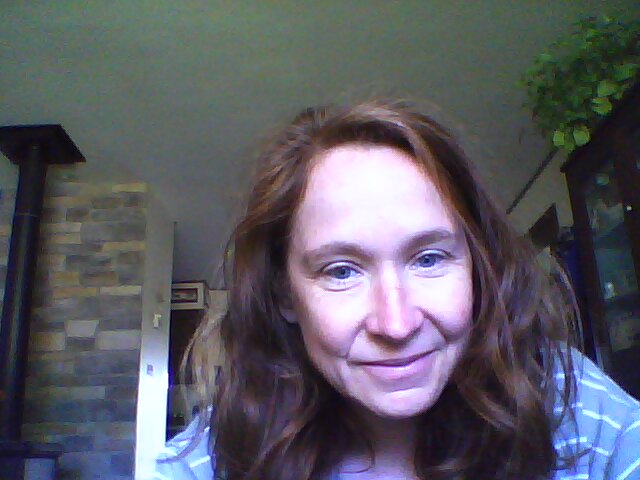
Drawbacks:  This whole process usually takes about three hours, and then I can’t wash my hair for another 12 to 24 hours.  (Forget swimming, which I try to do regularly).  I almost always get a crick in my neck because of the difficulty of applying the dye.

Advantages:  Huge money savings.  Each package of dye contains a lot of dye.  At first, I used one package for a dyeing, but I had a lot left over.  After awhile, I decided to divide the packages in half, use half and save the rest in a plastic baggie for the next time, and I still had plenty of dye.  I have quite a bit of hair, too.  After doing that for a number of months, I now divide the packages into thirds.  This seems to be the perfect amount of dye for my shoulder-length hair.

The product I buy costs $7; that’s $2.33 per dye.  A lot less than the $70 I used to pay at the salon.

And, of course, the henna is plant-based and doesn’t make me sick, which the chemical dyes did.

Other Tips:

Don’t worry about getting the dye on your forehead, ears, fingers, etc.  You need to get it close to the scalp to cover the gray, and I’ve found that the dye washes off my skin easily.  That said, I have fair skin that is still (at age 46) extremely oily, so  I can’t promise this will be true for everyone.

Save plastic shower caps from hotel rooms to use to cover your hair.  The plastic head covering that comes with the box isn’t very good.

Those are all the tips I can think of right now.  If you have any questions, ask them in the comment section below, and I’ll answer to the best of my ability.

Camp NaNo

For the past three Novembers, I’ve participated in NaNoWriMo, the National Novel Writing Month journey, and this year I’ve signed up for Camp Nano.  I’m going to use the month of June to try to get  Wilde Wagers, my historical mystery, cleaned up and ready to submit to publishers.

Writing Wilde Wagers has been a long road.  It was my favorite book while writing i t– the characters were so alive, and the story flowed beautifully.  It was my mom’s favorite too — after each chapter I’d send her, she’d proclaim, “Write faster!”

I often wonder if she knew what was coming.

She died suddenly before I’d gotten to the end.  Finishing the story was difficult, but I felt I had to.   Unfortunately, I was so depressed and so unhappy that I couldn’t bring myself to have anything bad happen to any of my characters.  I also couldn’t force myself to create evil or nasty-behaving people.  Not an effective technique when writing a murder mystery.

My mom died about 18 months ago, and although I’m still sad and depressed, I think I can start murdering characters again.

At the end of June, I’ll let you know how my revisions at Camp NaNo went.


Interview with Beth Elliot

Today I’m welcoming to my series of author interviews Beth Elliot.

Beth writes about adventure and romance in Regency England.

Q: Beth, can you explain to my readers who may not know, what is Regency England, and why have you chosen this time period for your novels?

A: Strictly speaking, the Regency lasted for just eleven years, from 1811, when King George III became too ill to be capable of ruling and 1820, when he died. His oldest son, Prince George, acted as Regent during that time. However, the influences, social changes and political events of what we call the wider Regency period began about 1790 and blended into the Victorian era in about 1830.

This wider Regency period is when Jane Austen lived. Her wonderful novels inspire many writers including myself. We are all fascinated by the society she describes, with its strict social conventions and especially the situation of women. Women of the upper classes were almost completely dependent on men. They could not work, except as a companion or a governess. As a general rule they could not inherit property. Their only option was to find security in marriage, so finding a suitable partner from the same social level was vital and had nothing to do with love. For a writer, this is a goldmine of material. The delightful fashions, the vast wealth and contrasting poverty, the long war with Napoleon, the celebrities, such as Byron, Beau Brummell, even the Regent himself, all provide plotlines. It’s so easy to think: ‘What If…’ and another story just creates itself.

Q: Tell us more about your stories.

A: My first two heroes are two friends, who each have their own story. In 1810, moody Theo struggles to readjust to civilian life in London [The Wild Card]. Two years later, his friend, Greg, has to sort out a potential family scandal in Bath [In All Honour]. In both cases, the heroines are determined not to be married off, even though they are both poor and marriage is the only ‘career’ option for girls. April and May is set in 1804. Rose, a gifted artist, seemingly jilted by Tom four years earlier, meets him in Constantinople [Istanbul] and has to work on a secret report with him. This is a story of trust destroyed and rebuilt. The Rake’s Challenge is the tale of a summer holiday in Brighton in 1814. Giles, the bored, elegant Rake, is obliged to rescue a very young damsel in dire distress. She is determined to model her life on Byron’s Childe Harold but falls from one disaster into another. Giles rescues her each time, stronger feelings stirring when the Prince Regent shows an interest in her.

Q: Are you working on anything currently?

A: I’ve just completed Scandalous Lady . This is another Ottoman Regency story, set in Constantinople in 1811, when Lady Hester Stanhope is living there. I enjoy blending real people into my stories, although they are never the main character. This story takes place against the background of negotiating peace between the Ottoman Sultan and the Russian Czar. Again, Napoleon casts his shadow over events, but as always, I keep the tone light. Olivia is an intrepid English heroine and she encounters a half-French, half-Turkish diplomat with the most beautiful eyes she has ever seen. Cue smoulder! This story has some exotic scenes.

Q: What is your favorite part of writing ?

A: Research, especially the practical kind, is fun. I pace out routes in London, Bath and Brighton and even Istanbul to check how long it would take my characters to walk from A to B. And it’s a pleasure to visit stately homes or costume museums. Perhaps the best part is when I read through my current WIP and eagerly turn the page to see what happens next – but am brought up short as there is no more – the shock has me rushing back to the computer at once to move the story on.

Q: Enough of your books—tell us about yourself.

A: My early life was full of sound. My grandmother used to switch between English and Welsh and I loved the rhythm of both. My parents both played the piano, and my Welsh aunt sang opera – but I never could sing a note. Words, however, came easily, whether reading or writing them. I was always telling stories. Later I studied modern languages and added one rather unusual one as my husband was Turkish. He was also a linguist and a poet. We wrote our first historical story together. We lived in eastern Turkey for some years before moving to England. I experienced wonderful kindness and hospitality during those years in Turkey, and have used that in my two Ottoman stories. I taught French and Italian and classroom teaching means a pretty busy life! One hobby is metallic embroidery, where I love overdoing the gold thread and beads, so that the finished piece shines, sparkles and gleams.

We’ve now reached the time in our interview for the let’s-get-to-know-the-author-better, nearly-pointless, sort-of-silly, rapid-fire questions:

Coffee or tea?

Tea, please, anytime, anywhere.

Ocean or mountain?

I’m a Celt, so feel happier on a mountain.

Hiking or shopping?

Hiking [see above]. Shopping makes me tired.

Violin or piano?

Piano. Both my parents played Chopin, which filled the house with delicate melody. I was not gifted at that keyboard, but I still listen to Chopin as I type.

Mystery or fantasy?

I think they go together. I love both and seem to live in them. I only have to walk down a country lane in the dark to imagine fantastical creatures behind every tree or in every rustle from the leaves. I see castles in the clouds and faces on the trees. And don’t get me started on what kind of personality I imagine for the person sitting next to me on a plane or train.

Darcy or Heathcliff?

I’m a Darcy girl. Just give me the chance to pierce that stoic front he hides behind

Love scene or death scene?

Love scene, of course!

For more about Beth, visit her blogs: www.bethelliott.webs.com

and http://regencytales.blogspot.com

Beth’s books are available on Amazon.com and from www.halebooks.com

Thanks to Beth for joining me today!

Book Launch with Pictures

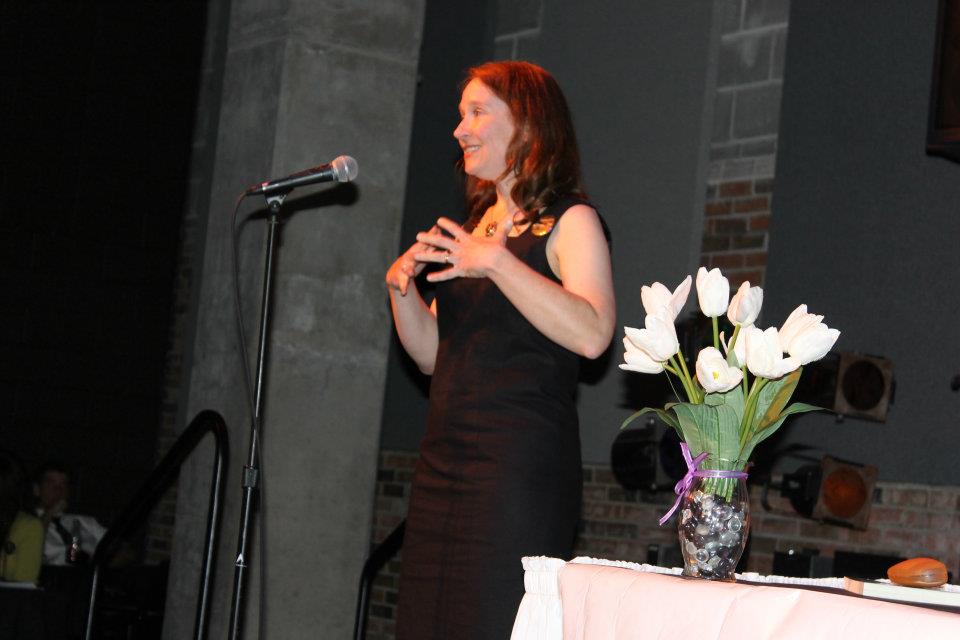
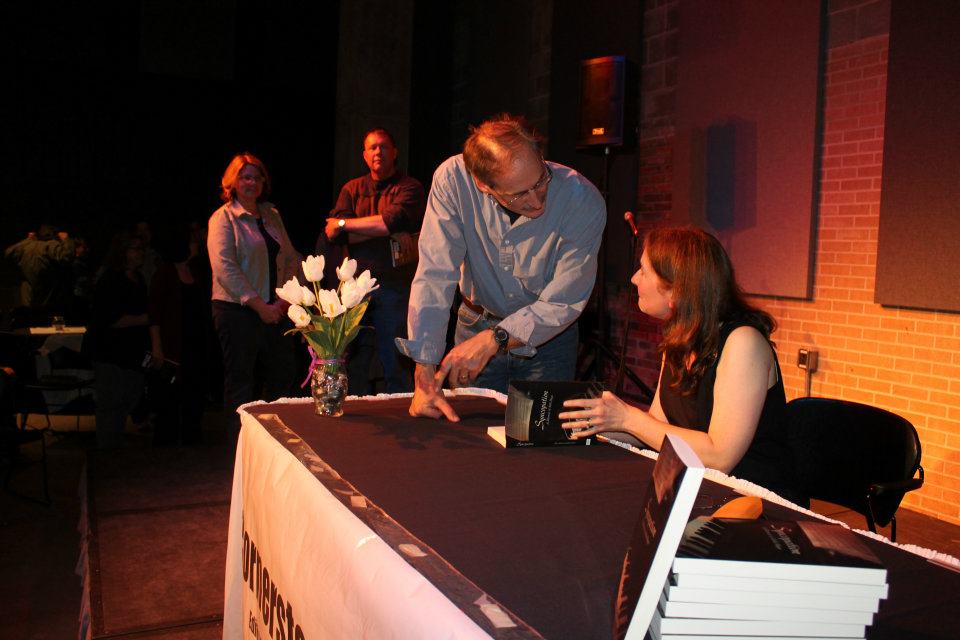
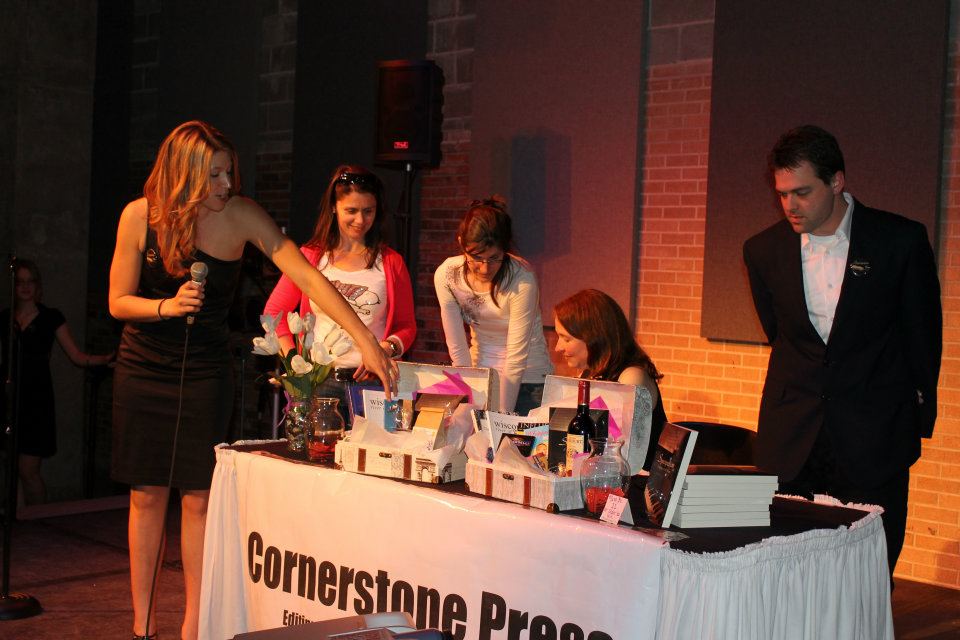
The book launch was fabulous! I thank everyone who came, and I am totally in awe of the staff at Cornerstone Press for doing such a marvelous job putting it all together. We estimated a crowd of about 150 (there were 150 chairs, nearly all filled, and people standing). I’m still waiting to hear how many books were sold.

So, here are some photos:

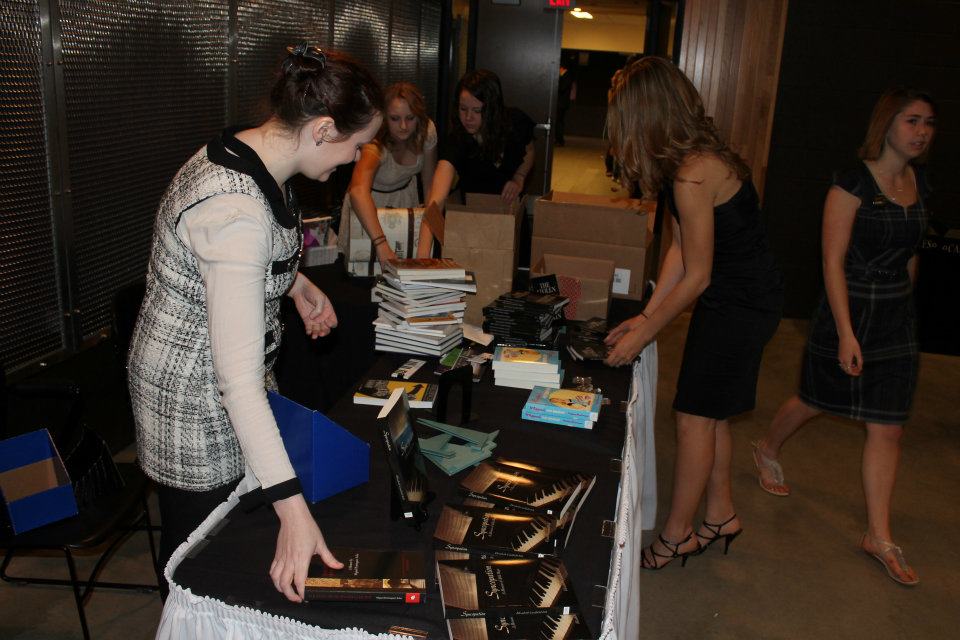
Cornerstone Press staff setting up the book table.  In addition to Syncopation, other Cornerstone titles were available, as was The Stolen Goldin Violin.

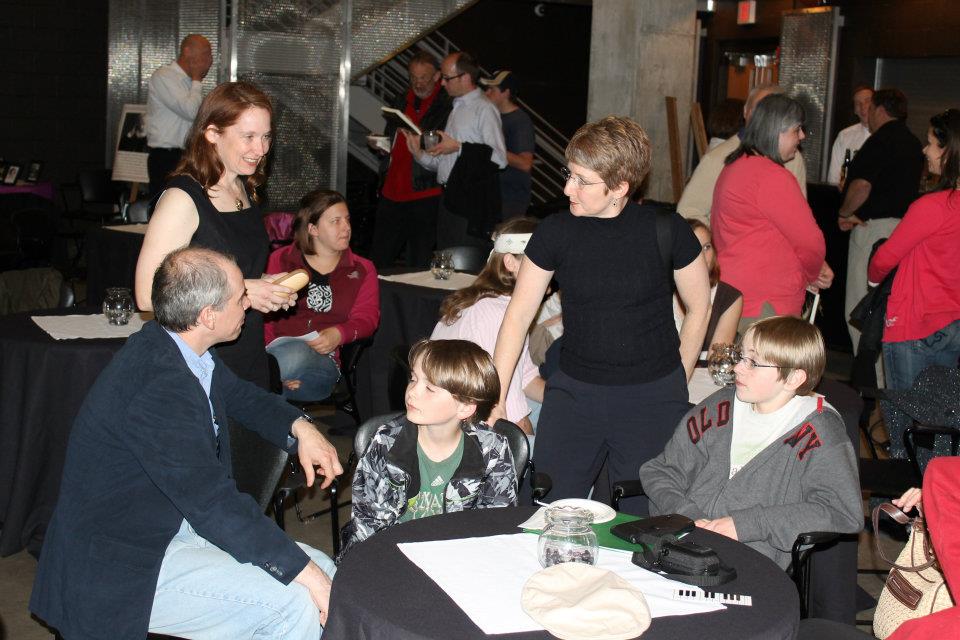
I greet a table of very important guests.

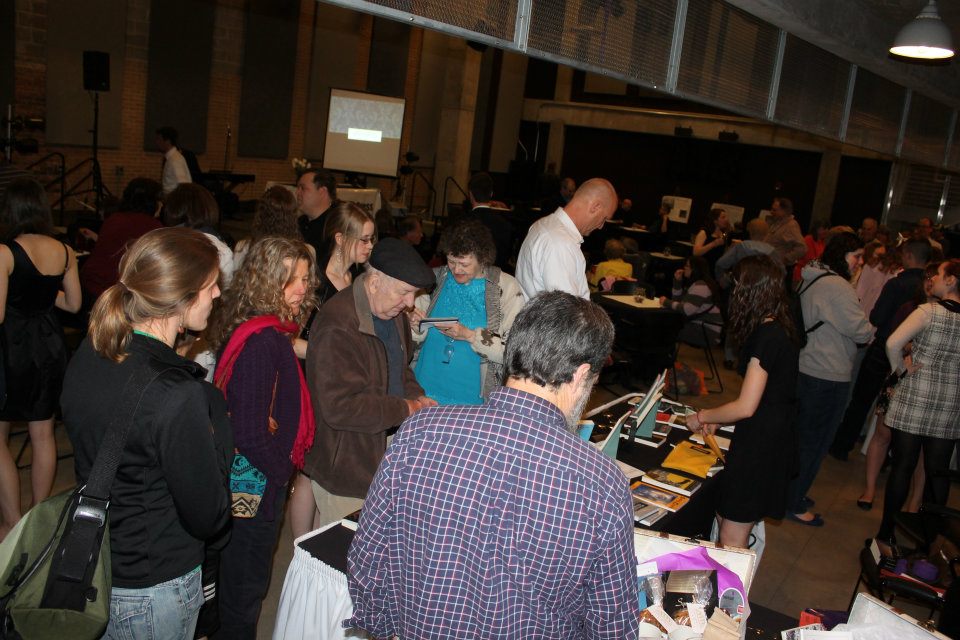
Guests check out the book table.


The place is starting to fill up!

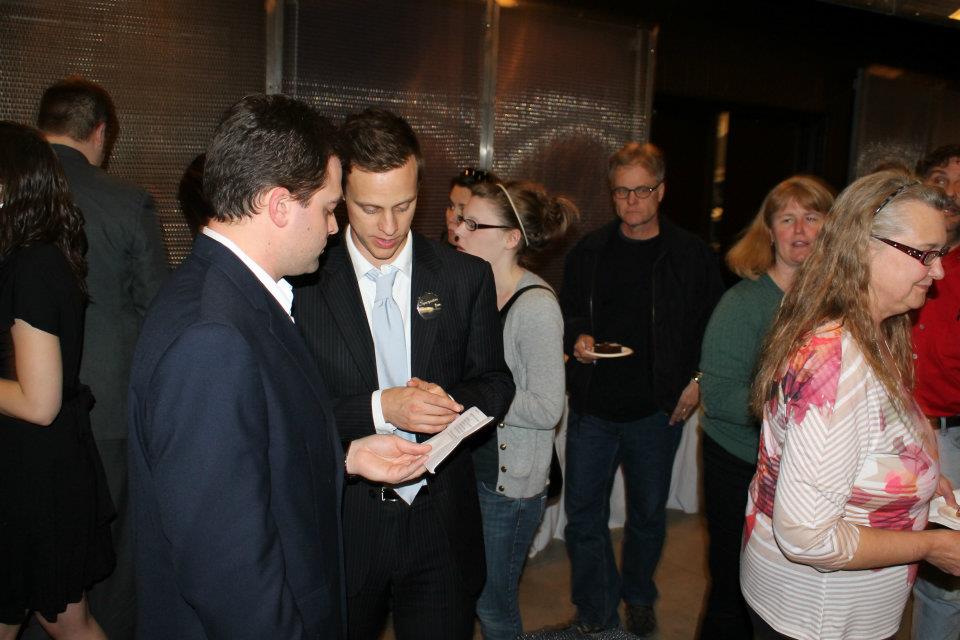
Boone Sorenson (program emcee, on left) and Per Henningsgaard (Cornerstone editor-in-chief, in center) discuss the order of the program.

The frightening moment arrives and I have to take the stage.  I talk about writing Syncopation and then read an excerpt.

I sign books.

Kristen and Boone draw the names of the raffle winners.(Don’t the raffle prizes look wonderful?)

Again, a heartfelt thanks to those of you who came and those of you who made the event so wonderful.

If you live outside central Wisconsin and would like me to visit a bookstore in your area, please contact me: elizabethcfelt at gmail.com.  I love to travel!!


Interview with Melanie McDonald

Today I’m welcoming Melanie McDonald to my series of author interviews. Melanie is the author of the coming-of-age novel Eromenos.  She has an MFA in fiction from the University of Arkansas. Her work has appeared in New York Stories, Fugue, Indigenous Fiction, and online in Fiction Brigade and Squawk Back. She has pursued her writing in New York, Galway, and Paris. She spent several months in Italy at work on Eromenos.

Q: Melanie, can you give us a brief description of your novel?

A: Eromenos is a coming-of-age novel set in the second century AD, in which Antinous of Bithynia, a Greek youth from Asia Minor, recounts his seven-year affair with Hadrian, the fourteenth emperor of Rome. Eromenos was published in March 2011 by Seriously Good Books, a new indie press for historical fiction, and we just celebrated the book’s one-year anniversary on March 11. I received a 2008 Hawthornden Fellowship in Scotland to work on this novel, and am happy to report that Eromenos was a 2011 Next Generation Indie Book Awards finalist and has received excellent reviews.

Q: Was Antinous of Bithynia, a real person or is he completely of your imagination?

A: Antinous was an actual person, and a member of Hadrian’s second-century Imperial court. Very little is known of his personal life (particularly before he became part of Hadrian’s milieu), so Antinous in my novel is a work of imagination based on the few facts we know about him.

Q: How much historical fact is woven into your novel?

A: I did quite a bit of research for the novel to ensure the historical facts would be as accurate as I could make them; that era of Roman history is fascinating, so the research was a pleasure.

Q: How did you come up with the title?

A: The word eromenos in Greek meant the young beloved, the younger man in a pair bond in which the older man, the erastes, was the lover and mentor who taught this partner how to become a Greek citizen, a duty they did not take lightly. The second-century Roman emperor Hadrian was an admirer of Greek culture, and he seems to have modeled his relationship with Antinous in part on that earlier Greek relationship ideal.

Q: Who designed the book’s cover?

A: The cover art for Eromenos is a gorgeous photo by artist Megan Chapman. The publisher and I both thought she did an amazing job of conveying the atmosphere of the story.

Q: Can you describe your writing process?

A: I jot down story ideas, make notes and start drafts in longhand; once I have enough to scratch out a full draft, I move on to the computer. It’s much easier to revise on the computer once you have a draft to work on, but I seem to think better on paper.

Q: How did your interest in writing begin?

A: I can remember being fascinated with the physical act of writing itself when I was very small, about three or four, I imagine. I would scribble all over sheets of paper and go show them to the nearest adult I could corner, usually my mother or grandmother, hoping that person who already could read would then read all this and tell me what I’d written.

I also drew in my books, either to redesign them to my satisfaction or to add my own stories-in-pictures to theirs. I’m so grateful that my parents never objected to these small acts of vandalism on my part – in fact, I think they may have encouraged them a little.

Q: Who are some writers who inspire you?

A: Oh, that is a tough one: Anton Chekhov, Alice Munro, Gina Berriault, Tillie Olsen, Ray Bradbury, Emily Brontë, John McGahern,, A. L. Kennedy, Iris Origo, Lars Gustaffson, Saki (H. H. Munro), the James Joyce of Dubliners – the list changes all the time, though.

Q: Any other thoughts about writing you’d like to share?

A: Actually I’d like to quote the writer Tom Rachman’s theory about fiction, because I think he articulated this so beautifully in an exchange with Malcolm Gladwell. Rachman said:


Writing (and reading) is a sort of exercise in empathy, I think. In life, when you encounter people, you and they have separate trajectories, each person pushing in a different direction. What’s remarkable about fiction is that it places you in the uncommon position of having no trajectory. You stand aside, motives abandoned for the duration. The characters have the trajectory now, which you just observe. And this stirs compassion that, in real life, is so often obscured by our own motives.


We’ve now reached the time in our interview for the let’s-get-to-know-the-author-better, nearly-pointless, sort-of-silly, rapid-fire questions:

Coffee or tea? Tea

Ocean or mountain? Ocean. . .though the mountains are alluring. . .

Hiking or shopping? Hiking (definitely not shopping!)

Violin or piano? Violin

Mystery or fantasy? Sci-fi Fantasy

Darcy or Heathcliff? Heathcliff forever, baby, no contest.

Love scene or death scene? um, deadly love scene?

Thanks to Melanie for joining me today.  For more about Melanie and her debut novel Eromenos, visit the Melanie McDonald website.


Bookfinders Fun

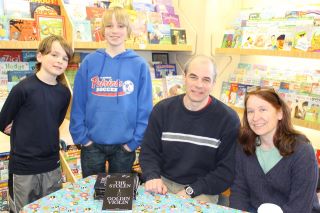
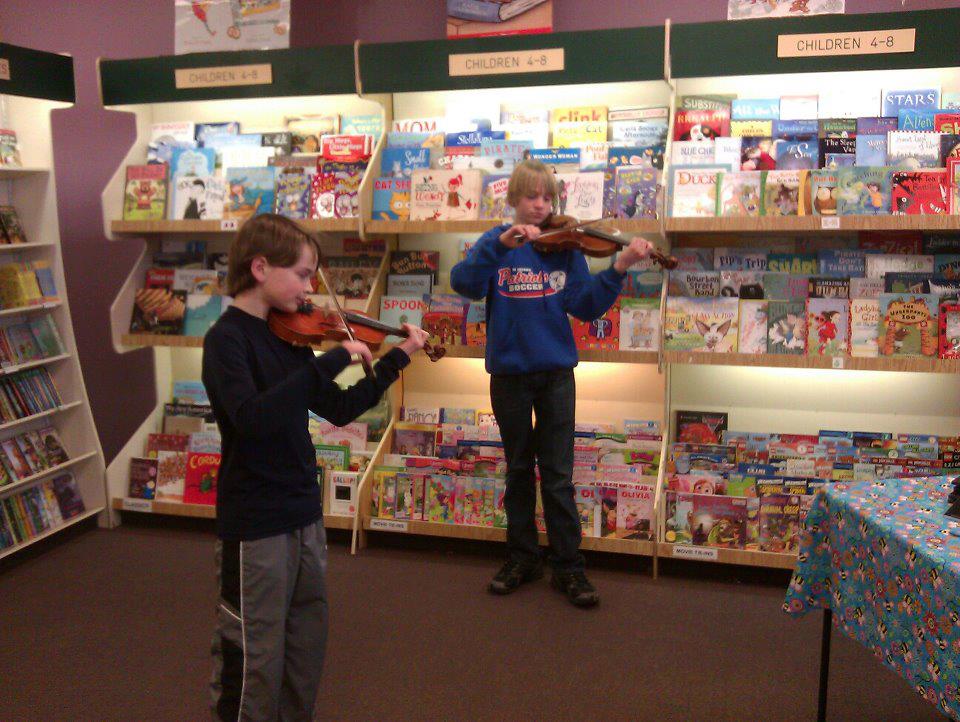
We had a great time at the Bookfinders Grand Opening this past weekend. We met some great people, enjoyed Zest’s coffee and cookies, bought a a cookbook, met some authors, and played some music. Here are some pictures of our signing and the boys playing violin.

Tom, Craig, Andy and me at Bookfinders
Tom and Craig play a duet.

Celebrate at Bookfinders This Weekend

The new owners of Bookfinders in Stevens Point are having a grand opening celebration this weekend that includes coffee, food, face painting, music — something for everyone. I’m excited to see the changes they are making in the bookstore. I believe they will be selling used books, they will be promoting local authors, and they may even have a small coffee shop. I’m not really sure, so come out this weekend and see how much of this I’ve gotten right!

We will be there on Saturday, 3:00 – 5:00pm. Below is the full schedule of events:

Friday, Feb 24

1pm to 8pm Zest Bakery and Coffee House
free samples, coffee & bakery for sale

1:30-3:30pm Darlene Biese Schultz
Decision Or Destiny
~Romantic Fiction

6:30-8pm Pat Rothfuss
The Name of the Wind & The Wise Man’s Fear
~Fantasy

Saturday, Feb 25

9am-8pm Zest Bakery and Coffee House
free samples, coffee & bakery for sale

9:30am-11am Charles Schoenfeld
A Funny Thing Happened on My Way to the Dementia Ward
~Humor/Bio

11am-4pm Face Paintings by Christie

11:30am-1pm Ken Danczyk FamilyGrandpa’s Farm
~Children’s book

3-5pm Felt Family
The Stolen Goldin Violin
Violin Performance by Children
~Children’s mystery

3-5pm Remington Crockett
We Interrupt this Marriage to Bring you Deer Season
~Outdoor Humor

5:30-7:30pm Justin Isherwood
Pulse, Book of Plough, Farm Kid & More
~Array of Regional Nonfiction

Bookfinders is at 1001 Brilowski Road, across from Fleet Farm.

A Whole New World

Syncopation, my novel about Adele Hugo has found a publisher!!!  Cornerstone Press, the student-run publishing house at the University of Wisconsin, Stevens Point chose my manuscript from among the many submitted.  (I don’t know how many were submitted, but I like to think it numbered in the thousands.  And, please, don’t pop my bubble.)

Hooray!  Hooray!  [insert picture of me jumping around]

I had a marketing meeting with some students on Thursday so we could talk about my ideas, their ideas, and get a strategy put together.  It was so exciting to talk about my book with people, people whom I barely know, who have read it!!

Hooray!  Hooray! [insert slightly different picture of me jumping around]

Working with student publishers is so exciting! (Have I used the word exciting too many times?)  They bring such energy and so many new ideas to the process.  I’ve been working alone for so long, trying to sell The Stolen Goldin Violin, that when they were talking about things they were going to do, I just couldn’t believe that I didn’t have to do everything myself.*

Hooray!  Hooray! [insert picture of me, tiring, as I jump around]

In other news, I’ve decided to expand what happens on this blog, and to make that happen, I’ve contacted a number of historical novelists whom I will be interviewing in the near future.  I plan to do two interviews a month–they should be fantastically interesting.  Think Fresh Air with Terry Gross, but in print, and with me.

* Note:  This is an apology to my husband and kids who have often worked harder than me to promote The Stolen Goldin Violin.  When I said I was “working alone” I was thinking of my family as being a part of myself.  We are one, and all that.  Yes?

Stella’s Workshop, a working title

My family went skiing today, and I stayed home to think. I thought all day.

I dyed my hair with henna and thought. I sat in front of a football game and thought. I did the dishes and thought. I vacuumed and thought.

Then I typed up some of those thoughts.

After about eight straight hours of focused thinking, I’ve come up with a basic outline for my next novel: a children’s fantasy. I’m thrilled with this new story idea. It’s a little bit Artemis Fowl, a little bit Harry Potter, a little bit Ella Enchanted, a little bit Despereaux, a little bit Septimus Heap, and all my own.

A few minutes ago, I danced around the living room to Alanis Morissette to celebrate my day of thinking.  Now it’s time to get off the computer and dance a little more.

Yippee!!