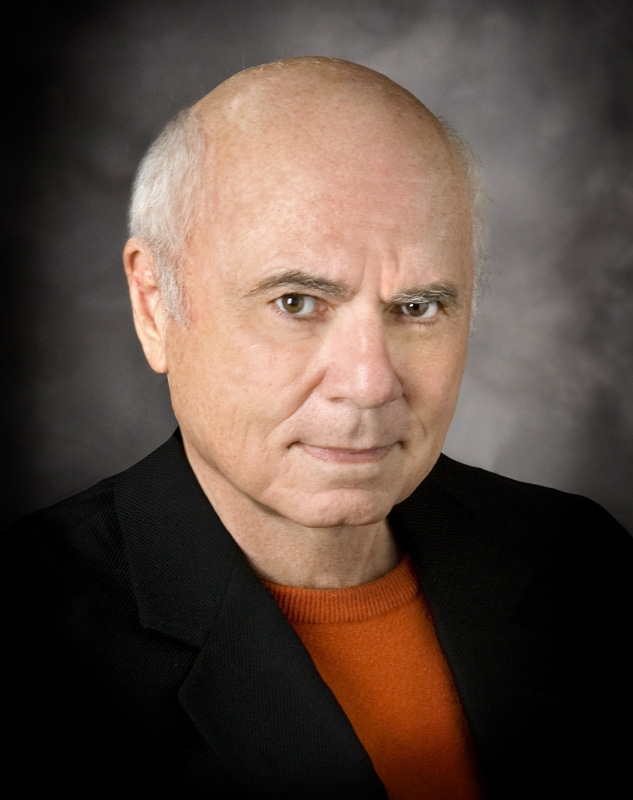
Interview with Donald Michael Platt


Today I welcome Donald Michael Platt to my series of author interviews. Donald is the author of A Gathering of Vultures, Rocamora, and its sequel, the soon to be released House of Rocamora.

Q: Donald, can you give us some background on your novel Rocamora and some idea of what readers can expect from the House of Rocamora? 
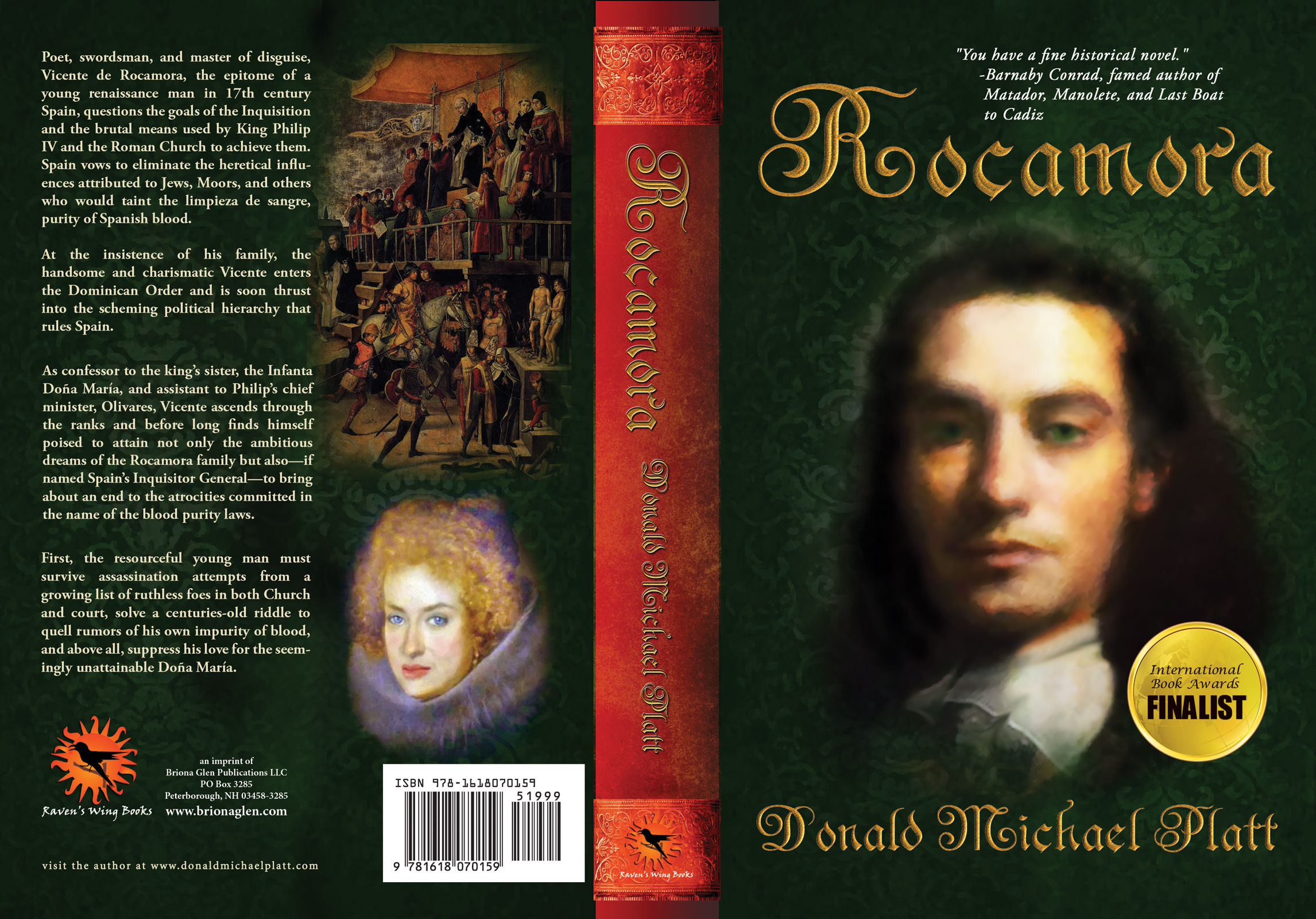
A: Rocamora, a finalist at the 2012 International Book Awards, is set in 17th century Spain during its Golden Age. My historical MC Vicente de Rocamora, 1601-1684, struggles to make his place in an empire dominated by the Dominican controlled Inquisition and obsessed with limpieza de sangre, purity of blood untainted by Jew, Moor, or recent converts.

Historically, Rocamora was the Dominican royal confessor for Philip IV’s teenage sister Infanta María and renowned for his piety and eloquence. For the first forty-two years of his life he lived in Spain, and I filled the novel with Court and Church intrigues, depredations of the Inquisition, a mystery about Rocamora’s origins, his romantic involvement with several interesting women, assassination attempts, and duels.

Q: Was there love between Rocamora and Infanta María?

A: Imagine a fifteen- to sixteen-year-old girl who had no personal contact with any young men except her brothers. Then, her elderly confessor is replaced by a young man only five years older than she. It is documented María confessed several times a week, honored Rocamora, and showered him with gifts. Their relationship is best summed by a Spanish saying: No man is closer to a woman then her confessor, not her father, not her brother, and not her husband. No portrait or written description of Rocamora has been found.

Q: How does the sequel continue the story?

A: House of Rocamora covers the last forty-one years of Rocamora’s life in Amsterdam, during which he must again make his place in a land antipodal to Spain antipodal by climate, landscape, religion, government, and religious tolerance. Does he succeed? I answer all that and more through my fiction and the following facts. Rocamora went to medical school, became a physician at age forty-six and married a twenty-five year old who bore him nine children over eleven years. One may wonder how celibate he may have been in Spain. Rocamora was one of only three Jewish physicians who received citizenship equal to Dutch Christians, a philanthropist, and a respected poet although none of his writings are extant. Through Rocamora’s second son, he established a multi-generational dynasty of physicians. All this takes place during Amsterdam’s Golden Age, which included several plagues, the excommunication of Spinoza, hysteria generated among Jews and Protestants by a false messiah, and wars against Spain and England.

Q: What made you interested in writing about this character?

A: Little-known historical individuals who led interesting lives arouse my interest. The less documentation about them, the freer I am to create character motivation and an entertaining story line unlike the well-plowed Tudors, as an example. That is why I selected Vicente de Rocamora, 1601-1684, to be the protagonist of my novels. Several anomalies, unanswered questions. and many gaps in his life piqued my curiosity. The historical spoiler at the end of Rocamora, a truly unique event, is what most motivated me to write the novel.

My research failed to discover Rocamora’s parents and lineage, why he entered the Dominican Order, how and why he became confessor and spiritual director for the Infanta, and why he left Spain when he did in 1643. I have a letter from the director of the Inquisitorial files in Madrid stating Rocamora was never arrested or even denounced as a secret Jew or later condemned and burned in effigy. In Amsterdam, there are no extant records that explain why he received citizenship equal to Dutch Christians. I did discover a tenuous relationship to the noble de Rocamoras of Valencia, caballero caste of Murcia, and documented evidence of his true attitude toward religion, all of which contributed to the course of my novels.

Q: How much historical fact is woven into your novel?

A: The historical background, personages, and events are treated factually, but the great lacunae in Rocamora’s life that I fill are fictional. One typical example: I inserted Rocamora into the comical wooing of María by Charles, Prince of Wales. Of course, I did my best to show and not tell thus avoiding info-dumping, I hope. I do have author’s notes at the end of both novels to separate fact from fiction and a list of fictional characters as well.

Q: Tell us a little about your novel A Gathering of Vultures.

A: A Gathering of Vultures is a contemporary thriller-horror novel, based on my experiences when I lived where the story takes place.  Professional ballroom dancers Terri and Rick Hamilton aspire to be world champions. Unfortunately, Terri’s recurring health problems place that goal well out of reach. They travel to Terri’s birthplace, Florianópolis, on the scenic island of Santa Catarina off the coast of Brazil to vacation and visit their best friends and mentors.

Along the picturesque beaches, dead penguins and eviscerated bodies wash up, and Antarctic blasts play counterpoint to the tropical storms that rock the island. The scenic wonder is home not only to urubus, a unique sub-species of the black vulture, but also to a clique of mysterious women who offer Terri perfect health and the promise of fame—at a terrible price. Rick fears Terri is being drawn into a cult and that his own life may be in danger. Will it be too late when he discovers something even more terrifying lives beneath the tranquil, tropical veneer of the island?

Q: What was your path to becoming published?

A: I either submitted my writing though agents or personal connections with some success in film and television, but none sold my novels. In 2007, I sent A Gathering of Vultures to a startup independent publisher, and she accepted it. My publisher also loved Rocamora, and she published it in hard cover. Later she merged with Briona Glen, another startup, and they republished both novels in soft cover, Kindle, Nook, ebooks.. They will be publishing House of Rocamora in the same formats.

Q: Enough of your books—tell us about yourself.

A: Born and raised inside San Francisco, I graduated from prestigious Lowell High School and received my B.A. In History from the University of California at Berkeley. After two years in the Army, I went to graduate school at San Jose State where I won several writing awards. One of my short stories was published in the college’s literary magazine, The Reed.

When I moved to southern California, I began my professional writing career. I sold to the television series Mr Novak, ghost wrote Your Hair and Your Diet for health food guru Dan Dale Alexander, and wrote for and and with diverse producers, directors and stuntmen. Options have been taken on my unpublished WWII fighter ace novel.

After living in Florianopolis, Brazil, setting of A Gathering of Vultures, I moved to Jupiter, Florida, where I wrote Vitamin Enriched with Carl DeSantis and The Couple’s Disease with Dr. Lawrence S. Hakim.

Currently I reside in Winter Haven, Florida, where I am polishing a completed novel set in the ninth century Carolingian Empire about another unusual and elusive historical personage, Bodo the Apostate, and I have a WWII fighter ace novel on the tarmac after that.

We’ve now reached the time in our interview for the let’s-get-to-know-the-author-better, nearly-pointless, sort-of-silly, rapid-fire questions:

Q: Coffee or tea?

A: Coffee, strong and black.

Q: Ocean or mountain?

A: Ocean. Mountains give me a feeling of claustrophobia.

Q: Hiking or shopping?

A: Neither, but if forced to choose, shopping, preferably for wines.

Q: Violin or piano?

A: Violin.

Q: Mystery or fantasy?

A: Mystery.

Q: Hester Prynne or Scarlet O’Hara?

A: Yuck, neither, but if forced, Hester, although I might wait for Pearl to reach a marriageable age. I never cared for “Queen Bee” types. I would have been an indifferent Ashley in Scarlet’s world.

Q: Love scene or death scene?

A: Love scene, but no gratuitous sex.

You can learn more about Donald Michael Platt at his website, www.donaldmichaelplatt.com,

see a trailer for Rocamora on Youtube: http://www.youtube.com/watch?v=RXZthhY6OtI&feature=channel_page

meet his publisher Briona Glen http://www.brionaglen.com/

and/or friend Donald on Facebook: https://www.facebook.com/donald.m.platt?ref=tn_tnmn

Rocomora and A Gathering of Vultures are available at amazon.com, Barnes and Noble and Smashwords.

Thanks, Donald, for visiting my blog today.

Interview with Jeanne Treat


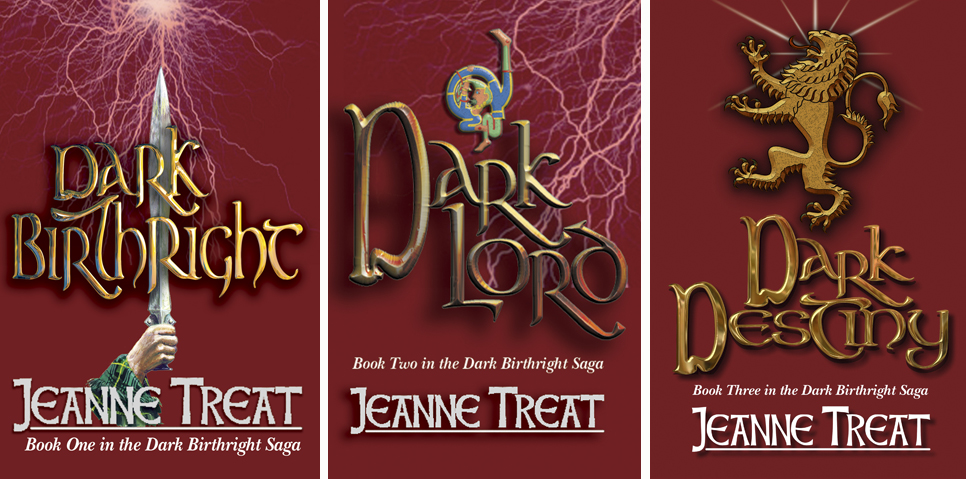
Today I’m welcoming Jeanne Treat, author of the Dark Birthright trilogy as well as a collection of short stories, Dark, Mysterious and Irreverent.


Q: Can you give us a brief description of the Dark Birthright trilogy?

(click to make bigger)

A: The Dark Birthright trilogy takes place in seventeenth century Scotland, England, and the American Colonies. The series has sold more than 8,000 books and eBooks through promotion at Scottish and Celtic festivals, book events, and the internet.

The first book, Dark Birthright, is the story of a child born of mysterious circumstances, given to a fisherman and his wife to raise as their own. Dughall grows up in a family bound by honor and becomes a healer.  His life is torn apart when he is claimed by his real father, a cruel and powerful lord who tries to mold him in his image.  Dughall must define himself, in the midst of a struggle between a Duke, an Earl, and the family who wants him back.  All the while, he’s determined to marry the girl he left behind, a woodland lass with eyes as green as a peacock’s feather.

Book two, Dark Lord, follows the same characters. Set during a time of political and religious strife, it features action, romance, and politics.  Dughall is settling into his new role when the King (Charles I) imposes an Anglican liturgy book on the Scottish church.  Protests and riots plague the realm, forcing lords and commoners to take a stand. Dughall and his half brother Gilbert are placed in precarious positions, torn between loyalty to the crown, their families, and zealous subjects. The National Covenant is signed and war breaks out. Tempers run hot and actions are rash.  To maintain order, one brother must take their late father’s place.  Who shall become the Dark Lord?

Book three, Dark Destiny, continues the story of the Gordon clan. The English civil war is over.  The imprisoned King and his lieutenants are in trouble.  Dughall’s half brother Gilbert is one of them.  What will the Gordon brothers do?  You will meet the next generation of Gordon children – one son’s supernatural abilities threaten his father.  England executes the King and declares itself a Republic, but the Scottish government refuses to follow.  The King’s son (Charles II) tries to gain his thrones, starting with Scotland.  Unfortunately, he was given a directive by his father to execute Lord Dughall Gordon. What will the Gordon brothers do? Will they abandon Scotland for the Colonies?

Q: You describe your writing as historical fantasy. What made you decide to mix these genres?

A: I describe the series as historical fiction with a touch of fantasy. It is historically correct, but there is a sword with a curse on it and two brothers with the second sight. What is the second sight? When they were children, their mother described it as, “They speak to each other without words, they each know where the other is, and feel each other’s pain and pleasure. Sometimes they say what others are thinking. It scares me that people will find out.” This spawns some interesting situations, particularly when they are older.

I have always been interested in the supernatural – so you will see this woven throughout my work.

Q: How historically accurate are your novels?

A: The novels are correctly set in the seventeenth century in respect to geography and political and religious systems. They follow historical events closely and reflect what it was like to live as a lord, a peasant, a fisherman, and a woodland villager. To research the novels, I used books and the internet, but I also traveled to Scotland and England to visit castles, seaports, and stone circles. I worked with a Scottish historian from a village near Old Deer.

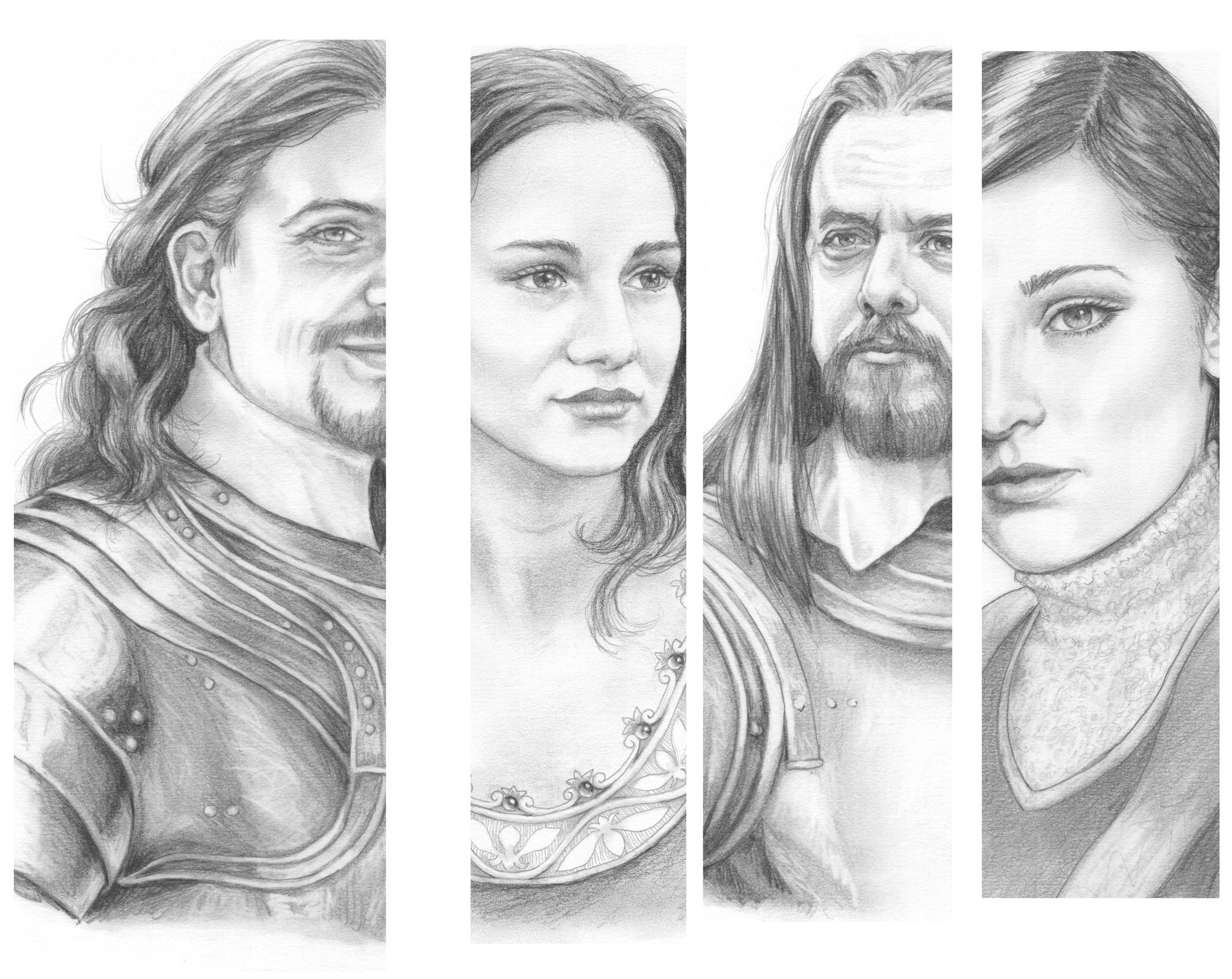
Q: Your books are illustrated by fantasy artist Jane Starr Weils. How did this collaboration occur? 

A: A press in Virginia agreed to publish my first book, Dark Birthright. They had already published The Rebel King Series, which was illustrated. My publisher suggested that my novel would benefit from character portrait sketches. Jane Starr Weils was one of the names mentioned, so I contacted her. She lives in New York near the Vermont border, so we visited her after a trip to Maine.

(click to make bigger)

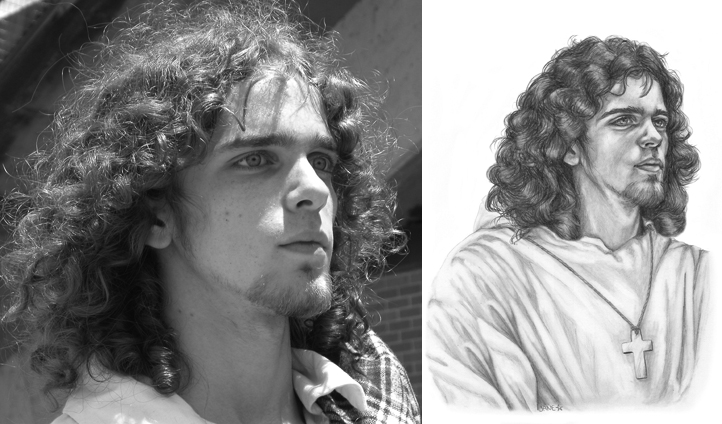
Here is how we created a portrait sketch. I would identify a person whose visage represented my character and photograph them. We knew some of these people. Others, we photographed at Scottish festivals. I would relay the photograph to Jane, along with a description of any changes – like clothing, hair color, and facial hair. She did an initial pass at the drawing and we collaborated until the sketch was perfect. The sketches are wonderful. I use them to promote my books.

Q: What is your creative process?

A: An author’s creative process is as unique as the writer. A friend of mine meticulously plans a novel ahead of time, using character descriptions, plot and chapter outlines, and theme and sub-theme descriptions. It works for her, but my creative process is different. I approach the task like it is an artist’s canvas. I know where the story begins and how it ends and that’s my road map. I ask the characters to talk to me and they do. In some ways I become them. My husband likes to tell people, “I’ve been sleeping with a dozen Scots in my bed for years. The women are fine, but it’s weird being with the men.”

Q: Enough of your books—tell us about yourself.

A: I grew up in Western New York, in a suburb of Buffalo. I began writing as a child and continued into my teens, when I penned a column in the school newspaper called “Tea Time with Cecily Fripple.” (Did I just date myself?) I graduated from college with an English Liberal Arts degree. I took literature and creating writing courses at school, which helped me to write.  I always wanted to be a writer, although I did not seriously pursue it until 2004. My mother is partially responsible for my success. The dedication in my novels says, “This book is dedicated to my mother, who told everyone I was an author before it was true.”

We’ve now reached the time in our interview for the let’s-get-to-know-the-author-better, nearly-pointless, sort-of-silly, rapid-fire questions:

Q: Coffee or tea?

A: Coffee – hopelessly addicted

Q: Ocean or mountain?

A: Definitely mountain!

Q: Hiking or shopping?

A: Hiking

Q: Violin or piano?

A: Violin!

Q: Mystery or fantasy?

A: Mystery

Q: Darcy or Heathcliff?

A: Hmmm… Neither… But Darcy if a choice must be made.

Q: Love scene or death scene?

A: Love scene

To learn more about Jeanne, visit her blog, http://jeannetreat.wordpress.com/

To learn more about her books and view some book trailers:

http://www.darkbirthrightsaga.com

Jeanne’s short story collection, Dark, Mysterious, and Irreverent is available for FREE download through 08/31/12.  Follow the link below and use coupon code KQ22Q

http://www.smashwords.com/books/view/54082

Jeanne, thanks for joining me today!

Interview with Monette Bebow-Reinhard


Today I’m welcoming Monette Bebow-Reinhard to my series of author interviews. Monette is the author of two Bonanza books, Felling of the Sons and Mystic Fire; is marketing a major nonfiction, Civil War and Bloody Peace and a fiction series about a Greek vampire, a Vrykolakas; has just been offered a contract for Dancing with Cannibals; and is in final edit with Saving Boone: Legend of a Half-Breed.

Q: Can you give us a brief description of your most recent novel ?

A: Dancing with Cannibals is set in 1906 Africa to show the Belgium conquest of the Congo, when two Belgian prisoners are released to become colonists of African villages, to bring them Christianity and claim their resources. Simon sees the wrong in what he’s doing but enjoys the power, while Jean sees the wrong and becomes enamored of the cannibal culture, eventually marrying into it. Inevitably, however, neither man can control the destiny of a country when a more powerful one is determined to conquer it. I think the novel holds great lessons for the world today.

Q: What made you interested in this story?

A: Dicho did, actually. He’s my partner on the book and the instigator of the story and its history. He lives in South Africa but was born in the Congo. He is a French speaker with story ideas who was looking for help and contacted me and others through the website Authors Den to edit his stories and get them ready to market. He had six stories to offer, and I chose the one on cannibals because I’ve done a lot of research on the practice in this country and am interested in removing the stigma, from the point of view of the cannibal, as to the reason one would eat another human. Attitude, to me, is the most important thing in history, and something that’s often overlooked. We’re often judging other cultures through our own eyes. This book tries to change that.

Q: How much historical fact is woven into your story?

A: It’s amazing what he had when he sent the book to me to edit. He didn’t have a fiction novel. He had a series of historical events, two fiction scenes, and a number of fiction characters. I had to take what he had and turn it into a novel. First I asked him – do you want this as fiction or nonfiction? We went from there. I took his characters, and with a lot of back and forth asking him questions about their motives, the plot began to emerge. He had specific ideas of how this would go. But I told him, I don’t want to make this from the point of view that Christianity was a good thing to happen to them. Let’s go for a more balanced approach. I wanted to see us portray the culture as it was, and I depended on him to get the history and the culture right. I bought a number of books of Africa in this period, however, so that I could familiarize myself with it, and I also watched some videos—because Dicho wanted me to add the descriptive material. Even though I’ve never been there! He says he’s not good at it. So you will see more plot than description. But we did what we could. He gave me a lot of history I had to try and incorporate so that readers wouldn’t get lost or bored. It was a challenge to make this kind of book not preachy or what they call “an info dump.”

Q: How hard was marketing something like this?

A: Very hard. We couldn’t tell if publishers were turned off by the title, but didn’t see any reason to change it. We also didn’t know if publishers wanted to work with two authors. I have no experience with a co-authored submission and really didn’t know how to address these concerns. But we just kept at it. And really, we never received any kind of feedback from anyone about why they would reject it. We followed the right format, we found publishers who wanted historical, who wanted cultural, and who wanted controversial. But no luck. We did several rewrites, thinking that might help. I think adding the viewpoint of Betu, one of the cannibal women who eventually marries Jean, was the perfect move.

Now with Spartan, I saw the opportunity to try a new history publisher, and they scooped it up as though the best thing they’d ever seen. It’s exciting working with someone raw and eager, and we’ve already gotten comments on how to improve the material. So Dicho and I really appreciate having Dancing with Cannibals recognized for what it has to offer. Dicho has turned all the edits over to me, because I was mostly responsible for putting it in its current readable format.

But sometimes I wondered if I wasn’t more of a hindrance to him, than a help. I was reassured recently when a publisher who rejected Dancing (the only one who told us why) asked me to help Dicho get one of his other novels ready for her. She says she loves his story but it’s way too long, and needs to be edited before she can consider it. So Dicho’s hired me, not as a partner here, but as an editor. I charge a meager $1 a page, because I enjoy helping other writers. He’s very excited about this second opportunity, and this same publisher is willing to look at my Greek Vampire as well. She’s into romance and it’s called Adventures in Death and Romance.

I would love to see something out there about partnering on a fiction novel – the ins and outs. I still don’t feel I’ve learned enough to write this commentary myself. I wish more publishers and agents were more direct about why they won’t look at something. I know they’re busy, but they don’t realize the disservice they do to projects like this.

Q: Your novels Felling of the Sons and Mystic Fire are Bonanza fan fiction. Can you talk about your “obsession” with Bonanza and how you came to write these stories?

A: Oh, that would take too long! Seriously, I have an article at my website, “Becoming an authorized Bonanza novelist” on the Bonanza page there. In brief, I can say that I was in the right time at the right place, and got David Dortort’s attention as a fan who said all the right things. I finally got to meet him, and we worked on a couple of scripts together for television. With that association, retaining the friendship was easy enough as well as getting permission to sell Felling of the Sons, which I’d written first and used to begin the initial contact. I felt it was too good to get thrown into the fanfic pile. A few years later we talked Civil War together and David was impressed enough with my knowledge to give me permission for the second novel. He’s since died, and I miss him like crazy. No one else has managed to go through Bonanza Ventures with a novel for authorization, but I hear people are trying.

Back in 1992, after I began to see the series on the air again, and while also writing other historical material, I thought I’d try my hand at Bonanza fanfic. I couldn’t believe how easily these stories just poured out of me. For some reason—maybe the death of my sister during the show’s first season in 1959—the show just captivated me and even at the tender age of seven I began rewriting the stories on I saw on TV to make them ‘better.’ Pretty crazy, I know, but one of those episodes I rewrote was”The Crucible” with guest star Lee Marvin, an episode so intense it still frightens fans. My rewrite was so vivid to me, even years later, that I thought it was an actual episode. Imagine my surprise finding out that I wrote the whole story myself, because it wasn’t an episode. “Fork in the Road” is now one of the short stories in Cartwright Saga, which is a complete anthology novel I offer free to people who purchase both of these novels.

I think the best part about Bonanza was its use of history with fictional characters. I can still remember my surprise finding out Mark Twain really did work in Virginia City and Philip Deidesheimer really did create a series of honeycomb safety timbering for the mines. I did some follow-up research on this and learned that he never patented it and died a poor man. Things like this spurred my interest in history—oddly enough, my worst subject in high school was history. I now hold a master’s in history.

Q: Did you get your master’s in history to teach?

A: Nope – just to write. I have a major nonfiction, Civil War & Bloody Peace: following a soldier’s orders, that I’m desperate to get published. Well, maybe not desperate enough, I recently canceled a contract with Sunbury Press because they kept dragging their feet on it—after six months I still didn’t have an editor and then they said, well, maybe we could put it out in two volumes after assuring me it would make a good 450-page book. Well, yes, that’s the way it needs to be, which is why I signed with them. In its submission format it’s about 750 pages with maps and photos. And I think it’s a really good way to look at the pivotal period in our nation’s history, following the orders of one soldier to find out why he was sent where he was sent. The soldier is my grandfather’s great uncle, and he had the unique experience of being in the army for 22 years, as a private, non-com.

But my BA in history didn’t teach me enough about research to finish this book. So I went back to become a better historian. And I think the book will speak for itself, once I find a decent contract. I had Potomac interested but they weren’t sure how to market it. I’ve since created a marketing query letter and hope I addressed some of their concerns.

While getting the master’s and researching the Civil War I created the second Bonanza novel, Mystic Fire. Using the Cartwrights, and having the Civil War tear them apart with an understanding of who Lincoln was in 1862, I created what I call an ‘epic saga.’ It’s a bit more of a challenge to read than my first Bonanza novel because I tear the four Cartwrights into separate storylines—a fire, ghosts, Lincoln, cattle rustling, runaway slaves, the Civil War and an unusual assassination attempt—all combined to help assure me that I had the right title. Sadly, it hasn’t done as well as Felling of the Sons. I don’t feel I’ve yet found its market. The goal in part is to demonstrate what Lincoln was like in 1862, and I really enjoyed giving him a voice in this novel.

Q: Enough of your books—tell us about yourself.

A: Not much to tell. Normal life in Green Bay, Wisconsin. Two brothers and two sisters. My sister Diane died when I was six, and then my parents had two more girls. Diane probably would have been my best friend. We were two years apart. I was my father’s favorite, or so I’m told. He died when I was 14. My mother moved away when I was 18, taking everyone but me to Phoenix in 1971. I stayed in Wisconsin, where all I wanted was my own family. Married my husband Joe in 1975, and have three kids – Carrielynn, Adam and Bennett. All grown and into their own lives. My youngest has made me a grandmother, but sadly they live over in Seattle. I run the Green Bay Reading Writers Guild, and we have a Facebook page. I post a lot of writing related topics there and encourage writers to find readers before they seek publication. I worked in offices as secretary nearly all my life, while helping on my husband’s family’s golf course as manager (for a little while) and bartender. Going back to college was a dream that finally came true when my kids were older. I had one year of college in back in 1972, majoring in theater, and went back in 1994. I’ve been an actress practically all my life in local community groups, even helped form one. I was curator of a museum for three years until I got tired of no pay, no time and no appreciation. But I now run the Archaic Copper Newsletter in conjunction with that experience. I’m one of these persons who doesn’t sit still well! I like being busy. And I have a lot in my head that needs to come out.

Q: How difficult do you find balancing your writing career and your other jobs?

A: Very very. I remember back when all I had was a typewriter. I typed my first novel, and sure wish I’d kept it. It was every night, typing for an hour after the kids went to bed, with my peppermint schnapps (yeah, I’m German). I had to drink before bed because my husband snores! Then my mother sent me her old computer, and though I resisted at first, became very fond of the idea of changing the material before I printed it. I’ve been updating my computers ever since, giving my kids my old ones (Bennett now works for Microsoft). But always my writing took place late at night, and then once I started school, I’d write a couple of pages between classes or between assignments. I got little sleep in those days, and often credit my great kid with raising themselves. Plus doing theater? I sure hope they don’t look back on growing up and wonder where their mother was! I also put myself through my BA with jobs, part-time, temporary. One semester I worked three at the same time. Crazy stuff. I was fortunate that my first successes are Bonanza novels because they were so easy for me to write. Much harder has been my conception of a Greek vampire. I created him as my own original, but, through inspiration of Bonanza, put him into historical events.

We’ve now reached the time in our interview for the let’s-get-to-know-the-author-better, nearly-pointless, sort-of-silly, rapid-fire questions:

Q: Coffee or tea?

A: Coffee! Actually both, but coffee first.

Q: Ocean or mountain?

A: I’d have to say ocean, but doggoneit, I like them both! I think we need water more than rocks, though.

Q: Hiking or shopping?

A: Hiking! Although shopping is a good substitute, especially on hot days.

Q: Violin or piano?

A: Piano. I wouldn’t know which end of a violin to hold, and the sound kind of irritates me.

Q: Mystery or fantasy?

A: Fantasy. I love to plot, but have never tried sheer mystery. On the other hand, in fantasy we can let our imagination run wild.

Q: Darcy or Heathcliff?

A: Darcy – to be honest, I don’t know Heathcliff. Maybe if I did, I’d like him better?

Q; Love scene or death scene?

A: Death – because it’s so final, or so some people think. And it’s so real, where love scenes can be phony. I’ve been criticized for having so much death in my writing, but I am fascinated by it.

Thanks to Monette for joining me today.  To learn more about Monette, her writing and to order her stories, visit her websites:

www.monettebebow-reinhard.com

www.bonanza-legacy.com

www.writewordsinc.com

www.spartan-publishing.com

Thanks, Monette!

The Hunger Games series: A Study in Novel Construction

I’m re-reading The Hunger Games. I know, I know, I’ve read it half a dozen times, but I’m doing it this time as WORK. How can that be work? You ask.

Well, I’m a writer studying The Hunger Games because I think it is one of the most well-written books in recent history, and I’m trying to figure out how Suzanne Collins did it.

Of course, lots of books have fast-paced plots and/or well-developed main characters with fully developed side characters and/or extensive world building and/or thought-provoking themes and/or clever symbolism and/or brilliant style. But how many books are at the top of the craft in all of these areas? The Hunger Games is the only one that comes to my mind. In the comments below I’d love to hear what other books you see as being similarly successful.

So, how does Suzanne Collins do it?

Point of View

First, I think her choice of first-person by Katniss Everdeen has many positive ramifications. We don’t see her world, Panem, as a passive outsider, we see it and feel it and understand it in the way Katniss does. We get her thoughts—what she understands to be normal, what she finds to be cruel, how she is able to survive.

Obviously, the first-person perspective allows for a thorough development of Katniss’s character. We understand her decisions and where she waivers. She is a character who has to make choices when there are no good options. She is always trying to do what is right, but is thwarted by her circumstances. She’s likable and admirable but by no means perfect.

Characterization

One of the things I enjoyed most in this novel is the development of the minor characters, and part of this happens because of the first-person point of view. When we meet people for the first time, we get Katniss’s take on them, which is usually limited and often biased by her own prejudices.

For example, Haymitch Abernathy is first shown to the reader at the reaping where he is drunk, causes a scene and falls off the stage. Katniss explains what an embarrassment he is to their district. And we see him like she sees him. When he first acts as her mentor, we see him as cruel and uncaring because that’s how Katniss sees him. But over the course of the novels, Katniss learns more about Haymitch’s sad history. Hunger Games survivors have nightmares that never go away.  And what is it like to mentor two children every year for 23 years and watch them die in the games? Is it pathetic that he drinks?  Or is it human?

This minor character development happens all over The Hunger Games trilogy. There are no stereotypes or flat side characters. Every single character has a history—even if you never learn what it is, you can feel it in their aliveness. Cripes, even the cat has surprising depth.

Every time I re-read these stories I’m trying to figure out how Suzanne Collins manages to bring to life such a vast army of characters.

Plot

This is what has made the trilogy a bestseller; your average reader doesn’t notice the clever manipulation of the POV or the depth of the characterization, but they know whether or not the plot works. The Hunger Games‘ plot is fabulously constructed, page-turning, and jam-packed with action. How does she do it? Constant conflict. Suzanne Collins covers all types of conflict: person vs society, person vs person, person vs environment, person vs self. Some conflicts last the whole series, others are solved quickly but replaced by others. Poor Katniss. She must handle conflict after conflict after conflict. Her methods for solving problems are diverse, mostly successful, but she is human enough to sometimes solve small problems without  realizing the ramifications and/or their long-term effects.

Plot is the main reason these books are so popular.

Setting/World Building

This is another aspect I’m studying, and I have to admit this is one area I struggle with. The Hunger Games takes place in a dystopian future, and Suzanne Collins creates this world in such depth and detail, that having read the series several times, I know Panem like I know my own world. Yet Collins never “info dumps.” Info dumping is when an author spends a whole lot of time describing the world without anything else happening.  Frowned upon in the literary community.  Boring to the average reader.

Suzanne Collins is able to have her action rolling along at a fast clip, while still thoroughly detailing the world of Panem (and deeply exploring every single character). How does she do it? The explanations of her world are subtle and thorough and wrapped up in the plot and characters, and I may have to read this series several more times before I can learn from her.

Themes

Collins takes on the theme of war and handles it with great adeptness and without any trace of didactism. Again, the first-person point of view helps here. Katniss does not have the answers, but asks good questions. At one point, Katniss ponders (and I’m paraphrasing here): Are there no rules for how badly a human can treat another? She doesn’t like the idea of killing innocent people, and yet she has been forced to do that very thing. And, like a real person, she waivers in what she thinks–especially in the heat of battle or when emotionally frayed.

Another theme Collins hits hard is the superficiality of popular culture and the harm that can come from it.

Symbolism

Wow! Symbolism is so much fun in this story. The most obvious is Fire. Katniss is The Girl on Fire, and that idea is played with throughout the whole series: by Katniss, by the Capitol, by the rebellion, by Suzanne Collins. But there are other symbols, both obvious and subtle: the mockingjay, the smell of roses, Buttercup, the pearl…. Can you think of others?

Style

Collins’ writing is superb. My set of books nearly reeks with the cloying smell of roses. Could you feel the heaviness of the jungle air in the Quarter Quell? Did your heart stick in your throat when the second parachutes went off? Did you laugh when Johanna stepped out of her tree costume? or when Boggs said, “Sorry if we’re not impressed, but we just saw Finnick Odair in his underwear.” Your reactions are the result of superb writing.

And most amazing? These books are short. So much happens, so much is accomplished, with so few words. My head spins just thinking of it.

So, I should get back to work—the rebels are underground and the mutts are calling Katniss’s name.


Interview with Susan Higginbotham

Today I’m welcoming Susan Higginbotham to my series of author interviews.

Susan is the author of five historical novels: The Traitor’s Wife, about Eleanor de Clare, favorite niece of King Edward II, wife of Hugh le Despenser, and lady-in-waiting to Queen Isabella; Hugh and Bess, about Bess de Montacute, who King Edward III chooses to marry Hugh le Despenser, the son and grandson of disgraced traitors; The Stolen Crown, about Kate Woodville, sister-in-law to King Edward IV and wife to Harry Stafford who must decide where he stands when the country is torn apart by the Wars of the Roses; The Queen of Last Hopes, about King Henry VI’s wife, Margaret of Anjou, who must hold her family and her country together when her husband goes mad.

Susan’s most recent novel is Her Highness, the Traitor.

Q: Can you give us a brief description of your most recent book ?

A: Her Highness, the Traitor is narrated by Frances Grey, Duchess of Suffolk, the mother of Lady Jane Grey, and by Jane Dudley, Duchess of Northumberland, the mother of Guildford Dudley, Jane’s future husband. It’s the story of Jane Grey’s crowning and tragic end, but it’s chiefly the story of Frances Grey and Jane Dudley, whose lives are changed drastically when Edward VI decides to change the royal succession laid out by his father.

Q: What is different about Frances and Jane when compared to some of your other heroines?

A: What drew me to Frances was the enormous difference between the historical Frances and the dreadful Frances that we usually see in historical fiction and popular nonfiction; I wanted to tell her story in a way that freed Frances from all of the myths that have grown up around her. As for Jane Dudley, when I read her will and a letter she wrote I was impressed immensely by her tenacity, her dignity of spirit, and her devotion to her husband. She hadn’t originally been slated to play a major part in the novel, but I came to admire her so much, I knew that she deserved a leading role.

Q: How much historical fact is woven into Her Highness, the Traitor?

A: There’s a great deal of historical fact in Her Highness, the Traitor. All of the characters are based on real people—even Jane Dudley’s green parrot existed, as it’s mentioned in her will. Many of the letters, and all but one of the scaffold speeches, are based on contemporary documents or accounts.

Q: How do you go about researching your novels?

A: I usually start out researching my novels with secondary sources and then use the references in those sources to find as many primary sources—wills, letters, inventories of household goods, diplomatic correspondence, and so forth—that I can. The wonderful thing about the Tudor period is that so much of this material has been put online, I can do much of my research without ever leaving my computer. I still have plenty of opportunity to buy Tudor books, though!

Q: Although your novels cover different time periods, they all focus on English royalty. Why are you drawn to this topic?

A: I’m mainly drawn to stories about English royalty and nobles because they lived such dramatic lives—or at least the ones I choose to write about did! There are characters from other periods and countries that interest me as well, however. For instance, there are a couple of stories from the American Civil War I would like to tell. I won’t say whose, because I may well get to them one day! There are a couple of French women whose stories I would like to tell also, but they’re women who aren’t well known outside of France, and I think I would have to be able to read French sources in order to do them justice. So I’ll stick with England for now! My late mother always wanted me to write about Regency England, but it’s a period I prefer to read about rather than to write about.

Q: Enough of your books—tell us about yourself.

A: In a moment of insanity, I chose to major in political science in college. Fortunately, I spent a great deal of time hanging out at the student newspaper, which was far more beneficial to me as a writer than anything else I did in college. I later got a master’s degree in English literature and a law degree. Both have helped me in my career as a novelist. My English literature courses helped me learn to read critically, while my legal training helped me develop my research skills.

In preparing us to conduct a mock criminal trial, one of my law school professors told us about the defendants who we had been assigned to defend, “All of these people have some good qualities. It’s your job as their attorney to make the jury aware of them.” I think that’s excellent advice for a novelist too—all of our characters have something in them that can appeal to our readers. We just need to show them what it is.

Q: How difficult do you find balancing your writing career and your full-time job?

A: I’m very lucky, because I have a home office and a fairly flexible work schedule, so if the Muse comes calling while I’m at my day job, I can drop everything and go to my own computer and start writing! But the fact that I do have a full-time job means that I can’t write as quickly as some full-time novelists do.

My day job involves writing summaries of legal cases, so by the time I finish for the day, writing my novels is sometimes the very last thing I want to do. It’s all too easy to start surfing online, and before I know it, the time’s gone. Disciplining myself is something with which I still struggle.

We’ve now reached the time in our interview for the let’s-get-to-know-the-author-better, nearly-pointless, sort-of-silly, rapid-fire questions:

Coffee or tea?

Iced tea, but for me, it’s really Coca-Cola!

Ocean or mountain?

Ocean.

Hiking or shopping?

Shopping.

Violin or piano?

Violin.

Mystery or fantasy?

Mystery.

Darcy or Heathcliff?

Darcy.

Love scene or death scene?

Death scene.

To learn more about Susan Higginbotham, visit her website, her History Refreshed blog,  her Facebook page  and/or her Amazon author page.

Thanks to Susan for visiting today!

Interview with David LeRoy

Image

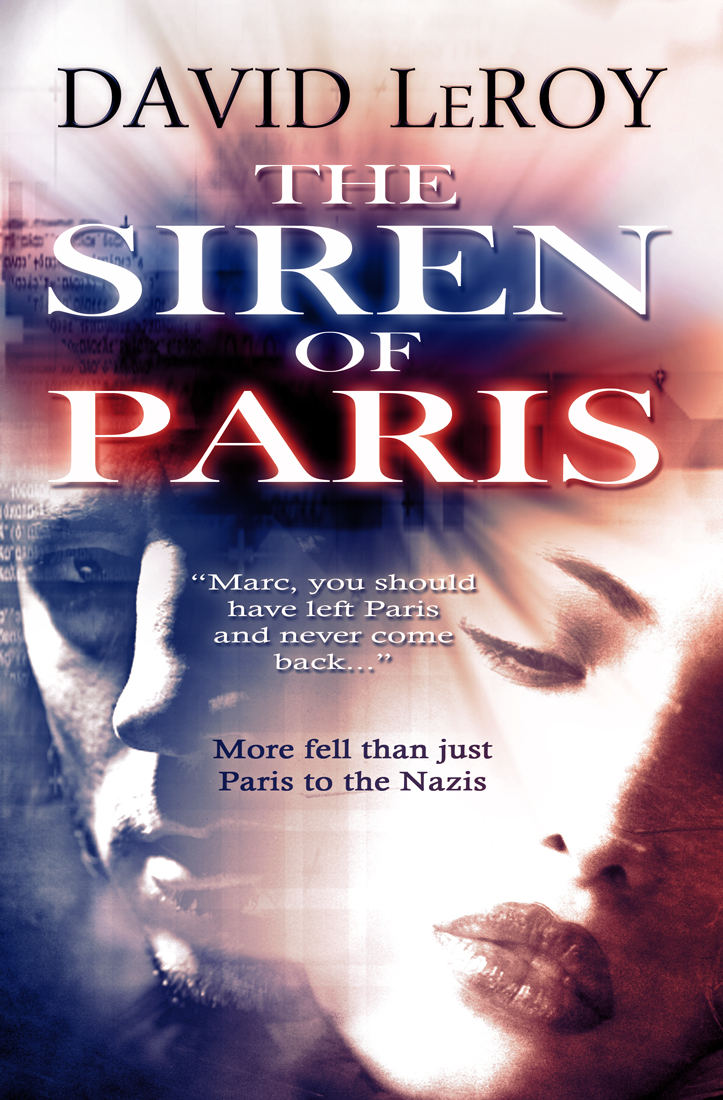
Today I’m welcoming David LeRoy to my series of author interviews. David is the author of The Siren of Paris.

Q: Can you give us a brief description of your novel?

A: The Siren of Paris is a story of survival of World War Two, told primarily in the point of view of a young French born, American male who returns to Paris to study art in 1939. World War Two broke out on Sept 1st, 1939. What many do not know is that at that time there were over 30,000 Americans in Paris alone. After Sept 3rd, they would have a terribly tough time getting home, because the Germans sank a British Passenger ship, the RMS Athenia, killing 98 passengers, and 19 crewmen. Nearly all trans Atlantic service stopped after the sinking which trapped many Americans in Europe during the war, including this young student.

Q: Sarah’s Key, I believe is during the same time period. Is Marc Jewish? Is that how he ended up in Buchenwald in the story?

A: Sarah’s Key is during the same time period, but unlike the young girl Sarah, who is Jewish and caught in the round up during 1942, Marc is Catholic. You would think that this would be something of a protection, but that is not the case. Marc ended up in Buchenwald because he was caught up in the arrest of a ring of various Paris underground resistance members in the spring of 1944. The Gestapo and Milice had hired thousands of plain-clothes undercover agents to smoke out the Paris underground, and tragically they were immensely successful. Paris was liberated in the summer of 1944, but at the same time, members of the resistance were being shipped east to concentration camps. The program was called “the fog and the night,” meaning that anyone who resisted the Nazis were sent someplace where they simply disappeared.

Q: How much historical fact is woven into your novel?

A: The Siren of Paris is packed with historical figures and facts of the time period. Better-known figures are Ambassador William Bullitt, Under Secretary Sumner Wells, Sylvia Beach of Shakespeare and Company, and Jacques Lusseyran. There are also lesser-known individuals such as Joan Rodes, know as the Angel of Saint-Nazaire, and Drue Tartiere, another American woman who helped with the underground. The unfortunate victims of the RMS Lancastria sinking on June 17th, 1940 are also within this story. Researching for this book was incredibly challenging. I have books in English, French and even a few in German. One book I have told me district by district in Paris of Nazi collaborative activities, and buildings taken over by the Germans. I tried to incorporate the real events of the time, whenever possible without the text feeling like a history book instead of a dramatic story.

Q: What is the RMS Lancastria? How did Marc get on that ship?

A: The fall of France was a terrifying event. About 10 million people evacuated from the North to the South of France as the German Army swept over the country. Nearly all the roads became clogged with abandoned cars that had run out of petrol, and refugees feeling on foot. Marc became swept up in this hoard of refugees and he boards the ship with a group he was traveling with. He was trying to get back over to England so he could go up to Ireland and catch an American ship home. At the time, American ships would only leave from neutral countries, which made the task of getting home even more difficult. Most of the passengers were from the British Expeditionary Force, but the ship took on civilians along with soldiers. It is estimated the ship took, in all, about 9,000 refugees. Most people do not know of the sinking because the British Government suppressed it during the war. To date, it is the single largest loss of life of any British Ocean liner and still one of the few war wrecks that is not recognized formally by the British Government.

Q: You chose to self-publish your novel as an e-book. Can you tell us how you came to that decision?

A: When I started writing, I had every intention of publishing it through a traditional publisher. It seems like the entire world of publishing is changing daily. The success of many authors in 2011 with self-publishing changed my opinion, and I began to consider self-publishing over a traditional publisher. It is still a lot of work. The most recent events with the DOJ have convinced me that I honestly do not want to sign a contract at this time with an agent or publisher. I can’t imagine signing a long-term contract now with all of the uncertainty out there in the market. Self-Publishing has evolved to the point that it has become a particularly attractive option. Honestly, five years ago I would never have considered Self Publishing, and the way things are going, in five more years this will not even be a question.

Q: So, who is the Siren?

A: You will have to read the book. Do not be so sure you know who the Siren is too early.

Q: Enough of your book—tell us about yourself.

A: I have a day job in the world of communications. My other passion is art. It was the reason I went to Europe back in 2010, and discovered the facts around this story. I was studying the artwork of various European modern artists. For the longest time, I was into large format black and white photography. Then one day, it just was not enough anymore, so I took up drawing and painting.

We’ve now reached the time in our interview for the let’s-get-to-know-the-author-better, nearly-pointless, sort-of-silly, rapid-fire questions:

Coffee or tea? I drink too much coffee and should drink tea.

Ocean or mountain? Ocean, but my friends love the mountains.

Hiking or shopping? Urban Hikes, through malls, or REI, where I can make believe I am hiking as I shop.

Violin or piano? I am in recovery from a classical Piano background.

Mystery or fantasy? There is a difference? I didn’t know.

Hester Prynne or Scarlet O’Hara? Hester Prynne, as a secret lover to Scarlet O’Hara.

Love scene or death scene? Love leads to death, and death of self, leads to love. They are the one and the same.

To learn more about David LeRoy, visit his webpage. You can buy his book here.

Thanks!

Author Interview: Debra Brown

Today I’m welcoming Debra Brown to my series of author interviews. Debra is the author of The Companion of Lady Holmeshire.

Q: Can you give us a brief description of your novel?

A: Sure! In about 1820 England, Emma was found and raised by a squire and then sent to work as a servant in the household of the Countess of Holmeshire. The widowed lady chose her as a companion and sent her for training in the ways of gentility. Emma was then dragged along into polite London society, where she received a rude reception. She had eyes for the young Earl of Holmeshire, but he was out of her class and engaged by arrangement. The story has elements of suspense and sweet romance.

Q: How much historical fact is woven into The Companion of Lady Holmeshire?

A: Some historical persons are mentioned, such as Caroline, Princess of Wales and her daughter Charlotte of Wales, as well as Queen Victoria. Everything mentioned about them in the book is fictional, but based on historical truth.

Q: What made you interested in this time period?

A: It started in my childhood with, believe it or not, Nancy Drew mysteries. I read them all, but all I really remember is a picture in my mind of Nancy Drew in an old Victorian house. Over the years there were other novels and movies that I loved- all historical fiction and pretty much English. When it comes to movies, I just don’t have much interest in anything but period drama.

Q: What moved you to start writing?

A: I had both a day job and a jewelry business. In the evenings, I would watch period movies and make jewelry. During the recession, my job ended and my business slowed down drastically. But the real crisis was that I ran out of movies! I thought it would be fun to write something like the Jane Austen stories, and so I did, starting as just a hobby.  I’m happy to say that my book has a four star rating- so I guess most of my readers didn’t realize I was writing just for fun!

Q: Do you have another book in the works?

A: Yes, I do. It has a working title of For the Skylark. It is about some young adult twins who have been raised on an estate by their mother, a strange and mysterious woman based on Charles Dickens’ Miss Havisham. She has secluded them from society, and they pretty much just have each other, as she spends her time in an attic-dome and the servants are not allowed to chat with the children. They live by a set of strict household rules. The story starts as the young man starts to want to see the outside world- and his sister wants to prevent that. She has been content and feels that they must leave well enough alone.

Q: Are your books part of a series?

A: Companion is not. Skylark is intended to be the beginning of a series. I can hardly wait to start on the next one! And who knows, I might have them meet the Holmeshires someday.

Q: What do you do to promote your books?

A: I was lost in the beginning, to be perfectly honest. I had a publisher, but I knew I needed to do more. I set up a Facebook profile and learned to use Twitter, and through that I became acquainted with other authors, and I began to see how they promoted their books. I started blogging, and later started a multi-author blog called English Historical Fiction Authors. Our goal is to have a new historical post every day, and so far we have done so since our launch on Sept. 23rd, 2011. We have a great group on Facebook where we chat with readers and other authors. Join us there!

Q: Enough of your book: tell us about yourself.

A: How boring is that! Well, I grew up in Minnesota and then the San Diego area. I went to nursing school and then spent years raising children and being too sick to work. During those years, I studied homeopathy and art, and I got my health back. I enjoy oil painting and all kinds of creative pursuits, but I must admit to being tired of making jewelry, at least for now. Writing books has been a great joy, and I really have gotten to know some wonderful people through this pursuit.

We’ve now reached the time in our interview for the let’s-get-to-know-the-author-better, nearly-pointless, sort-of-silly, rapid-fire questions:

Coffee or tea?

Green tea, thank you, since coffee causes my eczema to flare up.

Ocean or mountain?

Ocean. Could I have a clipper ship please?

Hiking or shopping?

Shopping and out to eat.

Violin or piano?

Piano.

Mystery or fantasy?

Mystery.

Darcy or Heathcliff?

Can I say Knightley?

Love scene or death scene

Yikes! Love please.

Thanks, Debra, for visiting today. If you’d like to learn more about Debra and her books, visit her blogs:

http://authordebrabrown.blogspot.com and http://englishepochs.blogspot.com

To order her books:

Amazon US: http://www.amazon.com/Companion-Lady-Holmeshire-Debra-Brown/dp/1937085376/ref=sr_1_cc_1?s=aps&ie=UTF8&qid=1332872327&sr=1-1-catcorr

Amazon UK: http://www.amazon.co.uk/Companion-Lady-Holmeshire-Debra-Brown/dp/1937085376/ref=sr_1_cc_1?s=aps&ie=UTF8&qid=1332872327&sr=1-1-catcorr

Thanks so much for the interview, and for all who came to read!

Thank you, Debra, for joining me today.  If you’d like to learn more about Debra, visit her blog:

http://authordebrabrown.blogspot.com

http://englishepochs.blogspot.com

http://englishhistoryauthors.blogspot.com

Amazon US: http://www.amazon.com/Companion-Lady-Holmeshire-Debra-Brown/dp/1937085376/ref=sr_1_cc_1?s=aps&ie=UTF8&qid=1332872327&sr=1-1-catcorr

Amazon UK: http://www.amazon.co.uk/Companion-Lady-Holmeshire-Debra-Brown/dp/1937085376/ref=sr_1_cc_1?s=aps&ie=UTF8&qid=1332872327&sr=1-1-catcorr

Thanks so much for the interview, and for all who came to read!

Videos and Marketing

Cornerstone Press has created a number of videos, which can be viewed on youtube, to market Syncopation.  I’m going to see if I can imbed some of these videos in this blog.  Wish me luck!

Of course, we should start off with the amazing book trailer:

Next, is Chalk Talk:

The next three are readings from the text:


I think I did it!  I hope you enjoyed the clips.

Come back tomorrow for my author interview with Beth Elliot.


Interview with Linda Collison


Today I’m welcoming Linda Collison to my series of author interviews. Linda is the author of the Patricia MacPherson Nautical Adventure Series.

Q: Can you give us a brief description of your books?

A: Stripped to the bone, it’s about a girl pretending to be a man aboard a ship in the 18th century.

The series begins in 1761 during the Seven Years War and is told in first person by Patricia, the illegitimate daughter of a dissolute English sugar planter. When her profligate father dies, sixteen-year-old Patricia finds herself without funds, family or interest. How is she to survive? She chooses to portray herself as a young man and make her living at sea. Living in disguise aboard ship with so many men (and a few women) is fraught with its own risks and rewards and I’ve drawn on numerous historical accounts of 18th century women who really did pass themselves off as men.

Q: How did you come to write this series?

A: My first novel, Star-Crossed (Knopf;2006) was the inspiration for the Patricia MacPherson Series. Knopf originally published it as a stand-alone and they weren’t really interested in doing a series. But Tom Grundner, publisher and senior editor of Fireship Press was! He published Surgeon’s Mate, the sequel, and waited to acquire the rights to Star-Crossed, once I obtained the reversion of rights after it went out of print with Knopf. Tom recognized that Star-Crossed was adult historical fiction, not YA, and he was committed to publishing the series. Tragically, Tom died suddenly last fall, but his publishing company Fireship Press lives on. Star-Crossed will soon be republished as Barbados Bound, the first book of the Patricia MacPherson Nautical Adventure Series, and the third book in the series will hopefully see print early 2013.

Q: In 2007, Star-Crossed was named by the New York Public Library as a “Book for the Teen Age.” Did you write it for adults or teens?

A: Funny you should mention that! I didn’t write Star-Crossed specifically for young adults; I wrote it from the perspective of a young woman, a sort of coming-of-age historical. The character is impetuous and she doesn’t always make good decisions. But she does what she can to survive.

My agent at the time, Laura Rennert, was keen to sell it as YA. She assured me she could attract a big publisher if she marketed it as YA, and she did. I was thrilled to be published by Knopf and to be included on the Books for the Teen Age – but throughout the series Patricia matures, and if the series continues she will grow old –which makes it more of an historical maritime saga than YA. So it’s a “cross-genre, cross-gender” book.

I do write young adult novels. Looking for Redfeather, a contemporary young adult literary novel I’ve recently completed, is represented by literary agent James Schiavone. I’m also working on a YA paranormal thriller set at sea that I’m very excited about.

Q: You studied history in college. How has that influenced you as a writer?

A: I’ve been a life-long student of history but the first time I went to college I majored in nursing to become a registered nurse (there being more jobs for nurses than historians — and I with a family to support!) I worked in acute care for over a decade, specializing in emergency and critical care. At the same time I worked as a freelance writer and had numerous articles, essays and short stories published by various magazines including Ladies Home Journal, Caribbean Travel& Life, Sail, Cruising World, Sailing, Parachutist, Nursing, etc. I wrote two guidebooks with my husband, which were published by Pruett, back in the ‘90s.

Over the years I’ve taken many college level history courses, mostly in history and French. Studying history has helped me examine sources objectively; it has helped me approach my research more efficiently and given me a wider perspective.

Q: How did you come to write historical fiction with a nautical setting?

A: In 1999 my husband and I served as voyage crew members aboard HM Bark Endeavour, an Australian-built replica of Captain James Cook’s 18th century sailing ship. The Endeavour was the closest thing to a time machine I have ever experienced and one of the most accurately reproduced historical ships in existence. We voyage crew members helped to sail her from Vancouver to Hawaii, a crossing that took nearly three weeks. We were expected to stand our watches, climb aloft and go out on the footropes to make and furl sail, take our turn steering the ship and keeping a look-out, as well as other duties necessary to keep the traditional vessel in good working order. We slept in hammocks strung from the deckhead, just as sailors did in the 18th century.

In many ways the experience changed my life. When I got off the ship in Hawaii I had a much better understanding what it was like to have sailed on an 18th century sailing vessel. And I carried inside the seeds for a novel. I had lived the time period, and the setting; I knew the ship intimately. I was getting to know the main character, the cross-dressing surgeon’s mate. But I still had years of research and writing ahead of me before Star-Crossed would be published. What a journey that was! And Star-Crossed was only the beginning. Book three of the series is taking me into the period leading up to the American Revolution where Patricia and her lover will find themselves on opposite sides of the war.

Your whole series sounds fascinating.  I look forward to reading about Patricia.

We’ve now reached the time in our interview for the let’s-get-to-know-the-author-better, nearly-pointless, sort-of-silly, rapid-fire questions:

Q: Coffee or tea?

A: Coffee, black! Except when I’m in England eating scones and clotted cream, then I’ll have tea.

Q: Ocean or mountain?

A: You might think I would choose the ocean because of my nautical books. But that isn’t necessarily the case! I divide my time between ocean and mountain. Today I’m at the ocean but next week I head for the Rocky Mountains. I need them both!

Q; Hiking or shopping?

A: Today I am hiking. Tomorrow I might be shopping. Life is broad!

Q: Violin or piano?

A: How about clarinet or cello? I played them both in high school, but maybe I should have learned piano, it’s so versatile and expressive. I do love piano — Adele, Elton John, Duke Ellington and Frederic Chopin jump to mind.

Q: Mystery or fantasy?

A: What about a mysterious fantasy? Actually, I don’t care for the mystery genre. Literary mysteries, such as Umberto Eco’s The Name of the Rose, now that’s a different story!

Q: Darcy or Heathcliff?

A: Heathcliff, of course!

Q: Love scene or death scene?

A: The best love scenes are usually lovers’ quarrels. It’s all about the conflict! Throughout the series I’m writing, Patricia tries to get together with her lover, and only sometimes are the trysts successful.

Death scenes are the best. “Out, out brief candle!”

Learn more about Linda and her writing at Linda’s website and at the Fireship Press website.

You can also order her books and learn more about her at Linda’s amazon.com page

Thank you, Linda!


Interview with T.C. Isbell


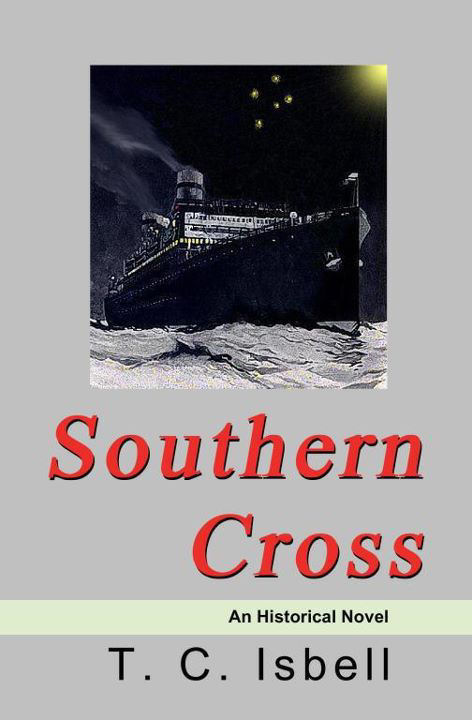
Today I’m welcoming T. C. Isbell to my series of author interviews.  T. C. is the author of Southern Cross, the first in the Prelude to War series.

Q: Can you give us a brief description of your novel?

A: Southern Cross is a World War 2 historical thriller. German agents Elsa Gable and Chris Schulte grew up together in a Germany ravaged by the Great War. They became inseparable as they matured into more than friends, more than family. They had a bond no one could destroy, at least that’s what Chris believed until the night of December 2, 1938 when a telegram arrived that changed Chris’ life forever.

Q: When will the second book in the series, Icarus Plot, be released and how does it continue the story started in Southern Cross?

A: Icarus Plot, the second novel in my Prelude to War series, takes place in Panama in 1940. Clive Smith, an MI6 agent, tracks a German spy, Chris Schulte, through the first book in the series. Clive is certain that the threat has not been resolved in Havana at the end of Southern Cross. He follows a trail to Panama where he discovers foreign and American interests are attempting to disable the Panama Canal and effectively divide the world in half. I hope to finish Icarus Plot before Christmas 2012.

Q: What drew you to this time period?

A: I have been an avid fan of World War Two history ever since high school. When I retired I started an in depth research project into the time period preceding Germanyfs invasion of Poland. Before I knew it, I was writing a novel that weaved the story of Chris Schulte and my other characters into my historical research.

Q: I see that you’ve written short stories in the past, can you tell us about them?

A: Yes, I have written a number of short stories. Presently, two of them, “Mattie’s Shoes” and “Surf’s Up” are available for Amazon’s Kindle. In “Mattie’s Shoes” a sixty-nine year old widow confronts a closet full of old shoes and old memories. “Mattie’s Shoes” placed in the 79th Annual Writer’s Digest Writing Competition in the Mainstream/Literary Short Story category. In the other story Billy Bonzer, an old surfer from Southern California, learns a lesson about working for big business and big government by participating in an inner tube race.

Q: Enough of your books tell us about yourself.

A: Ever since childhood, I have been intrigued by the arts–painting, music, and writing. Starting in high school, I wrote short stories and poetry. In the late sixties I joined the Navy. During the Vietnam era I wrote a number of poems that were published in the Berkeley Barb. I may publish them as a collection sometime, but for now they remain locked away. After my discharge, I returned to college and graduated with a BA in mechanical engineering. I worked for the Navy repairing nuclear power plants until I retired in 2005. My first challenge after retirement was to learn how to not write like an engineer. My second challenge was to learn everything I missed while staring out the window during my high school English classes.

Q: What advice would you give to an aspiring author?

A: First: sit down and write – write everyday. Set aside a specific time each day. Maybe in the beginning it’s just thirty minutes or an hour, but do it religiously. Soon writing will become a habit. Don’t get bogged down with creating the perfect sentence. Nothing is ever perfect to a writer. Write what’s in your head and sort it out later. Second: read books in the genre you write in. The authors you read have spent a lot of time learning their craft and have things to teach you. Third: consider, but don’t be deterred by the opinions of others – follow your dreams.

We have now reached the time in our interview for the let’s-get-to-know-the-author-better, nearly-pointless, sort-of-silly, rapid-fire questions:

Coffee or tea?

Coffee, I drink vast mounts of strong, French Roast coffee while I work. I don’t smoke, so I have to do something that’s bad for me. To paraphrase Mark Twain, when you get really sick, you need a vice to throw overboard to stop your ship from sinking. I guess coffee is mine.

Ocean or mountain?

Mountains – I was in the Navy for six years and have seen enough of the world’s oceans.

Hiking or shopping?

I enjoy hiking and climbing. I have climbed most of the volcanoes in the Cascade Mountain Range, including Mt Rainier.

Violin or piano?

Piano, but really harpsichord. In the early seventies when I lived outside of San Francisco I owned a Baldwin electric harpsichord along with an assortment of guitars and other musical instruments.

Mystery or fantasy?

Mystery, but actually both. I like writing mysteries, but I am working on a science fiction novel.

Hester Prynne or Scarlett O’Hara?

Hawthorne’s Hester Prynne for all of the contradictions in her life. Her story becomes even more poignant, considering today’s political climate.

Love scene or death scene?

Death scene – I think a richer palette of emotions from love to hate can be drawn into a death scene.

Thank you, T.C.

To learn more about T.C. And his writing, visit his website, like him on Facebook
and even better, buy his books:

Amazon , Barnes & Noble,  Google Play

Thanks, T.C. !