Best Books of 2011

2011 sucked. I had to deal with the death of both of my parents, and so I spent a lot of time reading as escapism. I read eighty-one books this past year, but I was in such a low psychological state that I didn’t find many new books that wow’ed me. I started a lot of books that I didn’t finish. (Wolf Hall, The Immortal Life of Henrietta Lacks, London by Rutherford, Water: the epic struggle for wealth, power and civilization, and probably others I can’t now remember. If I didn’t finish a book, it didn’t count toward the eighty-one.)

For comfort, I re-read books that I knew I would enjoy. Every now and then, I read a new book that hit me just right, and I’m completely aware that if I had read it two weeks earlier or later, it might not have affected me the same way.

So, enough of my prose. Here’s the list:

The Curious Incident of the Dog in the Night-Time by Mark Haddon

The main character/narrator is autistic. Because he is telling the story to you, and doesn’t understand the world the way you do, you understand things before he does. Through his voice, you learn how his mind works, so you clearly understand why he responds the way he does to difficult circumstances. Fascinating and emotional.

The Wise Man’s Fear by Patrick Rothfuss

Rothfuss’s long awaited sequel to The Name of the Wind was all I’d hoped for and has me eager for the final installment in the trilogy. This is an enormous book (almost 1000 pages) and I’ve been sitting here for about ten minutes trying to figure out how to summarize it, and I’ve just decided not to try. If you like fantasy and haven’t read these books yet, get The Name of the Wind. If you aren’t a fan of fantasy, I still recommend them. The writing is almost poetry (actually, there is a bit of poetry in there), and the story multi-layered.

The Circle Cast: The Lost Years of Morgan le Fay by Alex Epstein

Epstein skillfully blends the coming-of-age, the fairy, the revenge, and the legend. Revenge is the sustaining force in Morgan’s lost years, and success in battle and magic are what give her power. Epstein holds true to the legendary woman Morgan le Fay in creating this story of the child. Fans of Arthurian legend will love this book, and so will everyone else. Great characters, great writing, great story.

Just Listen by Sarah Dessen

I read this book straight through, staying up until about 2:00 in the morning. Once part of the popular high school crowd, Annabel Greene is now a social outcast. Something traumatic happened, but Annabel won’t talk about it—not to her overpowering mother, not to her troubled older sisters, and not to us, the readers. Fellow outcast Owen befriends Annabel, and their relationship slowly becomes romantic. Dessen is flawless at creating the female teenage world. I’m not sure why anyone would want to return to that horrible time and place, but I love Dessen’s writing and characters, and if she’ll keep writing about it, I’ll keep reading.

Elijah of Buxton by Christopher Paul Curtis

Twelve-year-old Elijah was the first child born free in the Canadian community of Buxton, where escaped slaves live freely. He is a sensitive child who wishes he were less sensitive, or “fragile” as his mother calls him. Through a series of funny, emotional, and gripping events, Elijah proves himself and an able young man. I loved Curtis’s Bud Not Buddy, and I loved this book too. This is a middle-reader story that adults will like as much as their kids. It’s a good read-aloud, as the funny scenes are even funnier when a small child is laughing along with you.

The Tale of Despereaux by Kate DiCamillo

This is a fairy tale story of a mouse who falls in love with a princess. It was made into a movie, which I haven’t seen, but which according to my son is good but quite different. DiCamillo’s writing is poetry.

The Lost Memoirs of Jane Austen by Syrie James

This was the last book my mother read before she died. She told me all about it on the phone, the day before her stroke. I read it way back in January and can’t remember a bit of it—I was in a fog of grief. This book will always have a special place in my heart.

Pride and Prejudice and Zombies by Seth Grahame-Smith and Jane Austen

Really? you ask. Yes, I answer. I picked up this book at the perfectly right time. It is the story I know practically by heart, interspersed with zombie attacks. Fun.

Bringing Yoga to Life by Donna Farhi

I don’t read a lot of non-fiction, but I had to include this self-help book. Again, good timing for me. After my father’s death, stress caused in me some physical ailments that have been helped by a daily yoga routine. However, this book is about more than yoga poses; it explores how to live a healthy, centered life.

and the series . . .

Thursday Next series by Jasper Fford

Clever fantasy/mystery/English-major type story. Very funny. I read these aloud to my younger son, who enjoyed them immensely. There’s a new one out I need to get.

A Series of Unfortunate Events by Lemony Snicket

I read these when my older son was in elementary school, and now I’m reading them out loud with my younger son. Such clever writing.

The Hunger Games series by Suzanne Collins

I keep re-reading this. Fast-moving story, incredible characters, fantastic writing. Is there anyone who reads this blog and hasn’t read this yet? Why haven’t you? You better get going; the movie comes out in March. I’ve watch the trailer four times and cried each time. Powerful story.

Girl with the Dragon Tattoo series by Stieg Larsson

I debated including this. The thriller is not my favorite genre, and I usually avoid books filled with sicko sexual torture. This made the list because of Lisbeth Salander. She is perfectly drawn—a powerful female character, perhaps a bit autistic, a survivor.
Holiday Fest Book Signing

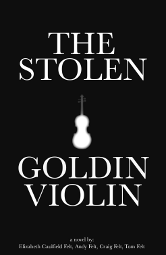
Once again, we will be selling The Stolen Goldin Violin at this year’s Holiday Fest.  Holiday Fest is one of Stevens Point’s biggest and best arts and craft shows. 

Saturday, Nov 12 from 9am to 3pm

St. Paul’s United Methodist Church, 600 Wilshire Blvd.

Proceeds from the show benefit community holiday baskets.  So come and check out our booth, have lunch, buy some crafts, and know that you are helping feed the needy in our community !

NaNoWriMo 2011


It’s that time of year again, and I don’t mean Halloween.

It’s time for writers to put pen to paper or fingertips to keyboard!

It’s NaNoWriMo time!

This will be my third year as a NaNoWriMo participant.  The first year, if you remember, I wrote The Stolen Goldin Violin.  The second year, I upped my word count on Wilde Wagers.  This year, I plan to spend the month of November completely revising Syncopation and getting it ready to submit to Cornerstone Press in January.

So, I’m a NaNoWriMo cheater. The idea of NaNoWriMo is to turn off one’s internal editor and write an entire novel, from start to finish, during the month of November.  I did that the first year, but these past two years that system hasn’t really fit into where I’m at as a writer, so I’ve adapted the program to suit my own needs.  I love the supportive emails I get from NaNoWriMo, and being part of a writing community is amazingly wonderful.

I’ll keep you updated on my progress, and I encourage anyone who has ever thought about writing a novel to sign up.  It’s great fun!  Just go to NaNoWriMo.org and sign up today.  You are running out of time for 2011!!

Why High School Students Don’t Read

Elementary schools are alive with reading. Students are excited about the books they read in class, they enjoy going to the school library, and they beg their parents to fill out the Scholastic book orders. Teachers of elementary aged children seek out new material, read it, and incorporate it into their classrooms. What are your elementary aged children reading? Most of it is not what you read as a child. The books are new and hip and relevant to today’s kids. The world of children’s literature is alive and vibrant, and elementary schools bring that world to students. Exciting stories in the classroom promote reading outside the classroom.  This doesn’t happen in later grades. Between elementary school and college, students stop reading. It happens in junior high and high school, and the current curriculum is the reason.

When examining what my children are experiencing in junior high and high school English classes, and listening to my college students about their reading experiences in high school, I see that the books being taught in high school are not chosen to encourage an enjoyment of reading. In eighth and ninth grade, my son read Great Expectations, The Fall of the House of Usher, Fahrenheit 451, Lord of the Flies, and Robinson Crusoe. I loved these books (English major that I am) when I read them, but couldn’t something contemporary be added to mix? The most recent of these books was published more than fifty years ago.

Classics are good for teaching; they show “universal truths” and provide good opportunities for analysis and discussion, but they are dated. They are hard to read. There are contemporary novels that handle the same “universal truths” and provide similar opportunities for analysis and discussion that adolescents would enjoy much more than the ones being used in today’s classrooms.

My son spent the first twelve years of his life an avid reader; he called the library his favorite place to be. Last year, he told me he hated English. His comment at the end of eighth grade: “The Diary of Anne Frank was the most cheerful book we read this year, and it was only cheerful because she didn’t know she was going to die.”

The classics should not be thrown away, nor should contemporary books be ignored. Amazing books are being written for young adults that could be used in combination with the classics. Compare The Lord of the Flies to The Hunger Games; Have journalist Anne Frank interview The Book Thief‘s Liesel Meminger. How would one of Sarah Dessen’s protagonists handle being stranded on a desert island? Students bored and not participating in group discussions? Get them to read Jodi Picoult and you’ll hear their opinions on a whole range of topics. Topics that matter to them.  If they discover a new author in school that they like, there is a good chance they will want to read outside of school as well.

Junior high and high school English teachers should take a look at what is going on in elementary schools. Reading is alive; it is dynamic; it is exciting in the early grades. It could be this in the older grades too.


Dick Caulfield dies

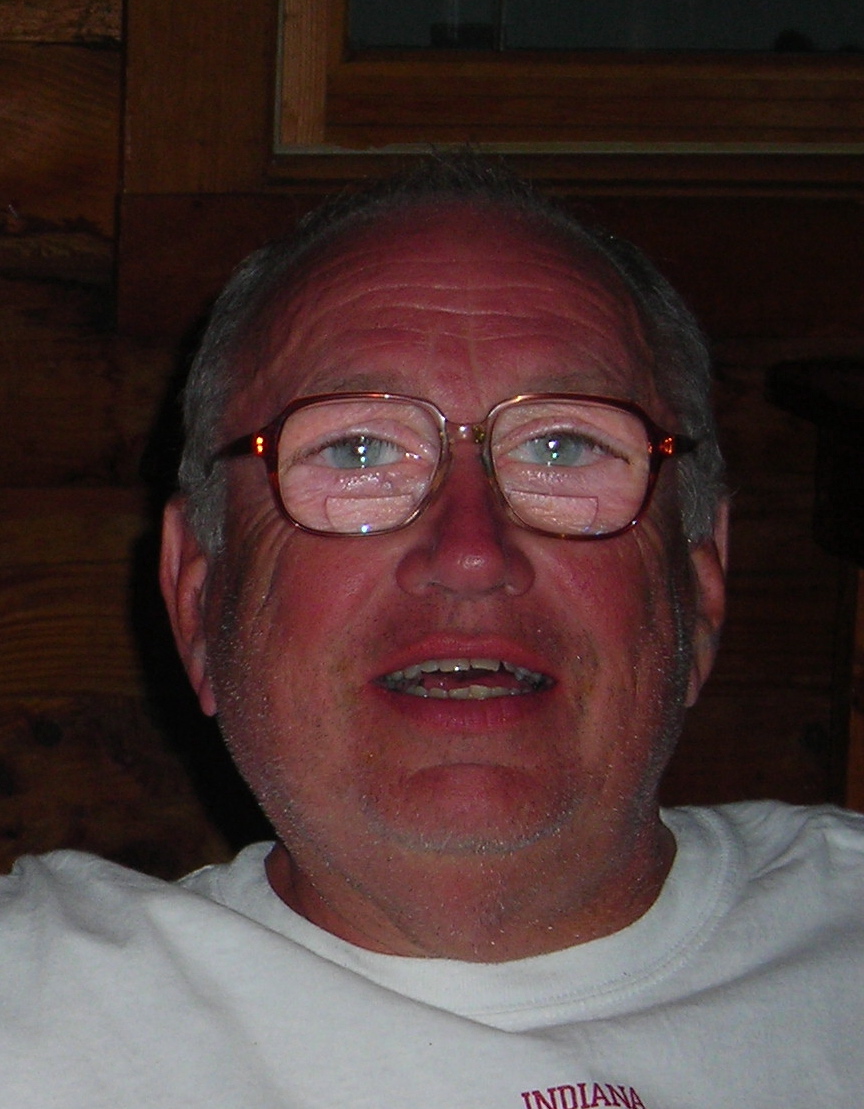
Richard “Dick” Howard Caulfield died August 19, 2011, in Bloomington, Indiana, following a brief battle with cancer. He was born November 28, 1936, to Howard and Dorothy (Lovelace) Caulfield. Dick grew up in Indianapolis, went to Shortridge High School and received a bachelors and masters in education from Indiana University. He married Betsy Pearson, and they had four children.

Dick was first and foremost a teacher, at the elementary and middle school levels, all the way through graduate school. He was always willing to share his knowledge and experience gained from nearly fifty years of experience. He taught elementary and middle school in Indianapolis, worked as an educational consultant, and was a visiting professor at Indiana University.

Dick was active in the National Council of Teachers of Mathematics. He was a Woodrow Wilson Fellow, a Danforth Fellow, a regular presenter at conferences, and a writer for educational testing services and professional journals.

In his free time, Dick enjoyed golfing and watching Indiana University sports. He had season IU football tickets for more than fifty years.

Dick was one of the most generous people who ever lived. If you needed something specific, he would give. If you needed something vague, he would give. If you didn’t think you needed anything, he would give. If you didn’t need anything, he would give. Giving is what he did. Because of this, there are a lot of people walking around with holes in their hearts today.

A memorial service followed by a reception will be held Saturday, August 27, at 11:00am at Trinity Episcopal Church, 111 S. Grant St., Bloomington. Donations in Richard’s name may be sent to Waycross Episcopal Camp, 7363 Bear Creek Road, Morgantown, IN 46160 , or to the IU Foundation/Varsity Club at 1001 E. 17th St. Bloomington, IN 47408.

We encourage those who cannot come to Bloomington for the service to reserve 11:00 ET on Saturday to spend a few moments thinking about Dick and joining us in spirit.

My Dad

I’m an irregular blogger. I only post when I feel I have something interesting, clever, funny, or informative to say, but I’m a quiet person, both in person and on paper, and meaningful conversations develop slowly (if at all). My blog forces me to spend time in my head, trying to be poetic, to be a writer that people will want to read. For me, planning a blog post is an enjoyable mind-puzzle–more personal than a Sudoku, more challenging than a crossword, with no wrong answers but with some solutions being much better than others.

I’ve been in my head a lot the past few weeks, but I don’t feel like words are coalescing into anything worthwhile. A part of my life has been crumbling all around me, and I want to pick up the pieces through my writing and create something meaningful and beautiful. Something about my father. My father and I did not agree on very much, but he was a man with a large heart who wanted the best for everyone.

He died of cancer a few days ago. He was diagnosed with cancer only about three weeks earlier. For my family, death has moved swiftly.

I’ll write more when I can think what to say.

This blog post is a lame solution to my current mind-puzzle.  When I come up with something better, you’ll read it here.

Congratulations Winners!

Wendy Wetzel has won my blog/facebook name-your-favorit- children’s-story contest and will receive a copy of The Stolen Goldin Violin!

The Goodreads Giveaway winners are:

Katrina Buell, Indiana

Holly Kinsey, Georgia

Sam Pierce, Arkansas

Jo Ashley, North Dakota

Lionel Garcia, California


Their copies of The Stolen Goldin Violin are on the way.  I posted them today!

Thanks for playing and I hope readers enjoy our story!  If you didn’t win and would like to buy a copy, Order Here!


A Few Pictures, A Few Thoughts from the HNS Conference

The Historical Novel Society conference in San Diego was wonderful! Historical novelists are such interesting, funny and fascinating people. I enjoyed chatting with people at dinners, listening to authors and editors at workshops, volunteering, and dressing up!

My favorite session was put on my Karlee Turner Etter and was called Nineteenth Century Fashion, From the Inside Out.

Karlee started the session wearing only a corset over a chemise (and thus I learned that no woman would ever wear a corset against her skin, because then she would have to wash it regularly and that was difficult to do.)

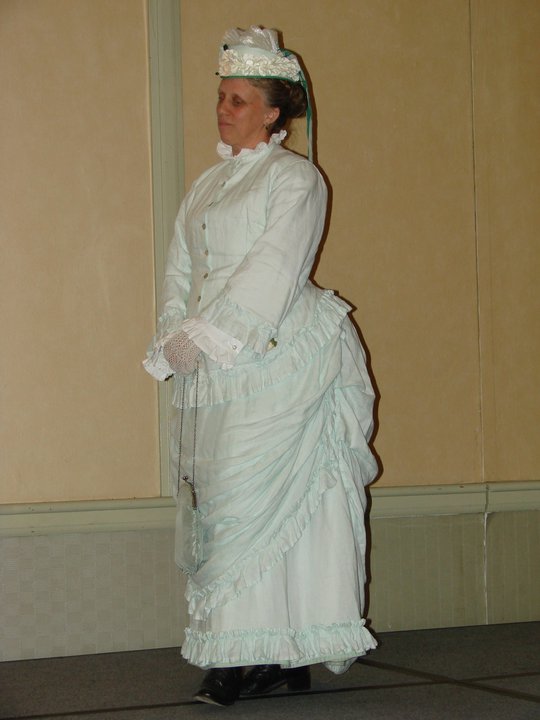
Then, piece by piece, Karlee got dressed, and while she got dressed she explained what the pieces were called, how they were worn, how often they were washed, and all sorts of incredibly interesting facts. When she was all dressed this is how she looked:


This dress represents what a middle to upper middle class woman would have worn in the 1880s / 1890s in America, and thus is similar to how my own Miss Olivia Snow would dress.


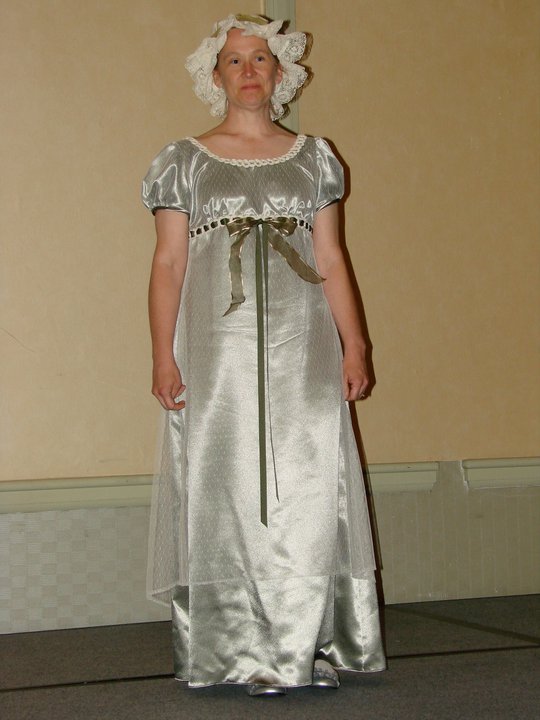
I wore my own costume in the Saturday evening costume pageant. I had nothing to do with making it, and would thank its creator if I had her name. This dress was a gift, but my aunt and I did make the mobcap.


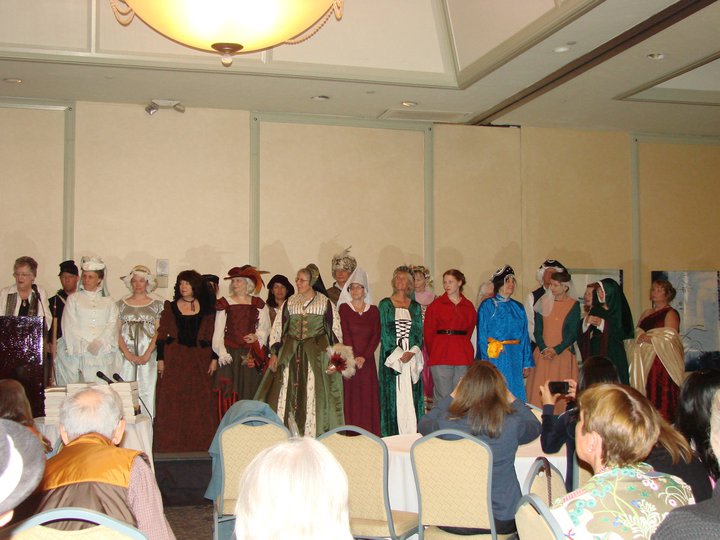
Thanks to author Christopher Cevasco for taking this picture during the costume pageant. Here’s another he took of everyone at the pageant:


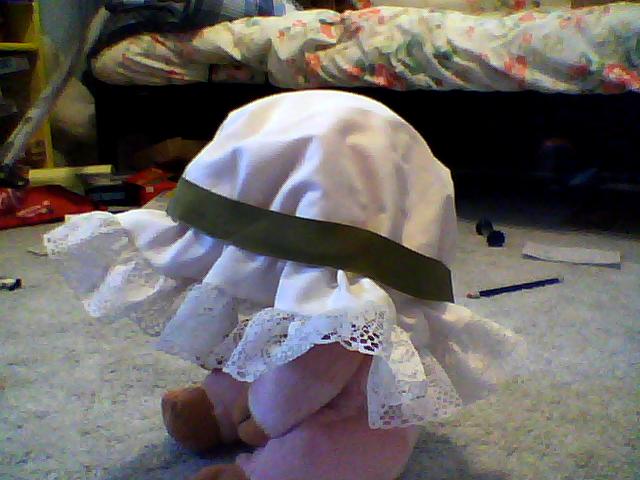
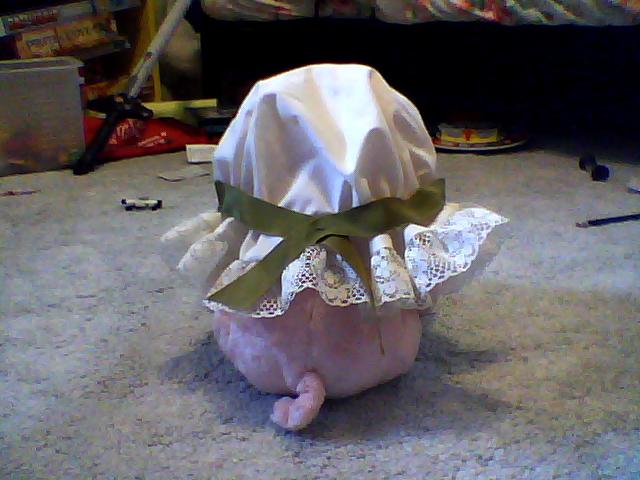
And finally, I have two close-ups of my mobcap. My aunt was so generous in her skills, materials and work in creating this cap in time for the pageant. (Thanks to Princess Esmerelda for modeling the cap, though it was too big for her)


Note Princess Esmerelda’s cute little tail below the cap:

Anti-Antimacassar

I’m editing/revising and came across this typo

anti-antimacassar

Rather than just delete the extra anti-, I started wondering what exactly an anti-antimacassar might be.

For those of you who do not know, in the nineteenth century, many men wore macassar oil in their hair. An antimacassar was a cloth cover, often crocheted or embroidered, placed on the top of a sofa or chair to keep the macassar oil off the furniture. Even after macassar oil went out of fashion, antimacassars remained.

I remember a number of chairs in my grandmother’s house that always had a lace antimacassar pinned to the top. Knowing my grandmother, she probably knew the original purpose of the antimacassar and used the lace just to achieve that nineteenth century look.

I picture an anti-antimacassar as a person involved in a movement to simplify interior design by getting rid of the unnecessary, embracing the modern. Of course this movement would not be gentle and pleasant, but rabid and controversial. An anti-antimacassar would be a militant interior designer, bent on molding the world to his/her specifications. What do you think?

I need to get back to revising. Revising is hard and thinking about anti-antimacassars was so much more fun.

Yes, I know, I’m weird.