Is it midnight yet? Tonight, at midnight, it’s time to book shop like a crazy person!
Sunday, March 5 through Saturday, March 11 e-books are on sale at Smashwords. It’s a great time to finally get your copy of Syncopation: a Memoir of Adele Hugo. (75% off the regular price.) Visit my Smashwords Author page to download your copy. Look for the coupon code and use it when you check out to receive the discount.
If you’ve already read my book, or historical fiction isn’t your cup of tea, there are oodles of other e-books on sale. Visit the Smashwords Promotion Catalog.
This Read-an-Ebook event was first started 12 years ago by author Rita Toews, as she explains in this interview.
Today I’m welcoming Richard Anderton to my series of author interviews. Richard is the author of The Devil’s Band and The Devil’s Lance, which are the first two books of The Devilstone Chronicles. The third installment, The Devil’s Pearl, is due out later this year.
Elizabeth: Welcome, Richard.
Richard: Thank you and thank you for inviting me to take part.
Elizabeth: Can you tell us about your series?
Richard:The Devilstone Chronicles are set in the early 16th Century, during the reign of Henry VIII, and tell the story of Thomas Devilstone, a disgraced alchemist and astrologer who escapes abroad after being sentenced to death for practicing witchcraft. Whilst in exile, he becomes a soldier of fortune, in the hope he can use his wits and his sword to win back both the king’s favour and his family’s lost estates. To help him in this ambition, he forms an unlikely alliance with three other mercenaries namely a Lutheran convert, a Portuguese adventurer and an escaped African galley slave.
At one level the stories are meant to be fun adventures, not to be taken too seriously, but I hope readers will be intrigued by the subtext which is the conflict between the superstition of the medieval world and the beginnings of modern science during the Renaissance. Thomas’ name is a deliberate reference to the biblical ‘Doubting Thomas’ because, after his constant failure to perform spells successfully, this onetime sorcerer has come to doubt his own, once unshakeable, belief in the supernatural. Thomas now understands that much of what appears to be magic can be produced by purely natural means and this knowledge allows him to dupe his enemies and thwart his rivals as he struggles to revive his fortunes.
Elizabeth: Do you and Thomas Devilstone have any of the same personality traits?
Richard: I think Thomas is the exact opposite of me but he is the sort of person I wish I was; he is much more of a swashbuckling hero than I am and much better looking! Thomas is also far more ready to embrace modernity whereas I struggle to cope with the 21st Century. To take just one example, I have passionate loathing of smart phones, because my huge sausage-shaped fingers are far too big for touch screens.
Elizabeth: How much historical fact is woven into your story?
Richard: A lot! As an avid reader and fan of historical novels, especially Bernard Cornwell and George MacDonald Fraser, I love it when an author constructs their plots around actual events so I’ve tried to include as much historical fact as I can without slowing down the action or turning the stories into textbooks. Thomas is entirely fictional but he is closely modeled on a genuine Renaissance alchemist, named Cornelius Agrippa, who publicly renounced magic and became a doctor. He also meets plenty of genuine historical figures which range from the last Yorkist prince to challenge Henry VIII (The Devil’s Band) to the actual grandson of Vlad the Impaler ‘the real Dracula’ (The Devil’s Lance).
I also believe the whole point of reading historical novels is broaden one’s knowledge of history so Thomas fights in the pivotal battles which took place at this period (Pavia 1525 and Mohacs 1526) and the machines he constructs, which are important plot devices, follow real designs produced by Leonardo de Vinci. Similarly, the ineffectual spells he casts to confound his superstitious enemies are all taken from a popular medieval spellbook called The Munich Handbook of Demonic Magic.
Elizabeth: What drew you to this time period?
Richard: As a writer I’m always looking to tell ‘the untold story’ but most publishers want books about popular periods so there is a large existing audience for the title. As a compromise, I chose to write about the early Tudor Age because Henry VIII and his six wives are perennially popular but at the same time I moved the focus away from England to the rest of Europe in search of stories that will introduce readers to different, and lesser known, aspects of this period.
Apart from the origins of The Reformation, the history of the rest of Europe during the 16th Century is rarely taught in UK schools so few people on this side of The Channel have heard of Charles V (b.1500 d.1558) despite the fact that he was one of the most powerful monarchs ever to have lived. Whilst Henry VIII ruled England, this Hapsburg Emperor simultaneously ruled Spain, Germany, Italy, the Low Countries and most of Central Europe as well as the vast Spanish territories in the New World, but as far as we Brits are concerned Charles was nothing more than Catherine of Aragon’s nephew! Moreover, Charles V’s wars with the French King Francis and the Ottoman Sultan Suleiman the Magnificent created many of the fault lines which still divide Europe today so I thought his reign would be the perfect backdrop for Thomas’ journey from the medieval to the modern world.
Elizabeth: What is your writing process?
Richard: To construct the plots of The Devil’s Band, The Devil’s Lance and the forthcoming The Devil’s Pearl, I chose a genuine historical battle to be the climax of each story and worked backwards. Why would an Englishman be here? What would be his motivation to fight for a foreign king? Would he benefit from the outcome? And so on. I then try and weave my answers to these questions around known historical facts and my golden rule is that any historical figure who appears in the story has to act in accordance with these facts. I do allow myself a some license with fictional characters but Thomas and his companions’ thoughts and actions always have to remain true to the period.
Once I have a rough chapter plan, I write down everything in my head then edit and rewrite it again and again. I reckon each chapter is rewritten at least fifty times before I’m happy, so my method of writing is not very efficient but it does mean I have (mercifully) never suffered from writer’s block!
Elizabeth: What have you read recently that you feel passionate about?
Richard: Whilst researching the use of slaves in Mediterranean galleys for Volume III of The Devilstone Chronicles (incidentally one of my favourite films, Ben Hur, got it completely wrong!) I read the only autobiography of a real galley slave known to exist. It is the story of Jean Marteilhe, a French Protestant who tried to flee religious persecution in his homeland. He crossed into what he thought was the Protestant Netherlands but in fact he’d arrived in a French enclave just a few miles inside Dutch territory. He was arrested and sentenced to life imprisonment. Later, he was transferred to the galleys and spent 6 years chained to an oar before he was rescued by an English fleet. All this did not happen in 16th or even the 17th Century but in the 18th Century, the so called Age of Enlightenment, so whenever I think my life is miserable I think of that poor Frenchman!
Elizabeth: Can you tell us more about yourself?
Richard: I am 52 years old, married with four children and I’ve lived all my life in the north of England. Though I always wanted to be a writer, I didn’t put pen to paper until I was nearly 40. Before that I failed at a wide variety of careers including lawyer, police officer, cartoonist and book illustrator…
We’ve now reached the time in our interview for the let’s-get-to-know-the-author-better, nearly-pointless, sort-of-silly, rapid-fire questions:
Elizabeth: Coffee or tea?
Richard: Coffee first thing in the morning then tea, lots and lots of tea, for the rest of the day.
Elizabeth: Ocean or mountain?
Richard: Tricky, I love both. Fortunately in England you are never more than 70 miles from the sea but as I live in the hills, and my favourite view is of the Cumbrian Mountains from the top of Hartside pass, I guess mountains have the edge.
Elizabeth: Hiking or shopping?
Richard: I’m a complete and unrepentant couch potato but as I simply can’t abide shopping I’d choose hiking – provided there’s a cosy pub at the end of the trail.
Elizabeth: Violin or piano?
Richard: actually neither. For some reason I don’t really like music. I never play records or CDs and my iPod is full of audiobooks! Perhaps it’s because my younger brother is an accomplished (amateur) musician and I was forced to listen to him practice when we were children…
Elizabeth: Mystery or fantasy?
Richard: Having spent ten years as a police officer I find it hard to take murder mysteries or any crime fiction seriously, however well written such books might be, so I’d always choose fantasy.
Elizabeth: Scarlett O’Hara or Jane Eyre?
Richard: Scarlett without a doubt, probably because I am secretly in love with Vivien Leigh and we did too much Jane Austen at school!
Elizabeth: Love scene or death scene?
Richard: I prefer to experience the former and write about the latter…
The Devil’s Band and The Devil’s Lance are available as paperbacks (UK £8.99/£9.99 US $17.99) and eBooks (UK £0.99 US$1.22) via Amazon and Richard’s website.
To learn more about Richard and his books, you can find him at:
Anyone reading this blog probably agrees that 2016 was a totally sucky year. Thank goodness I found so many wonderful books. The best year of reading possibly ever! It has been difficult to choose this list. I’ve included books from a number of genres, for a variety of audiences, and I’ve left off some very good books to keep the list from getting too long. (Code in descriptions: MG= middle grade books, for children ages 9-12 or thereabouts; YA=young adult books, for teenagers.) The order is the order I read them this year.
Illuminae by Amie Kaufman and Jay Kristoff (YA)
A planet is attacked and a few of its inhabitants manage to flee before the planet is mostly destroyed. Two ships make their way across space, but something mysterious happens on one of the ships. Have the passengers been hit by a deadly virus, or is the ship’s computer taking over? The protagonists are a teen girl and a teen boy on different ships, and the story is presented as a file of information: emails, notes, audio recordings, etc. A fast-paced, sci-fi thriller with sequels coming.
Ophelia and the Marvelous Boy by Karen Foxlee (MG)
A modern day version of Andersen’s fairy tale The Snow Queen, this story within a story will keep you guessing. The Marvelous Boy has been kept a prisoner for centuries. Only Ophelia can rescue him, but her dedication to science makes her skeptical of magic and the quest she is destined to complete. Great fun.
The Storied Life of A.J. Fikryby Gabrielle Zevin
Widower A.J. Firky is a grumpy young-old man who owns a bookstore. When suicidal mother leaves her baby in his store before killing herself, A.J.’s life is turned upside down. Firky adopts the child, opening his life to love and much more. This is a funny, smart story with lots of literary references. Loved it!
Bone Gap by Laura Ruby (YA)
When the beautiful Rosa disappears, nobody in Bone Gap is surprised because people often disappear from their rural community. Finn knows Ruby was kidnapped, but nobody believes him, not even his brother Sean who was in love with Ruby. This magical, folk-lore tale is exciting, scary, poignant and wonderful.
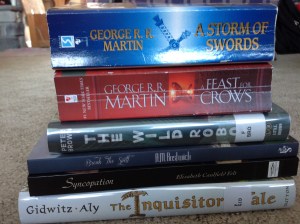
The Game of Thrones, whole series (well as much as has been published….) by George R. R. Martin
This past summer, I joined the world-wide, Game of Thrones-obsessed fan club. If I look back on my year of reading, this is the gravitational pull. My life after reading these books is different. I think about the characters and the events constantly. If you’ve watched and loved the television series, you should read the books. The first season and the first book are almost identical, but by season three, the stories have diverged. The books are better. By far. Like everyone else, I’m waiting for that next book.
Chalice by Robin McKinley (YA)
In this subtle and beautiful world, human communities are linked to the land, and both are kept whole and happy by a Master and a Chalice. One community is almost destroyed when its selfish Master and weak Chalice fail to perform their duties. The new Chalice must learn her job quickly, with little training, and is aided by a new Master who is barely human. The prose and plot are as beautiful and breath-taking as the world. Lovely, lovely story.
The entwined stories of an orphan German boy and a blind French girl trying to survive during World War II. Beautiful. Brilliant. Smart. What I like most about this book is how it is more than one thing. If you take the story at face value, it is a good story. Suspenseful. Engaging. Characters you care about. But if you study the story, you see that everything is more than what you first see. I read this twice last year and may read it again. Highly recommended.
Break the Spell by A.M. Bostwick (YA)
Allison has a terrible secret about her health that she hasn’t shared with anyone. Ethan is on the run from the police. The weekend after the last day of school, Ethan holds Allison hostage to keep her quiet about his whereabouts and both get more than they planned for. This is a delightful teen romance that handles real problems with grace. Read it!
Mathilda Savitch by Victor Lodato
I had no idea what to expect when I started this book, which was left in my little free library. The voice and character of Mathilda are well written. She is a twelve-ish year old, grieving girl, dealing with the death of her sister and the disintegration of the family she once had. She is, in turns, nasty, sweet, cynical, innocent, comical and tragic. At first I wasn’t sure I liked her, but she grew on me. The way the author handles the idea of “story” is remarkable. This may not be a book for everyone. I think writers will enjoy it, as well as readers who like smart books that make you think. I loved it
Sprig Muslin by Georgette Heyer
I read all of Georgette Heyer’s Regency romance novels a few years ago in a whirlwind of giddiness. This was my favorite, but I couldn’t remember its name! I came upon it again this year. I love Heyer’s clever plot tangles and funny characters. This is one of the best. Light and enjoyable.
Raymie Nightingale by Kate DiCamillo (MG)
This is the story of three girls who become friends while taking baton twirling lessons one summer. Each has a difficult family life. The book was medium-good until the end, when all elements of the story converged in such a surprising and satisfying way, that it became one of my favorite books of the year. Another great book by DiCamillo.
Fangirl by Rainbow Rowell (YA)
Cath is starting her freshman year of college, but her twin sister Wren wants them to strike out on their own. Cath is afraid of her roommate, the dorm cafeteria, and for her father, who isn’t coping well with being without his girls. Cath’s place of refuge is her fan fiction world, where she is a highly-acclaimed writer. I read this at exactly the right time: when I, too, wanted to hide from the world. Rowell’s story was a great place to hide. Cath’s character is wonderfully drawn. The story is well paced, with romance, family drama, fun fanfic, and more. I wonder, is anyone writing fangirl fanfiction? Something to look into….
Pax by Sara Pennypacker (MG)
This is the story of a fox and his boy. It is a story of war and forgiveness. It is about survival in the wilderness and about self-sacrifice. It is about creating art. It is so beautiful, on so many levels. It is has a great shot at this year’s Newbery Award.
The Wild Robot by Peter Brown (MG)
This book hit all the right “cute” buttons in me. A solar-powered robot, programmed to take care of itself and learn from its environment, gets washed up on an island inhabited only by animals. The way the robot makes friends and improves the lives of those he meets is a well-hidden message for everyone. The illustrations are precious.
The Inquisitor’s Tale: Or, the Three Magical Children and their Holy Dog by Adam Gidwitz (MG)
What I love most about this book is that it is like The Canterbury Tales for children. A group gathers in an inn in the middle ages to wait for the king who they believe will soon pass by. The king is about to arrest and condemn to death three children and a dog. The visitors to the inn take turns narrating the story, telling what they know about each child, the “holy dog” and the miracles they have performed. Gidwitz understands his middle-grade audience. The story is exciting, funny, and brings to life, for children, the middle ages.
Syncopation: a Memoir of Adele Hugo by Elizabeth Caulfield Felt
Is it tacky to put my own book here? I love it like a mother loves her child. If you haven’t read it yet, I’ll hope you consider doing so. Information about buying Syncopation (print and e-book) is over here.
Welcome to 2017. I wish you a happy year of reading and #resistance. As tempting as it is, we can’t hide in books all the time.
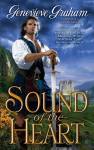
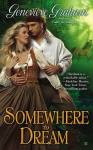
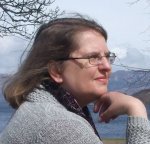
Today I’m welcoming historical novelist Genevieve Graham. Her first international best seller Under the Same Sky, and its two companion novels, were set in Scotland and the colonies, but she has since found her niche in writing Canadian historical fiction.
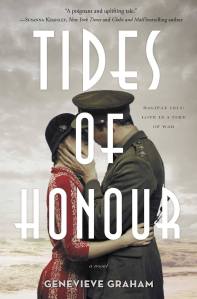
Elizabeth: Welcome, Genevieve. Can you tell us more about your most recent novel, Tides of Honour ?
Genevieve: Thanks, Elizabeth! I’m very happy to be with you here today, and I would love to tell you about Tides of Honour. Who doesn’t love to talk about their baby?
The story is about Danny Baker, an Eastern Shore fisherman here in Nova Scotia. Like so many other boys, Danny heads overseas in 1914 with no idea of the nightmare he’s about to experience. Life in the trenches steals men’s humanity, suffocates hope beneath blood and mud – except just when the horrors of war are becoming too much for Danny, along comes Audrey. The last thing he had ever expected was to meet the love of his life in France. They fall in love via dirt-smudged, water-stained letters, and Danny asks Audrey to marry him, to become his wife in Canada. Even after he is gravely wounded she is determined to be with him, and she begins her own voyage – meeting suffragettes and working as a munitionette – on her way to Halifax, Nova Scotia.
Elizabeth: That sounds like a fascinating journey for both of them. I imagine for many love was the only way to survive the nightmare of war.
Genevieve: Very true. But often people change along the way, and as soon as Audrey arrives in Canada it becomes apparent that Danny’s a different man from the one she met in France. The war has taken so much more than his leg. He is tortured by memories and by the fact that his disability now renders him unable to do things he’s always done. Misery consumes him, makes him volatile and unpredictable, and he turns to the bottle for escape. With no other option, Audrey leaves him, and he is devastated.
The next morning two ships collide in the Halifax Harbour, and the explosion destroys most of the city. Almost two thousand people are killed and thousands more are maimed and/or blinded. Danny is jerked back to reality and joins the reconstruction efforts, but he cannot find the answer to the only question that matters: where is Audrey?
Elizabeth: And we’ll have to read the book to find the answer! Readers should also check out the beautiful book trailer for Tides of Honour. How much historical fact is woven into the story?
Genevieve: A lot. My goal is to breathe life back into real historical moments, and in order to do that I basically write the history and weave fictional characters/stories through the reality. History creates stories and shapes people, so my characters have to grow from within the facts, not the other way around.
Elizabeth: What does your writing process look like?
Genevieve: The spark is lit when I am intrigued by an event in Canadian history. The flame rises as I recognize that one specific moment does not stand on its own. It is surrounded, often caused, by others, and all of those things play a part in the creation of my story and characters. I am not a historian, so when I research I am teaching myself something for the first time, and I approach my writing from that perspective: my characters learn as I do. When I wrote Tides of Honour, I started by learning the basics of the Halifax Explosion, watching WW1 movies, and looking through websites on basic history, trends, fashions of the time. I need to feel as if I’m there. The creative process starts when I’m struck by an imagined scene, and that’s when I finally write. I often can’t get farther than a few pages before I have to stop to investigate something, and often that leads me down the rabbit hole and I eventually have to – reluctantly – rein myself back in. Through the course of writing a book, I always write tens of thousands of words about things that will never make it into the eventual book, but every word is vital to what I’m learning.
Elizabeth: I see you were also an editor for a number of books.
Genevieve: Yes, I ran my own editing business for about three years. Over that time I edited more than seventy books of all different genres. Editing had its pros and cons. On the positive side, it paid the bills, and it opened me up to all different styles of writing. Working with other writers was a challenge I usually enjoyed, and the end result could be truly rewarding. I enjoyed helping a writer transform an okay book to a good book, or a good book into an excellent one. I also loved to help writers learn and hone their craft. Unfortunately, I found it impossible to work on my own writing while I was editing for other people. Their styles and “voices” found their way into my work, and I inevitably had to rewrite my stories. In the end I had to take the plunge and leave editing behind so I could focus on my own books.
Elizabeth: What are you working on now?
Genevieve: Simon & Schuster Canada will be releasing my next novel, Promises to Keep, in April 2017. Again it is set in Nova Scotia, but back in 1755 the area wasn’t called that. The people called it Acadia. It tells the story of young Amelie Belliveau, one of the more than ten thousand Acadians who were ripped from their homes by the British, packed onto leaking ships, and sent nowhere in particular. Many people will know about the Acadians who became “Cajuns” in Louisiana, but my characters had a different fate in store. The romantic complication in this story stems from the fact that one of the British soldiers is a Scot who had survived Culloden. He bears no love for the British, but he is a good, honest man. If he is to save Amelie, he must commit the sin of treason.
Elizabeth: I can’t wait to read it! Can you tell us more about yourself?
Genevieve: I’m a classical musician by training, but I have dabbled in lots of different things through my life, from advertising to fundraising for the Humane Society to teaching piano and editing. I never planned to be a writer, and I feel incredibly lucky that I am able to do what I do. I began writing after I’d finished reading the Outlander series about seven times because I wanted to see if I could actually do it. About five years after I typed my first exploratory pages, Penguin US published my internationally bestselling 18th century Scottish “MacDonnell trilogy”: Under the Same Sky,Sound of the Heart, and Somewhere to Dream.
My husband and I will soon become empty-nesters, which is a difficult concept to face! Both our amazing daughters will be attending Dalhousie University in the fall (our eldest is already there), and we’re excited for them. They are both brilliant and ready to explore the world, and we can’t wait to see what directions they choose. My husband and I are comforting ourselves with the concept of travel … so many places to see! For now we’re just happy to bundle up with a good book in front of the fireplace along with our little white dog, Murphy. When the snow melts a little we’ll see more of our friendly flock of heritage chickens as they scratch and peck past my office window.
We’ve now reached the time in our interview for the let’s-get-to-know-the-author-better, nearly-pointless, sort-of-silly, rapid-fire questions:
Elizabeth: Coffee or tea?
Genevieve: Tea … or Coffee with Baileys.
Elizabeth: Ocean or mountain?
Genevieve: Mountain. I live by the ocean now, but I miss the Rockies.
Elizabeth: Hiking or shopping?
Genevieve: Shopping. But mostly reading.
Elizabeth: Violin or piano?
Genevieve: Oboe! Ha! Actually, I play piano and my daughter plays violin. As long as it’s classical, I’m happy.
Elizabeth: Mystery or fantasy?
Genevieve: Either … if it’s believable.
Elizabeth: Darcy or Heathcliff?
Genevieve: Darcy
Elizabeth: Love scene or death scene?
Genevieve: Love, of course, though it can be heartrendingly beautiful to pen a poignant death scene.
There are book trailers for each of Genevieve’s books. I just love book trailers!
For more about Genevieve and her books, visit the sites below.
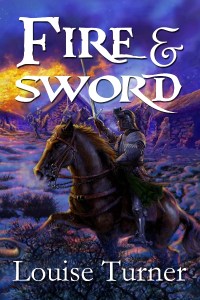
Today I welcome Louise Turner to my series of author interviews. Louise is both a historical novelist and an archeologist. Her novel, Fire and Sword, is set in fifteen century Scotland.
Elizabeth: Welcome, Louise. Can you tell us more about Fire and Sword?
Louise: It’s based on real historical events that occurred in the west of Scotland in the late 15th century, during the early reign of King James IV. James arguably went on to become Scotland’s greatest Renaissance king, but his reign began in typical early Stewart fashion with a bit of skulduggery. His father, King James III, was very unpopular because he made a mess of the economy and surrounded himself with ‘evil counsellors.’ Things came to a head in the spring of 1488 and by June of that year, there was an armed rebellion that ended in a battle which saw James III murdered and his son made king in his place.
It’s the very turbulent events which unfolded during the aftermath that form the focus of both Fire and Sword, and its follow-up, The Gryphon at Bay, which will be published next spring by Hadley Rille Books. The story of Fire and Sword revolves around the trials and tribulations of John Sempill of Ellestoun, who fights for James III and finds himself having to rebuild his fortunes following the regime change. Historically speaking, he’s quite an obscure local figure who merits just a brief mention in the wider story of Scotland’s past, which meant there really wasn’t much to go on when I started to explore his life story.
Elizabeth: So what inspired you to write about John Sempill in particular?
Louise: I’ve lived in west Renfrewshire all my life: the landscape, the history and the archaeology is very familiar to me, and it’s an area which I think should be more widely appreciated. When I first explored the idea of writing a historical novel, it seemed obvious to look close to home for inspiration, and since the Sempills were one of our prominent local families they seemed an obvious place to start my research.
It was while reading one well-known local history source (The Parish of Lochwinnoch by Elizabeth Anderson), I discovered an intriguing paragraph which related how, only a few years after John Sempill’s father died during the battle fighting for James III, Sempill himself enjoyed an astounding change in fortunes and was made a Lord of Parliament. I wanted to find out more about the circumstances behind his dramatic change in circumstances.
I soon discovered an intriguing link between John Sempill of Ellestoun and one of the more notorious local characters at the time, Hugh, 2nd Lord Montgomerie, who was one of James IV’s most loyal followers and who was appointed to the Privy Council in the early years of the new reign. The events which unfolded clearly demonstrated that Renfrewshire and Ayrshire, normally thought of as cultural and political backwaters well away from the intrigues and powerplay of Edinburgh, were the scene of pivotal events which helping secure James IV upon his throne.
Castle Semple Collegiate Church
Right from the start, I found Sempill a fascinating figure. He was definitely ahead of his time: in a world where disputes were settled at the point of the sword and where feuding was the widely accepted method of finding justice, he seemed determined to keep the peace and put his faith in the legal system. He was a builder: he left a secure legacy for his descendants and he was fond of the finer things in life, too. He was a patron of the arts, and he seems to have been a pious man: he founded a Collegiate church and ‘sang school’ (i.e. a school for choristers). Perhaps this was his most enduring legacy: its ruins still survive and can be visited by the general public.
It was only at a comparatively late stage that I discovered I’m not the first writer to have found my curiosity piqued by the Semple family! In a literary sense, John Sempill’s family punches well above its weight, with the Sempills/Semples having achieved notoriety in literary circles for their place in the work of the celebrated historical fiction author Dorothy Dunnett.
Elizabeth: How much historical fact is woven into your story?
Louise: I’d say it’s about 20% fact, 40% educated conjecture and 40% fiction. The framework, everything which underpins the story, is fact, and I populate the narrative was as many recreated historical characters as possible. It’s the interaction of these various individuals which drives the narrative, and recreates history. Or at least, that’s the theory…
Elizabeth: What does your research process look like?
Louise: Very long, and tortuous! I approach historical novel writing in a multi-layered way, because my final aim is not to tell a story, but to experience a story. My first task is to read up on the literature, and listen to the music, so I can get an impression of the way they might have been thinking through the metaphors that dominated their thinking and language. For my late medieval gentry and nobility, this includes both Biblical and religious analogies, some Classical thinking as well as chivalric ideals (we’re in the era which saw the increasing popularity of King Arthur and his nights of the round table) and more mundane practical things like hunting. And of course I’m writing a story set in medieval Scotland, so I have to balance the fact that the characters communicate in Middle Scots (think Rab C Nisbet meets Geoffrey Chaucer) with the needs of the reader.
Then there are the physical and material aspects of their lives, which I explore from the top down, so to speak. What was the physical environment like at the time, including settlement distribution, natural environment, agriculture and architecture? And what was the material culture like? This covers a vast range of topics, from textiles to horse harness to weaponry to the tableware that graced their boards each night. In that respect, a lot of my research was archaeological, as opposed to historical. I’ve worked on a few medieval urban excavations in the west of Scotland myself, so that provided a good starting point, and I’d also made a few useful contacts in my profession who were more than willing to help point me in the right direction.
Building the actual story was also quite a challenge. In this case, I wanted to establish what was happening on the national scale, and to figure out how the information derived from local historical sources fitted into this wider picture. The local sources were all rather blinkered, going along the lines of ‘they were all a shocking bunch of angry lawless men who kept on fighting and feuding with each other.’ The overall impression I got was that the west of Scotland was like a late medieval version of America’s Wild West! But when I juxtaposed these local feuds against the wider political landscape I discovered that most of the unrest unfolding here in Renfrewshire had their roots in grievances that stemmed from decisions made much further afield in Edinburgh. That’s when things began to get interesting!
As this narrative started to take shape, I was creating a network of characters, based on real individuals who often little more than references in the historical record. To make these characters authentic, I mapped their life-paths – what age were they when the action took place, who were their parents, who did their children marry, how many children did they have both inside and outside wedlock, and what distinguishing actions did they performed in their life, whether it was being charged and acquitted of murder, or serving on the Privy Council or building a church or whatever- and at that point I could start to see how they interacted with one another in the ‘real’ historical world. The final test was when I was able to set them loose in the scenario history had created for them and see how they reacted in these circumstances. Thankfully, things mirrored the (known) historical reality rather well!
Elizabeth: What is your writing process?
Louise: The first draft usually slips out very easily, but at this stage, everything’s quite skeletal. I often hear the conversations before I see the actions and the reactions of those doing the talking. Then once I start to ‘see’ what people are doing, I’ll pan out and take in more of the surroundings, ‘re-writing for atmosphere,’ so to speak.
I usually spend a lot of time editing, to get things just right. Then the final stage is like trimming a bonsai. I clip, clip, clip away at all the excess growth (usually going through the manuscript three or four times), until I have a tight paced narrative which springs along at a sprightly trot (though I don’t believe in pushing it on into a gallop).
I’m a firm believer in sending the finished manuscript on to my publisher when I genuinely think I cannot do anything more to improve it. This does not mean it doesn’t need any editing – of course it does, because every piece of writing benefits from being scanned by a fresh pair of eyes – but it certainly eases everyone’s workload!
Elizabeth: Tell us about your short story, “The Lay of the Lost Ministrel.”
Louise: Originally intended as a short introduction to Fire and Sword, it proved really interesting to write. I wanted to explore the events in the novel from a totally different viewpoint character, but one who was, nonetheless, integral to the action.
William Haislet was an excellent choice because he’s always there or thereabouts, providing John Sempill of Ellestoun with a rather stoical supporting presence whatever the circumstances. At the same time, he keeps his own counsel and I always found him quite reserved and unassuming. Actually getting into his head was quite an adventure: I’d always known that he was English, and that he’d originally lived an itinerant life before marrying a local girl and settling down to life at Ellestoun. He also gets on extremely well with the novel’s irascible anti-hero, Hugh Montgomerie, and the exact nature of this relationship was something I was able to pursue further. The odd thing is: I always tend to write short stories in a completely different way, and The Lay of the Lost Minstrel was no exception. It was much more literary in tone (the need to drive the narrative onwards was less of an issue, so I indulged myself a little…) and it was written in the present tense so I was quite literally seeing the world through William’s eyes and ears.
Although William’s a fictional character, even he has his origins in historical fact. John Sempill kept a talented harpist named John Haislet amongst his retinue, who played to James IV on the king’s visit to Ellestoun in the early 1500s. He was also one of 574 named individuals ‘put to the horn’ with William 2nd Lord Sempill (John’s son) in the 1520s, following riots in Edinburgh which resulted in the death of a Dutchman. William’s the fictional father of John Haislet, who himself appears briefly in my second novel and who will I suspect become more prominent in the future!
Elizabeth: What are you working on at the moment?
Louise: The follow-up to Fire and Sword (The Gryphon at Bay, mentioned earlier) will be published next spring, and in the meantime I’ve taken a short sabbatical from historical fiction to write a historical fantasy called A Black Ship Into Hades. It’s a time travel novel where a young man from Ancient Sparta finds himself brought to modern (i.e 21st century) Wiltshire. So many time travel novels feature young heroines from the modern world traveling back to a Past which is in so many ways simpler and more appealing than the Present. I wanted to turn this trope on its head to some extent: Lysander, the hero of my novel, knows he’s better off in the modern world (for all its faults) and there’s no way he’s going back. He is, in essence, seeking political asylum from the Past.
I’m having great fun writing it because, once again, it requires an awful lot of research because I want my Spartans to be as authentic as possible. Which means that they come across as slightly strange, and slightly alien, while at the same time remaining recognizably human. And I get to pay homage to all sorts of archaeological sites and schools of thoughts and even artifacts. It is becoming, I suppose, my archaeological novel…
Elizabeth: What have you read recently that you feel passionate about?
Louise: I spent the last couple of years grappling with Dorothy Dunnett’s House of Niccolo series, and finally I’m hooked on Dunnett. I can’t say it was love at first sight: I’d read Niccolo Rising twice and was halfway through Spring of the Ram before Dunnett’s writing finally clicked, but now I’m finally a convert. I don’t always agree with how she portrays the Scotland of James III and I’m irritated at the suggestion that the root of Scotland’s woes at the time was a brilliant and mischievous Flemish merchant, but the way she uses history to weave a story is magnificent and her breadth of knowledge in terms of what’s happening on the world-wide stage at the time is staggering. Next year, I plan to batter into the Lymond Chronicles, which will be another epic reading task….
Elizabeth: Can you tell us more about yourself?
Louise: I’m an archaeologist by training: I work for a medium-sized commercial archaeology company in the west of Scotland. This is really quite beneficial for my writing, and a bit strange at times because sometimes these two facets of my life overlap. I’ve worked as an archaeologist in locations which feature in my books, and I often write about places and people I’ve stumbled across at work.
Though medieval archaeology was something I discovered rather late – I specialized in prehistory and the study of Bronze Age metalwork hoards for my Ph.D. research. I now spend much of my working life working with finds, in particular medieval and modern ceramics, and I also do a lot of historic building recording and industrial archaeology, too. Castles are a regular destination these days, and what’s more of a bonus is that quite often I find myself working with conservation architects and incredibly talented stonemasons. It’s always very rewarding to be taking part in a historic building’s long-term survival and preservation.
And when I’m not working or writing, I enjoy gardening, horse-riding and hill-walking, so I’m never bored, or at a loss for something to do.
We’ve now reached the time in our interview for the let’s-get-to-know-the-author-better, nearly-pointless, sort-of-silly, rapid-fire questions:
Elizabeth: Coffee or tea?
Louise: Coffee, please. Almost every time. Except perhaps when it’s a hot and sunny afternoon, in summer…
Elizabeth: Ocean or mountain?
Louise: Ooh, mountain. Definitely mountain. I love the Lake District, and the Scottish Highlands, and the Welsh mountains too. A trip to the Lakes and a bit of fell-walking does wonders to invigorate me! Scottish mountains, however, I prefer to admire from afar. I went walking in Glencoe a few years back and realised, during an ascent of the unforgiving Bidean Nam Bien, that I’d finally met my hill-walking nemesis. I didn’t quite reach the summit, but at least I got down safely, without the aid of a helicopter…
Elizabeth: Hiking or shopping?
Louise: See above – I love my hill-walking, I think there’s nothing quite like venturing up on to the fell tops in the Lake District and getting a completely new perspective on the world. I don’t suppose I collect summits, but I do collect views! Every fell top is slightly different, and I’ve walked up so many fells now that they all seem like old friends. And they have wonderful names. Like Helvellyn, and Blencathra, and Ullscarf, and Thunacar Knott. And Barf. Let’s not forget Barf…
I’m not entirely impervious to shopping, though. I do like garden centres. And I love bookstores, too…
Elizabeth: Violin or piano?
Louise: Can I play Devil’s Advocate here and say ‘French Horn?’ I was very musical in my youth. I played piano, violin, viola and French Horn with varying degrees of competence and seriousness. The French Horn was always my favourite, by a long chalk, and at one point in my life I was planning to become a professional orchestral musician. Before I discovered archaeology. Though if I really must choose between the two, I do have a soft spot for the piano, too.
Elizabeth: Mystery or fantasy?
Louise: Most definitely fantasy. I’m a Tolkein fan, and I was brought up with Susan Cooper’s The Dark is Rising series.
Elizabeth: Darcy or Heathcliff?
Louise: Heathcliff. He wins hands down. All that smouldering! But here’s the caveat – I’d rather he stayed safely confined within the pages of a book. I mean, having to put up with such a high maintenance Significant Other in real life would be just impossible, wouldn’t it?
Elizabeth: Love scene or death scene?
Louise: Hard to say, really. I’m inclined to say ‘death scene,’ because that’s where you strip your characters right back and make them confront their own mortality. It’s not really the character who’s just kicked the bucket who faces all these problems – it’s those left behind. They have to renegotiate their place in the world, and sometimes the seismic shift that ensues (particularly on the political level, when you’re dealing with members of the nobility or whatever in the late middle ages) can have profound consequences which must be dealt with along with the more ‘mundane’ aspects like grieving and loss. Gosh, I’m talking like a theoretical archaeologist now, aren’t I?
Elizabeth: Louise, thanks for visiting my blog today.
Louise: Thank you very much for having me! It’s been a pleasure.
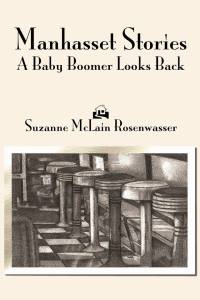
Today I welcome author Suzanne McLain Rosenwasser to my blog. She is the author of the essay collections Manhasset Stories: A Baby Boomer Looks Back and Manhasset Stories: More Baby Boomer Memories. Suzanne’s most recent publication is the historical novel Don’t Ya Know, which takes place on the fictional Corycian Island, off the coast of Long Island, at the start of the 20th Century.
Elizabeth: Welcome, Suzanne. Tell us more about Don’t Ya Know.
Suzanne:Hello, Elizabeth. Thank you for inviting me to talk about my work, in particular, Don’t Ya Know, a labor of love for my Long Island roots. Until the 1890s, Long Island’s shoreline was dotted with malodorous, fish oil factories. Terms like “The Gold Coast” and “The Hamptons” were not part of the vernacular. Change came rapidly, however, once real estate developers saw the value of beachfront luxury. By the 1900s, the ferries of the Long Island Sound transported tourists instead of fertilizer to and from the barrier islands.
Corycian (Core’seen) Island represents a microcosm of Long Island’s physical and cultural transformation through the stories of her indigenous people, the locals who meet the challenges of change head-on, though often haphazardly. The worst among them sow silent seeds of hate; while the best cling to the ancient concept of living “all-a-wanna”- or all together – and sow seeds of spirit and hope.
Elizabeth: What drew you to this time and place?
Suzanne: I grew up on Long Island in the 50s and 60s, lived on Manhattan island in the 70s, and moved to a small barrier island off Long Island’s east end, Shelter Island, in the 1980s. The similarities of those, vastly different, island environments intrigued me, and continued to do so as I visited more islands along the eastern shoreline in later years.I also wrote for a 100-year-old local newspaper in the 80s, The Shelter Island Reporter. The feature stories I researched opened up a whole world for me. I was introduced to splintered Algonquin tribes, Dutch sugar merchants, Barbadian slaves, runaway New England Quakers, and legacy baymen. This unlikely group formed an agricultural society that led to a thriving economy driven by fertilizer factories and canning plants along hundreds of miles of shoreline. This was the world of Long Island until its beaches became a mecca for real estate developers and millionaires in the1890s. I wondered how the locals dealt with that enormous transformation, along with the turbulence of the times.
Elizabeth: How much historical fact is woven into your story?
Suzanne: The story takes place from 1900-1928 when great change occurred worldwide. Corycian Islanders endured the effects of women’s suffrage, spiritualism, WWI, the flu epidemic, and Prohibition. Fortunately, there are many books specific to Long Island on these topics, including guides for Algonquin words and stories of Barbadian slaves on Long Island, as well as photographs of the factories, the Victorian cottages, the baymen, the ferries and the hotels of the era. I visited many island cemeteries from Shelter Island, New York to St. Simon’s, Georgia. Sadly, one of those had been desecrated, and the impact of that senselessness worked its way onto Corycian Island.
Elizabeth: Tell me about your protagonist, Nuna Shellfoot.
Suzanne: Nuna is of Native American and Barbadian ancestry. Nuna expresses the theme of the novel in her rhythmic dialect: “Great spirit be a mother. She feed us, we feeds dem. Round and round. That’s de way. You helps dem, so you helps alla us; all-a-wanna or all together, don’t ya know.” Nuna’s words are few, but her wisdom is great.
Elizabeth: Tell us about your essay collections, Manhasset Stories.
Suzanne: Manhasset and so many towns like it on Long Island in the mid-20th century were new hamlets, largely made up of first and second generation Americans moving from the boroughs of New York. Growing up as Baby Boomers in this era allowed a “new” post-WWII perspective. The suburbs were a new concept. It was a new middle class. The families were young and new. The highways to Long Island were new. The shopping centers and area parks were new. We lived in the epicenter of changing times. We shared a golden era, and I chose to dwell on the times we enjoy remembering. The small book was intended as a gift-sized volume. It proved so popular, I followed it up with Volume II – More Baby Boomer Memories.
Elizabeth: What led you to write these essays?
Suzanne: The New York Times had published two essays I submitted about my hometown and beach life as a Long Island Baby Boomer. The great feedback I received led me to the idea of a gift book
Elizabeth: What are the biggest differences between writing nonfiction and fiction?
Suzanne: When I write non-fiction, mostly memoir, I know how it’s going to turn out ahead of time. In fiction, the story unfolds before me as it takes on life.
Elizabeth: What does your writing day look like?
Suzanne: Having newspaper deadlines in the 1980s for everything from zoning board meetings to historical features introduced discipline to my writing days. I had two small children, so I started writing at 4 a.m. before they woke up for school. I continued to do that for the next 35+ years, either writing myself or reviewing my students’ writing.
Elizabeth: What have you read recently that you feel passionate about?
Suzanne: I listened to the audio book of The Nightingale by Kristin Hannah and found the story to be so well woven with history, character, and place – all further enhanced by the French accents of the reader while I listened. Also, I reread a favorite, The Power of One by Bryce Courtenay, and was once again struck by the lessons we learn about the world in fiction. This is a brilliant book. While reading it I realized a character in Don’t Ya Know, Ezra Goldsmith, may well have derived his wisdom from the influence of “Doc” in Courtenay’s book.
Elizabeth: Can you tell us more about yourself?
Suzanne: I am a retired educator who loved teaching English literature, writing, and drama to high school students. Reaching a teen’s heart is challenging and rewarding. I found the written word to be a great vehicle for that target. Also, I am a life-long writer who began entering short story contests at the age of ten. I received nothing but rejections until the age of 35 when a major publisher offered me an astonishing contract. The book ended up in publishing hell (see Harry Chapin and Me). My job at the newspaper and a website called scribd.com, renewed my writing voice.
Elizabeth: We’ve now reached the time in our interview for the let’s-get-to-know-the-author-better, nearly-pointless, sort-of-silly, rapid-fire questions:
Elizabeth: Coffee or tea?
Suzanne: Coffee – though I’m being told to cut back. Horrors!
Elizabeth: Ocean or mountain?
Suzanne: Ocean. Ocean. Ocean.
Elizabeth: Hiking or shopping?
Suzanne: Hiking
Elizabeth: Violin or piano?
Suzanne: Violin
Elizabeth: Mystery or fantasy?
Suzanne: Mystery
Elizabeth: Darcy or Heathcliff?
Suzanne: Darcy
Elizabeth: Love scene or death scene?
Suzanne: Death scene
To learn more about Suzanne and her writing, visit:
For the month of July, Smashwords is offering huge discounts on many ebooks. Syncopation is available at half price: Syncopation at Smashwords. Be sure to notice the coupon code and enter it at check out to receive the discount.
Today I’m welcoming Annie Whitehead to my series of author interviews. Annie is an author of historical fiction, including To Be a Queen, the story of Aethelflaed, the daughter of Alfred the Great and the only female leader of an Anglo-Saxon kingdom. Her most recent novel is Alvar the Kingmaker, a novel about the tenth century nobleman who helped King Edgar ascend to the English throne.
Elizabeth: Welcome, Annie.
Annie: Thank you, it’s lovely to be here.
Elizabeth: Can you tell us more about To Be a Queen?
Annie: To Be A Queen is the true story of Aethelflaed, daughter of Alfred the Great. She spent her formative years in the Kingdom of Mercia (which roughly equates to the modern day Midlands of England) and was married off to the leader of Mercia as part of a political alliance against the Vikings who had overrun all the other kingdoms barring Mercia and Wessex in the south east. Her role became more than just that of a political pawn when her husband became incapacitated and she found herself ruling Mercia as a queen, in all but name. I was thrilled when the book was long-listed for the HNSIndie book of the Year 2016 and even more delighted when it was recently awarded an IndieBRAG Gold Medallion.
Elizabeth: Congratulations! What drew you to this character?
Annie: Initially, it was her husband. When I was an undergraduate student, my tutor spoke about Ethelred of Mercia and how ‘nobody knew who where he came from.’ I was fascinated by this man who seemingly rode onto the pages of history from nowhere, and I vowed one day to write his story. Of course, once I began researching, I realised that while he was an interesting and admirable person, the real story to be told was that of his wife. I was staggered to discover that no-one else had ever written her story and I needed to put that right.
Elizabeth: Can you tell us more about Alvar the Kingmaker?
Annie: This book is set in Mercia about fifty years later and features the descendants of some of the characters from the first book, although it is a stand-alone story. Aelfhere (Alvar) was a powerful noble who was instrumental in helping successive kings, but who paid a high personal price. Unusually, this was a period where there was no Viking threat, but this left a gap, and it was filled with in-fighting, treachery and murder… He spent a lifetime trying to prevent uprising, and anarchy, and often found the ‘Establishment’ was his greatest enemy.
Elizabeth: What drew you to this character?
Annie: Because he angered the Church, who wrote the histories, Aelfhere got a bad press, and was accused of colluding with the queen, who herself had something of a bad reputation, even being suspected of murdering her own stepson. Studying this period for my degree, I came across a footnote in an academic paper, which mentioned a widow who was deprived of her lands after Aelfhere’s death. It’s thought that she might have been his wife, and I knew I wanted to write their story and explain why it might have been that he had no sons to leave his earldom to. These characters really existed, but I was free to make up their love story.
Elizabeth: How much historical fact is woven into your stories?
Annie: I try not to alter known history, (although an exciting new project has seen me doing just that, for a very specific reason.) Obviously with this period it is rather difficult and sometimes the chronicles are pretty sketchy. But wherever there is a stated date, or fact, I try not to mess with it. Occasionally, for the sake of my narrative, it’s necessary, but I make that clear in my author notes. I want people to be able to feel that what they read could really have happened, so I only fill in the blanks and I try to do it logically and plausibly.
Elizabeth: So tell us about your project that has you altering history.
Elizabeth: What are the challenges when writing about this time period?
Annie: The frustrations are, as mentioned above, the paucity of sources, although we are incredibly lucky to have as much of the surviving record as we do, particularly when the Vikings had a habit of burning down churches where a lot of this material was kept! The other thing is that the landscape has changed so much; coastlines have moved, forests have disappeared/sprung up. There are few buildings from this period, either, as the Anglo-Saxons tended to build in wood which does not survive the centuries in the same way as stone does.
Elizabeth: What fascinates you about this time period?
Annie: The fascination comes from knowing that these people didn’t live in some ‘dark’ place inhabited by dragons and elves, but were real, medieval folk who had sophisticated laws and government and where women had more rights than later on in the Middle Ages. I wanted to tell their stories and bring them out into the spotlight.
Elizabeth: What is your writing process?
Annie: I begin by researching the period, before, during and after the years in which my stories are set. I set up a time-line and then begin weaving my story around that. I always have an idea before I start about the nature of each character, and I try to find reasons for their actions so that they remain ‘in character’ throughout. I then write the story and research any additional detail I might need, such as which foods were available in certain areas in specific season, adding this in later so as not to interrupt the first draft ‘flow’.
Elizabeth: What are you working on now?
Annie: I’m editing the third in my Mercian ‘series’ and simultaneously working on a novel which won a prize in the Mail on Sunday competition. Judge Fay Weldon encouraged me to complete it, so I thought I probably should! It’s not historical, well, not strictly anyway, and it’s set in the Lake District.
Elizabeth: Congratulations again! What have you read recently that you feel passionate about?
Annie: I recently read The Light Between Oceans by ML Stedman. Not only was the premise of the story unusual and interesting, but the historical detail was superb. The sense of time, place and atmosphere was brilliantly drawn. Every so often I would look up after having read a beautiful phrase and think, “I wish I had written that.”
Elizabeth: Can you tell us more about yourself?
Annie: I’m not ‘from’ anywhere, having moved around as a child because my father was in the forces. After graduating I lined up a job in publishing in Manchester, but took a train to the English Lake District one day, and stayed there! I have three children, all grown up, and when they were little I re-trained as an Early Years Music and Singing teacher, something I still do occasionally on a freelance basis, although my writing takes up most of my time these days.
Elizabeth: We’ve now reached the time in our interview for the let’s-get-to-know-the-author-better, nearly-pointless, sort-of-silly, rapid-fire questions:
I am pleased to be able to interview Abigail Bostwick for the second time. Abigail’s first middle grade novel, The Great Cat Nap, was published by Cornerstone Press in 2013. It is the story of Ace, a reporter and a cat, who solves the mystery of a missing show cat. Abigail, who publishes as A. M. Bostwick, talked about writing that novel in our first interview. The Clawed Monet is the sequel to The Great Cat Nap and was released in February of this year.
Elizabeth: Welcome Abigail! Tell us what new adventure Ace, the mystery-solving cat, is up to now.
Abigail: Thank you so much for hosting me, Elizabeth! In The Clawed Monet, we find Ace on the trail of a new mystery following the scandalous opening of a new art exhibit at the historic Rhys Art Museum. When opening night is lights out after a peculiar power failure and a priceless Monet reproduction is clawed beyond repair, all paws point to the new curator’s prim and proper feline – Miss Kitty. Hired by Miss Kitty, Ace and his feline and canine friends are out to find the criminal and restore the reputation of Miss Kitty and her companion before they are fired. Tailing the shadow of a “ghost cat” through the historic district and a cemetery, Ace finds himself interrogating museum guests, local residents and even a so-called psychic cat to try and solve the crime. He’ll have to fend off a pack of Dobermans and contend with a gang of raccoons– all under deadline.
Elizabeth: Sounds like fun! Do you have plans for more books about Ace?
Abigail: In my mind, Ace is always having one adventure or another! While I certainly have ideas for a third novel, I don’t have anything concrete in the works right now.
Elizabeth: You’ve also published a young-adult novel called Break the Spell. Can you tell us about it?
Abigail: When Allison Evans walks out of high school the last day of her senior year, she has no idea that her carefully guarded life is about to unravel. Her classmate, Ethan Knight is on the run. Accused of dealing drugs and armed with nothing but a bad reputation and his motorcycle, he takes refuge for the weekend inside the old high school. Thinking no one will find him and no one does. At least not at first. Allison tracks him down, hoping to get a newspaper story out of him. Panicked and left with no other choice, Ethan takes her captive. It should be a nightmare, but together, both of their lives take an unexpected turn. It’s time for them both to stop running from their problems, and in each other, they find common ground and someone they can trust.
When I wrote this novel, I think I most wanted to explore the secrets we sometimes keep, and how they can become toxic without someone to talk to. I found it especially hard when I was a young adult to confide in other people, especially about the things that scared me, or the things I could not fix or control.
Allison’s particular struggle with coping to accept the possibility of a debilitating, life-changing neurological disease – multiple sclerosis – was rooted in my own experience. While I couldn’t hide my early diagnosis from those around me the way Allison did, I certainly found myself wanting to do everything I possibly could to make it more bearable. Even if readers don’t have MS, I think they’ll be able to relate to Allison’s driven motivation to change her circumstances.
Elizabeth: It’s wonderful that you’ve shared your experiences and written about MS in a way accessible for young people. Do you approach writing for middle-grade readers (ages 8-13) differently than writing for young adult readers (ages 13-18) ?
Abigail: I do. When I’m writing Ace, I’m mostly having fun with the antics of felines and canines while also trying to entertain young readers (though I was reminded this week I have readers of all ages for this cat!) When I’m writing for young adults, I’m a little more candid and raw. Kids, especially teenagers, can see right through a façade or something that isn’t real. A book should be, most of all, fun. Engaging. Something people can see themselves in. If kids can see ordinary teens in literature rising to the occasion and figuring issues in their lives out, I think it’s easier for them to envision themselves doing it as well. And that’s empowering for them.
With both, I do my best to keep readers engaged with suspense and humor.
Elizabeth: What advice would you like to give to my readers who are also writers?
Abigail:I think many of us write because we have something to say, or something we want to be heard. Don’t write for trends, or the market, or what you think will sell. Write because you love it, because it’s your passion, and part of you. Write for you. Make friends who are writers, they’ll understand you better than anyone. Also, feed the cat before you start writing or he’ll lay across your keyboard.
Elizabeth: What have you read recently that you feel passionate about?
Abigail: I recently read All the Ugly and Wonderful Things by Bryn Greenwood, and I absolutely loved it. She writes with this beautiful clarity, and her characters are so well-drawn and heart-wrenching. In middle grade, I read Flora and Ulysses by Kate DiCamillo and I’m still smiling about the story. The poetry in it was lovely. I also have to say, two of my great writing friends had books release last week that are incredible – Running for Water and Sky by Sandra Kring and Devil and the Bluebird by Jennifer Mason-Black. These are don’t miss books, and make me want to go on a road trip.
Elizabeth: What do you do when you are not writing?
Abigail: I read – haha! I also enjoy spending time with my cat (who looks a lot like Ace), my husband, and my niece, who is turning 9 next week. I garden a little bit, love to paint and enjoy walking in the woods.
Elizabeth: Thanks so much for joining me today.
Abigail: Thank you for hosting me. Always a pleasure.
Elizabeth: If you’d like to learn more about Abigail Bostwick and her books, visit http://ambostwick.com
Writers’ Conferences are a great way to meet others in the industry, talk books, discuss craft, participate in workshops, buy books, sell books and have a good time.
A few weekends ago, I went to the Lakefly Writers Conference in Oshkosh, Wisconsin. It is a well-organized, inexpensive and fun conference. I was able to pitch to two editors, learn about a “Books & Beer” book club, get details on creating a “30-Day Promotional Plan” and meet and re-meet some wonderful authors.
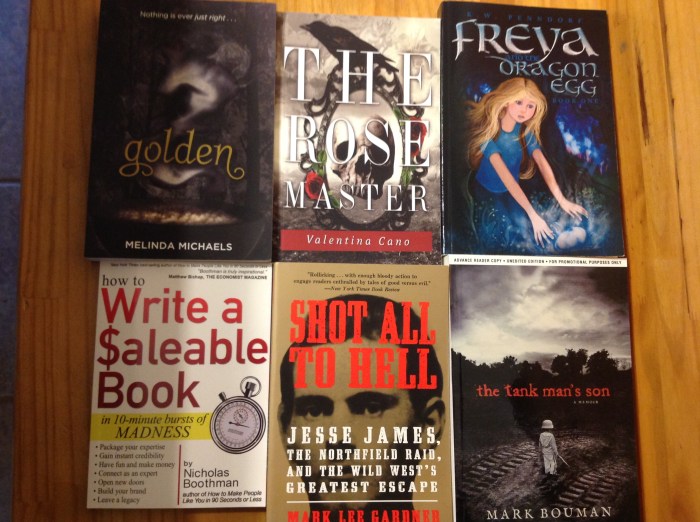
Of course, I can’t go to a writers’ conference and not buy books! Here are the books that came home with me: K.W. Penndorf’s Freya and the Dragon Egg (middle grade time-slip fantasy!), REUTS press novels: Melinda Michaels’s Golden (a loose re-telling of Sleeping Beauty) and Valentina Cano’s The Rose Master (a re-working of Beauty and the Beast and Jane Eyre!) I’m so excited to read these books!
The three other books in the picture came to me via a door prize gift basket that included a bottle of wine, chocolate pretzels, and a deck of cards. Lucky me!

 Today I’m welcoming Richard Anderton to my series of author interviews. Richard is the author of The Devil’s Band and The Devil’s Lance, which are the first two books of The Devilstone Chronicles. The third installment, The Devil’s Pearl, is due out later this year.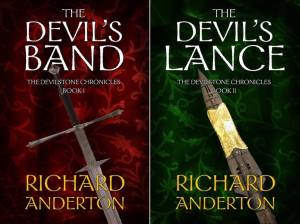
 Today I’m welcoming historical novelist Genevieve Graham. Her first international best seller
  The story is about Danny Baker, an Eastern Shore fisherman here in Nova Scotia. Like so many other boys, Danny heads overseas in 1914 with no idea of the nightmare he’s about to experience. Life in the trenches steals men’s humanity, suffocates hope beneath blood and mud – except just when the horrors of war are becoming too much for Danny, along comes Audrey. The last thing he had ever expected was to meet the love of his life in France. They fall in love via dirt-smudged, water-stained letters, and Danny asks Audrey to marry him, to become his wife in Canada. Even after he is gravely wounded she is determined to be with him, and she begins her own voyage – meeting suffragettes and working as a munitionette – on her way to Halifax, Nova Scotia.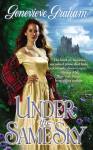
 Louise: It’s based on real historical events that occurred in the west of Scotland in the late 15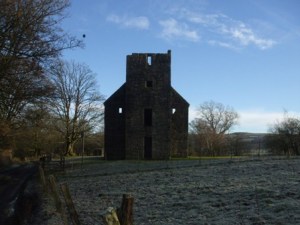
 Today I welcome author Suzanne McLain Rosenwasser to my blog. She is the author of the essay collections Manhasset Stories: A Baby Boomer Looks Back and Manhasset Stories: More Baby Boomer Memories. Suzanne’s most recent publication is the historical novel Don’t Ya Know, which takes place on the fictional Corycian Island, off the coast of Long Island, at the start of the 20th Century.
 Suzanne: Hello, Elizabeth. Thank you for inviting me to talk about my work, in particular, Don’t Ya Know, a labor of love for my Long Island roots. Until the 1890s, Long Island’s shoreline was dotted with malodorous, fish oil factories. Terms like “The Gold Coast” and “The Hamptons” were not part of the vernacular. Change came rapidly, however, once real estate developers saw the value of beachfront luxury. By the 1900s, the ferries of the Long Island Sound transported tourists instead of fertilizer to and from the barrier islands.
  Suzanne: Manhasset and so many towns like it on Long Island in the mid-20th century were new hamlets, largely made up of first and second generation Americans moving from the boroughs of New York. Growing up as Baby Boomers in this era allowed a “new” post-WWII perspective. The suburbs were a new concept. It was a new middle class. The families were young and new. The highways to Long Island were new. The shopping centers and area parks were new. We lived in the epicenter of changing times. We shared a golden era, and I chose to dwell on the times we enjoy remembering. The small book was intended as a gift-sized volume. It proved so popular, I followed it up with Volume II – More Baby Boomer Memories.
 Today I’m welcoming Annie Whitehead to my series of author interviews. Annie is an author of historical fiction, including To Be a Queen, the story of Aethelflaed, the daughter of Alfred the Great and the only female leader of an Anglo-Saxon kingdom. Her most recent novel is Alvar the Kingmaker, a novel about the tenth century nobleman who helped King Edgar ascend to the English throne.
 Annie: To Be A Queen is the true story of Aethelflaed, daughter of Alfred the Great. She spent her formative years in the Kingdom of Mercia (which roughly equates to the modern day Midlands of England) and was married off to the leader of Mercia as part of a political alliance against the Vikings who had overrun all the other kingdoms barring Mercia and Wessex in the south east. Her role became more than just that of a political pawn when her husband became incapacitated and she found herself ruling Mercia as a queen, in all but name. I was thrilled when the book was long-listed for the HNSIndie book of the Year 2016 and even more delighted when it was recently awarded an IndieBRAG Gold Medallion.
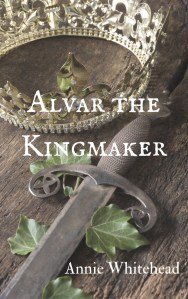 Annie: This book is set in Mercia about fifty years later and features the descendants of some of the characters from the first book, although it is a stand-alone story. Aelfhere (Alvar) was a powerful noble who was instrumental in helping successive kings, but who paid a high personal price. Unusually, this was a period where there was no Viking threat, but this left a gap, and it was filled with in-fighting, treachery and murder… He spent a lifetime trying to prevent uprising, and anarchy, and often found the ‘Establishment’ was his greatest enemy.
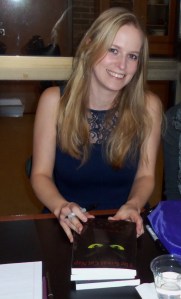 I am pleased to be able to interview Abigail Bostwick for the second time. Abigail’s first middle grade novel, The Great Cat Nap, was published by Cornerstone Press in 2013. It is the story of Ace, a reporter and a cat, who solves the mystery of a missing show cat. Abigail, who publishes as A. M. Bostwick, talked about writing that novel in
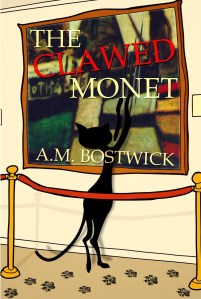 Abigail: Thank you so much for hosting me, Elizabeth! In The Clawed Monet, we find Ace on the trail of a new mystery following the scandalous opening of a new art exhibit at the historic Rhys Art Museum. When opening night is lights out after a peculiar power failure and a priceless Monet reproduction is clawed beyond repair, all paws point to the new curator’s prim and proper feline – Miss Kitty. Hired by Miss Kitty, Ace and his feline and canine friends are out to find the criminal and restore the reputation of Miss Kitty and her companion before they are fired. Tailing the shadow of a “ghost cat” through the historic district and a cemetery, Ace finds himself interrogating museum guests, local residents and even a so-called psychic cat to try and solve the crime. He’ll have to fend off a pack of Dobermans and contend with a gang of raccoons– all under deadline.
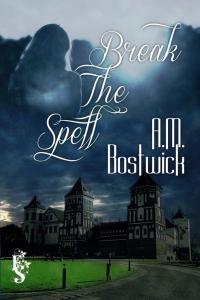 Abigail: