Writer’s Block

I never believed in writer’s block. I always felt that it was the result of a lack of discipline. A writer should sit down and write and eventually he/she will work through it. I’ve come to think that perhaps writer’s blocks is something a little different.

Let me explain to you my boxes metaphor. I think of my mind as a big open space with a few boxes floating around. The big open space is where I live most of my life. When my head is in the here and now (at work, with my family, doing ordinary chores, etc.) I am in the big open space.

There is a box for my reading life. When I sit and open a book, I move into one of the boxes floating in my big open space. I’m in a different world, a fun place to be. I can go in and out of that box whenever I want.

There is a box for my writing life. If I sit down at my computer, I go into that box and stay there until I leave the computer. I can go into that box in a day-dream sort of way at other times in my day as well. I go there to meet with my characters, sort out what’s happening with them, what they think and feel about the plot, tour their landscapes, etc.

Lately, I find I don’t have access to that box. I’ll step inside, start to think about what is happening with the story, but then I’m suddenly outside the box. I’m not thinking about what’s happening with the story. So, I go back in and like a mirror trick I find myself outside the box again. I can’t seem to focus on the story or the characters or anything. I sit down at the computer and type (I’m disciplined), but everything is flat. I’m only writing what I remember from being in the box–I’m not actually in the box.

How has this happened?

There is another box floating around that has its door open, and I can’t seem to get it closed. It is the box where I keep all the unpleasantness of life: world poverty, wars, communities not willing to pay for public education, divisive government, global warming, etc. That box used to work quite well. It had a strong door that I opened when I wanted to be a good citizen, knowledgeable about what was happening in the world and my community. I would go into that box when I listened to or read the news or when I talked politics with friends; however, I could leave and close the door when the news was too painful, so that it would not interfere with my everyday life–my big open space.

Now the door to that box is open. I can’t shut it. I’m plagued by the ignorance and selfishness of mankind. We are a cancer upon the earth. Unable to shut that box, I’ve tried desperately to get inside my writing box so I can be productive, do something “happy” and maybe when I come back out, the pains-of-the-world box will have a working door again. But my writing box won’t let me in.

Which brings me back to discipline. Should I force myself in front of the computer more often? If I write flat, then I write flat. If I just stare at the screen trying to access the box, will I eventually gain admittance?

Comments? Ideas?
April 29

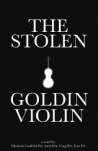
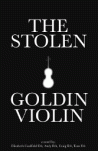
This is the date I just received for the probable pick up date for our 2000 copies of The Stolen Goldin Violin from Worzalla Publishing. A local music store has agreed to sell our book online, and hopefully we will have that page up and running pretty soon. I’ll keep you informed.

Inspiration

About ten years ago I read Girl with a Pearl Earring, a beautifully crafted, brilliant book by Tracy Chevalier. After reading it, I wanted to be a writer again. I was inspired to sit down and write, to mould a story, invent and develop characters. It took me three years, but I finished Charlotte’s Inheritance. It is not yet published, but I now consider myself a writer.

Last week I started reading A.S. Byatt’s The Children’s Book. It is an incredible novel, with a host of amazing characters, and so much information about the turn of the twentieth century. She writes so skillfully, and I learn so much without feeling like I’m being lectured at. While writing Charlotte’s Inheritance, I read other works by Byatt, and I feel like her “instructional” prose influenced that story. However, I do not feel inspired by The Children’s Book. Instead, I feel disheartened, unworthy, incapable of creating anything worthwhile. Her standard is so high, and my ability so low, why do I bother?

Intellectually, I’ve been wondering why those two responses? The Girl with the Pearl Earring remains one of my favorite books. Byatt’s new novel has not set a standard that Chevalier did not reach. Why does one incredible book inspire and another incredible book deflate?

Is it my own mood? The book I’m currenly writing isn’t progressing well. I am having trouble making myself work on it, and it isn’t growing at the rate it should. When I’m reading Byatt, I’m neglecting Olivia. Is that it? Is it something else?

Pi Day, two days late

My son Tom and I have decided to collaborate on another book. We talked about this during breakfast today. It will be another children’s mystery, but this one we will write in Pilish. The most famous sentence written in Pilish, according to the Writer’s Almanac, was written by English physicist Sir James Jeans:

How I need a drink, alcoholic in nature, after the heavy lectures involving quantum mechanics!

Note that “How” has 3 letters, “I” has 1 letter, “need” has 4 letters (3.14… ) which is Pi. So, the entire sentence uses words with the number of letters in the same sequence as the numbers that make up Pi. Because Pi goes on forever, it would be possible to write an entire novel in Pilish. Wouldn’t that be cool? It’s quite a challenge, but Tom and I are up for it. I’m not sure when we’ll find the time to attack this puzzle, but I’ll keep you updated.

Gosh, if we write a book using Pi, will I have to change the subheading of my blog????

Self Publishing

It’s been a while since I’ve blogged, so I’ll update you on what’s happening.

The Stolen Goldin Violin is ready to go to the printer–except that we have not yet gotten copyright permission to use some lyrics from a Beach Boys song in the book. It took me a long time to discover who owned the copyright, but I did, and now we are just waiting. If we get permission for free or for a very small fee, we will add the copyright permission information at the back of the book. If the lawyers want to charge us too much, we’ll just remove the lyrics. Either way, the book should be at the printers by spring break, which was our goal.

The trick with self-publishing is now we have to market. The background work on this is time consuming and not an activity I find fun or intriguing. In my spare time, I want to be writing my new historical novel.

I find myself fighting myself: shall I write? or shall I look up names of people to contact, emails, music conferences, etc. about the children’s book? This battle is interesting because writing is hard and, in the past, I have done little chores and other little work activities, to delay my sitting in front of the computer to write. However researching marketing is hard and boring and so it is pushing me to write more often.

A good thing and a bad thing at the same time.

Writing Longhand

My family went downhill skiing this weekend. The first time I ever skied I was 23 which is much too late. When we went skiing last year, I worried the entire week before we went, I was terrified as I was skiing, and only relaxed when the weekend was over.

This year, I planned to stay in the ski lodge and write while everyone else skied. I brought my laptop and had a chapter already outlined in my head. And then tragedy struck! I had forgotten to bring the cord to plug the laptop into the wall. The battery is fickle and unreliable. I had to write longhand.

If there were no computers, I would not be a writer. For most of my youth and early adulthood, I wrote on paper and never finished anything. I edit a lot, and going back and re-writing and crossing out sections and inserting sections creates more mess than masterpiece. After a while, I would look at my project, unable to understand what was going on, what was meant to be there, where it was supposed to go, and end up throwing out the whole thing.

I did write on paper in the ski lodge. I got that chapter out, although the pages are a total disaster. Later today I will sort through them and type up what I can decipher–editing as I go. Then, I can keep on editing in a clean and organized manner. Aren’t computers wonderful?

On Lengthy Narration

As a reader, I’ve always been focused on story and character. I don’t need to be kept breathless with constant action and excitement because an exceptional, complex character will keep me engaged. However, books that have long passages devoted to setting and other descriptive narrative not directly related to character or story bore me. I discovered a few years ago that as a reader I actually just skim through these sections. I don’t read them with my full attention. I don’t care what kind of dresses people are wearing or what sort of furniture is in the room; I don’t care about the no-name people walking down the street and what they are doing; I want to find out what will happen to the real characters.

When I became a writer I discovered (no surprise) that I had trouble writing good description. Although I don’t like to read it, setting is important and needs to be handled, whether in short concise sentences or long detailed paragraphs. This is especially true in historical fiction because the reader needs to understand and connect with the environment of the story. Having skimmed this kind of narrative for so many years, I now give it my full attention.

And now that I’m doing it, I can’t help but wonder: how much of this does the reading public want? Some writers do it, in my opinion, exceptionally well: Tracy Chevalier, Philippa Gregory, Markus Zusak. Their writing is poetic, descriptive and concise. I don’t even realize I am reading setting, or if I do, it is so well written and fascinating that it works for me. I never feel the need to skim with these authors. Other extremely successful historical novelists put so much into their settings that the setting becomes a character in the novel. I admire their ability to do this, and yet the setting is not a character I care about. Although I love Claire and Jamie and their story, I stopped reading the Outlander series because I was so tired of wading through material I didn’t care about.

I find this true of modern short stories as well. I feel like I’m missing something. Most short stories I have read recently (in the New Yorker or in published collections) leave me thinking: Huh? They seem to have very little story and fairly boring characters. I don’t mean to seem anti-intellectual or uncultured. I’m hoping to have a conversation about this with people who do get it and can explain to me why they love the modern short story or Gabaldon’s lengthy narrative.

So, comment please!