Pride and Prejudice and Zombies

Last week I was at the library and looking for something light to read and remembered hearing about Pride and Prejudice and Zombies.

Many of you know that Pride and Prejudice is one of my favorite books. I’ve read it at least a dozen times and seen all the movie versions. Well, Pride and Prejudice and Zombies follows the original: all the same characters, saying the same things (word for word in many places), following the same plot, but every now and then the regular story pauses to accommodate a zombie attack. The Bennet girls have been trained in weaponry and physical combat, so the zombies pose no serious threat to the main characters.

This book is such fun! You know how when you re-read a favorite book, you know what is going to happen, but you re-read anyway because you enjoy the story and characters so much. Well, in Pride and Prejudice and Zombies, you get to re-read a favorite and know everything that is going to happen, and you still get to be surprised.

I won’t pretend this book is for everyone. First off, I think you need to be a fan of Pride and Prejudice, and you also need to be open to having silly things happen to the characters in that literary classic.

Silly is sadly under-rated.

Waking to a Poem

Within fifteen minutes of waking, a poem had fully formed in my head:

After my grandmother died,
my mother told me of a dream
she had from time to time

In my mother’s dream,
my grandmother was alive
There’d been a mistake
She hadn’t died

It was a great relief, my mother said,
and her dream was filled with joy.
But when she awoke,
it was like losing her mother all over again.

I haven’t had that dream
I long for it

To discover that there was a mistake
that my mother is not dead
To see her again
to enjoy her company and conversation
her gentle and kind ways
her smile

I would gladly pay the price
of the pain of waking up and losing her

To be with her again, if only in a dream.

I believe in revision, and this poem has not been revised. I will revise it, over the next weeks and months and it will become a better poem.

But I had to post it today because today is my mother’s birthday.

Costume Dress

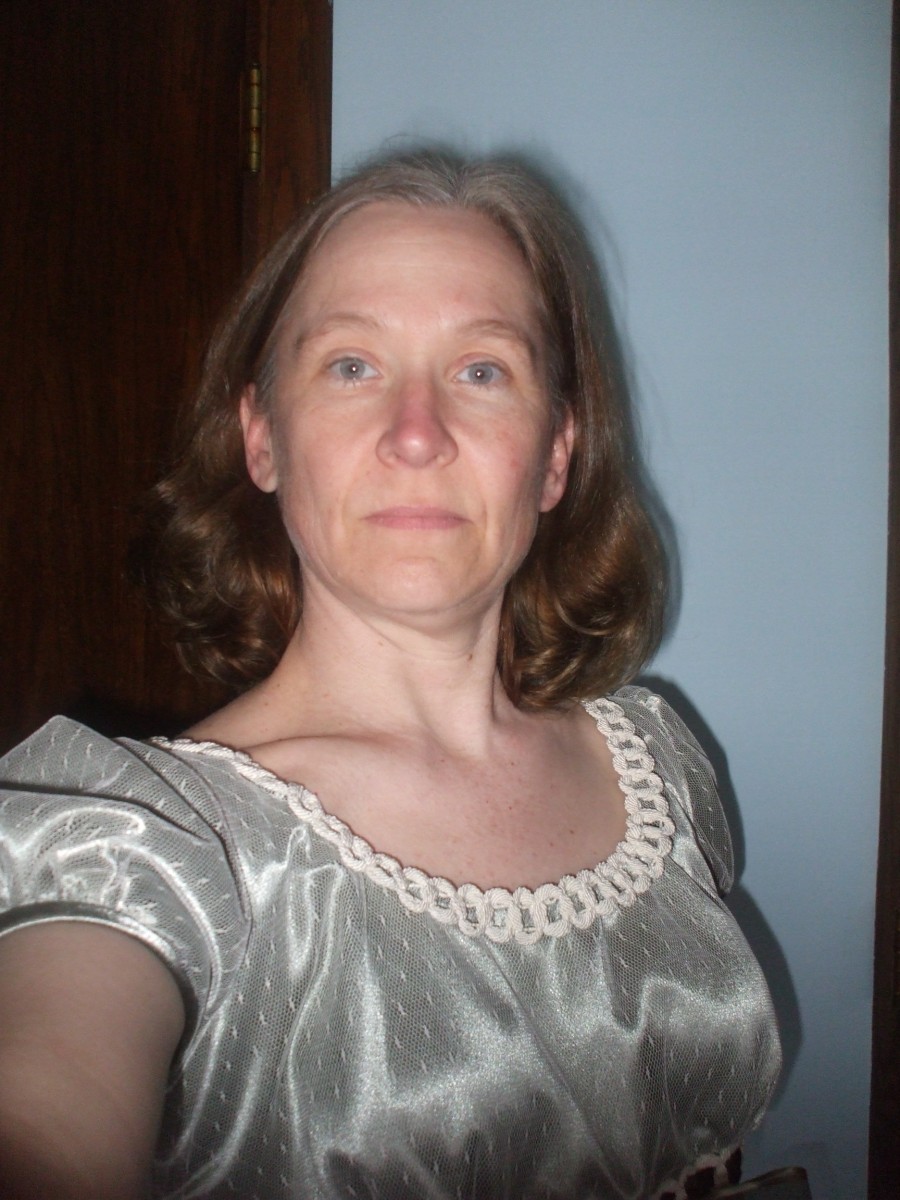
I was trying so hard to get the camera angle right, I forgot to smile.

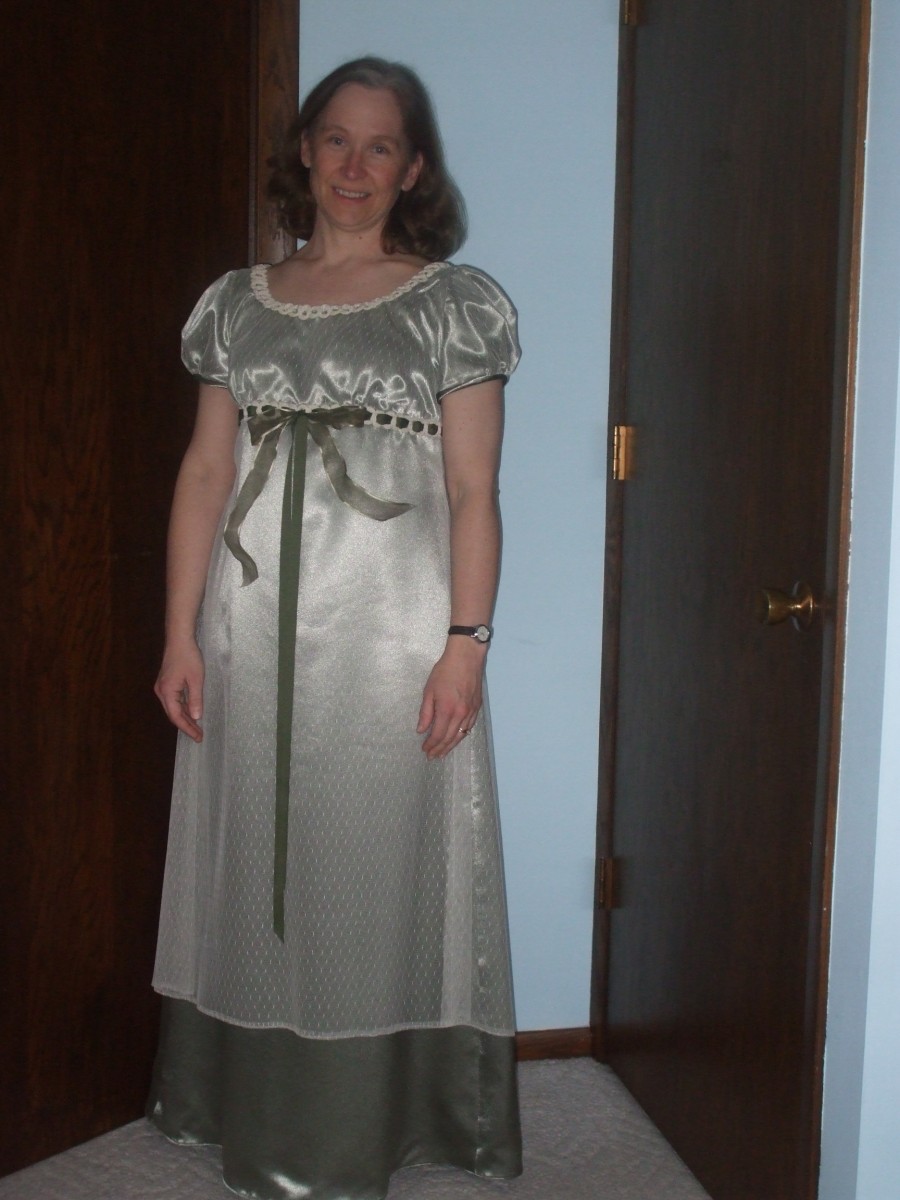
I have wanted a nineteenth century gown for a long time.  How does one go about finding something like that?  I contacted the theater department at the university to find out what they do with costumes after a performance is over (answer:  they keep them).  I did learn that the department’s cutter/draper sometimes does freelance projects.  How could I possibly justify the cost?

Then, out of the blue, a friend who is moving asked me if I would like a regency gown she had had made for a costume party and will probably never wear again !!!!

I answered “yes” very quickly.

I hope to upload some better pictures soon, but for now these will have to do.  This is the full view.  I’m not too happy with how it looks, but that is more the fault of the person in the dress, than the dress itself.  (Note to self: make time to exercise!)

I’m hoping to take this to the Historical Novels Society conference in June (and get some better pictures).

When one of my historicals is finally published, I plan to do book signings in costume.  This could be one of the costumes, but I will probably hire that draper to make a costume that is more era-appropriate depending on which book I’m selling.  Charlotte’s Inheritance and Syncopation are both mid-nineteenth century, while Wilde’s Wager is late nineteenth century.

I guess I’ll just have to write a book to go with my new regency-era, Jane Austen-style gown!

Selling Syncopation

In my novel Syncopation, Adele Hugo writes her memoirs, and as she writes she sometimes argues with her sister.  These pieces of dialog fall outside the main narrative and are indicated by italics.

All of the people who have read only the first few chapters of  Syncopation comment that the dialog between the sisters is confusing and should be dropped.  All of the people who have read the entire manuscript say that the dialog between the sisters is brilliant, the best part of the story.

At one point, I took the suggestion about removing the dialog and revised for many months.  The story fell apart.  I put it back together, but it wasn’t anywhere near as good.  So, I’ve “trashed” that revision and continue to try to pitch the version with the dialog.

You see, as the memoir progress, the dialog develops and merges with the ongoing narrative.  The reason for it becomes apparent.

How can I get people to want to keep reading in order to see how good that part of the story is?  In particular, how can I get agents and editors to keep reading?  I’ve been hesitant to explain all of this in my query letter, but should I?  My query letter is getting responses, but my first few chapters do not.

Any ideas?

Getting It Done

But what is “it” ?

Yesterday I had a long list of things I needed to do.  I was quite busy until about 4:00, when I looked at my list to cross things off and discovered I’d actually only finished one of the jobs.  I had partially completed a few more, but I had yet to begin the majority of things on my list.

How do writers get things done?  If you follow my blog, you’ll notice how rarely I post.  How do other bloggers post so regularly?  How do they have the time?   I read the blogs of other writers and am just shocked at how often they post.  Do they do anything else?  Do they work on their novels?  Do they have families?  Do they exercise? clean their homes? eat?

I suppose with better time management, I could improve, but then I wonder if there isn’t some other problem at work.  As Landon Parke-Laine said,

I’m trying to figure out whether the lack of progress is writer’s block, procrastination, idleness or just plain incompetence. –Jasper Fforde, Thursday Next First Among Sequels

It’s comforting to see other writers struggle with this problem too (even if they are fictional).

Losing and Winning

Thanks to all of you who voted for me in the Pitchapalooza contest.  I was not a winner, but I did get a bite from a literary agent who liked my pitch.  She is reading the manuscript now.

So, even losers can be winners.

Not that I’m calling myself a loser . . . .

’cause I’m not, you know . . .


Dyeing hair the old-fashioned way

This afternoon my friend Sally came over and helped me dye my hair with henna. The henna smelled nice– like cooked spinach. It was the same green as cooked spinach as well:

I was happy with the natural scent, but a little alarmed at the strong green color.  On my head, the effect was even more alarming:

I put the plastic bag that came with the henna on my head and spent the next two hours grading homework, reading, and wondering if the green would wash out or if I would be teaching my classes with spinach-hair on Monday.

I then took a shower and washed the green muck down the drain (no picture available).  My hair is darker than normal but softer as well.


Now, if I need one of my nineteenth century characters to dye her hair, I know how to use henna.


Since writing this post in Feb 2011, I’ve learned a lot about dyeing with henna, so I encourage you to read my Dyeing with Henna Update post.

Celebrity

Over the past year, I’ve been visiting the blogs of writers and studying them and trying to figure out what makes a blog interesting. What makes a reader want to return again and again to a blog?

The answer is the human connection. Writing about writing is interesting, but what readers really want is to feel a personal connection to the writer celebrity. If you’ve been with me from the beginning, you’ll remember that in my first post I said I would not be handing out personal information on this blog.

Get ready for an about face!

While I still plan to retain a basic level of privacy, I’m now going to reach out to my readers in a personal way. I’m going to let you know more about me.

For example, did you know that I’ve been having a mid-life crisis through my hair?

For the past fifteen to twenty years, I’ve had the same short hairstyle:


About a year ago, I decided I wanted to grow out my hair. Now, I look like this:


I have a very slight colic and that hair that grows out of that spot is fully gray. I’ve been paying to color my hair with chemicals and as the gray starts to come in, I hide it. I love this hair band, but wearing it every day seems odd, and in the cold Wisconsin wind, I really need to wear a hat.


For the past five years, I’ve been getting my hair colored at a beauty salon. I like the results, but I’ve worried about putting such harsh chemicals on my head every six weeks for the rest of my life. Plus, it’s quite pricy.

So, I’ve decided to color my hair myself, with henna. It’s my project of today. Stay tuned for updates and photos.

Backstory

In my head, I spend a lot of time on backstory. I don’t write it down, mostly, but I try to get a clear sense of what has happened to my characters before they enter my story. For the main characters, this is essential. Otherwise, how could I understand them and their motivations and their desires, and write them with any sense of reality? I think most writers understand this and have a backstory for their main characters.

Strong writers have a backstory for every character. I am amazed by writers who can get their minor characters to grow and develop over the course of a story. This can only happen when the author has given them as much backstory as the main characters. An author who can do this and do it well is like God. God knows everything about everyone, and a writer should do be the same for her characters.

Of course, one does not want minor characters to start thinking they are main characters and take over the novel. Like God, a good writer must stay in control. If a minor character becomes too big, pull him out and give him his own story. Developing characters thoroughly is different than having a lot of main characters.

I create backstory for some of my minor characters, and I want to push myself to do it with all of them. I’ve found that when stuck on a scene or when having trouble moving through a minor conflict, if I start thinking about the minor characters involved, thinking about where they came from and what they want, my writing carries more purpose and complexity.

Backstory. It’s for everyone.