I just finished another unfinished series. I find it so frustrating to become engrossed in a story only to have the last page not be the end of the story.
Ack!
Forgetting for a minute my frustration as a reader, I have to ask,
“How do writers do this?”
When I write, I often return to earlier parts of my story to add or delete or change things so that they will work with later parts of the story. I can’t imagining publishing the first half and being unable to alter it.
I am amazed by writers who have their stories so well constructed in their heads that they can publish the first parts without having finished the later parts. I’d be petrified.
As a reader, I hate this system!! I read a book, I love the book–but it isn’t finished. I have to wait a year? I won’t remember the story in a year! Re-read the books, get the new book, and it isn’t finished either??!!?
Ack!
Knowing all this, I still some how can’t stop myself from picking up a recommended book and getting into this predicament. My most recent frustration is the Lunar Chronicles by Marissa Meyer (which I highly recommend, despite the fact that is a series of four books with only two currently available).
Cinder is the first book, a sci-fi, young adult Cinderella-story. Obviously marketed to the young adult female reader, I’m working to get my sons to read them. There’s a lot in here for boys to like too. Action-packed with really cool technology and humor too.
The second in the series just came out in February and is called Scarlet. This story continues the Cinderella story, but also introduces us to Scarlet and an altered Little Red Riding Hood story. Wolf is as hard for us to figure out as he is for Scarlet. He’s genetically altered and scary, but sometimes kind and gentle. Cool story.
I’ve read that the third book will be called Cress and feature a Rapunzel-like character.
Today I’m welcoming Tinney Heath to my series of author interviews. Tinney is the author of A Thing Done, published in October 2012 by Fireship Press.
Tinney: Hi, Elizabeth. Thanks for hosting me.
Elizabeth: Welcome, Tinney. Can you give us a brief description of your novel?
Tinney: A Thing Done is a historical novel which takes place in Florence in 1216. Here’s the blurb:
The noble families of Florence hold great power, but they do not share it easily. Tensions simmer just below the surface. When Corrado the Jester’s prank-for-hire goes wrong, a brawl erupts between two rival factions. Florence reels on the brink of civil war. One side makes the traditional offer of a marriage to restore peace, but that fragile peace crumbles under the pressure of a woman’s interference, an unforgivable insult, and an outraged cry for revenge.
Corrado is pressed into unwilling service as messenger by both sides. Sworn to secrecy, he watches in horror as the headstrong knight Buondelmonte violates every code of honor to possess the woman he wants, while another woman, rejected and enraged, schemes to destroy him.
Corrado already knows too much for his own safety. Will Buondelmonte’s reckless act set off a full-scale vendetta? And if it does, will even the Jester’s famous wit and ingenuity be enough to keep himself alive and protect those dear to him?
This is Corrado’s story, but it is also the story of three fiercely determined women in a society that allows them little initiative: Selvaggia, the spurned bride; Gualdrada, the noblewoman who both tempts Buondelmonte and goads him; and Ghisola, Corrado’s great-hearted friend. From behind the scenes they will do what they must to achieve their goals—to avenge, to prevail, to survive.
Elizabeth: How did you first learn about this Florentine feud and what made you decide to write a novel about it?
Tinney: I was researching Florence in Dante’s time, several decades after the pivotal event in A Thing Done, and almost every contemporary chronicle, every diary, every after-the-fact history looks back at this incident and cites it to explain the beginning of the Guelf-Ghibelline split that divided Italy for centuries. Dante refers to it, in such a way that it’s obvious he expects his readers to know the story. Machiavelli details it in his history of Florence. You really can’t avoid it. It’s either a footnote or a prologue to every history of 13th century Florence.
Elizabeth: How much historical fact is woven into the story?
Tinney: Pretty much everything I could find in the historical records about this incident is there. Even though the story pops up everywhere, the actual information provided was minimal – a paragraph here, a brief mention there, and the jester is only mentioned in the earliest chronicle. Even in that one, as soon as he performs the action that sets it all in motion, he disappears from the record. Other chronicles tend to begin with the betrothal and continue from there. The families, their political alignments, the contracted marriage, the jilting, the vendetta, its outcome, its aftermath are all as history records them. The places are as I wrote them: the palace with its tower, the bridge, the church where the meeting took place. Even the heraldry is accurate. What is my own invention is the personality and the continued involvement of the jester, some of the specifics of how it all happened, and the roles played by the women other than Gualdrada (whose role as strategist and gadfly is in the historical record). Medieval chroniclers tended not to record much about women.
Elizabeth: How do you go about doing historical research?
Tinney: My research is mostly extensive reading, and I’m lucky to have access to a good university library. I read in both English and Italian, and I’ve been to Florence a number of times. I do use the internet, but sparingly and with caution, because I’ve encountered so much utter drivel there, strutting around as if it were backed up by real research.
Elizabeth: What is your writing process?
Tinney: My writing process is rather volcanic: a lot of rumbling below the surface for quite a long time, the occasional belch of smoke, and suddenly everything erupts onto paper. (Then there’s the looooong cleanup and rewrite…)
Elizabeth: What’s the story behind the title of your book?
Tinney: “Cosa fatta, capo ha.” These words, which translate roughly to “A thing done has an end,” were uttered by a Florentine knight in 1216 as he urged his colleagues and allies to take lethal vengeance against an enemy, rather than merely wounding him as payback for an insult. This is the vendetta that’s at the heart of A ThingDone. Dante repeated it when he wrote of the incident; even today, the phrase is used in Italy, though an Italian friend tells me that these days the meaning is closer to “It’s over, so get on with it.” They didn’t get on with it, though, not for a very long time. Even today it’s possible to identify Italian towns as having been either Guelf or Ghibelline (though many switched sides more than once).
Elizabeth: What are you working on now?
Tinney: In the time period about halfway between A Thing Done and Dante’s lifetime, a female poet lived and wrote in Florence. She was known as “La Compiuta Donzella” – The Accomplished Maiden. No one really knows anything about her – her life, her real name, whether the three poems attributed to her are in any way autobiographical or not. But she lived in a period that fascinates me, turbulent and full of change, so I’m now working on a book about her, using her surviving work as a starting point.
Elizabeth: Sounds wonderful. I look forward to reading it. Now, tell us about yourself.
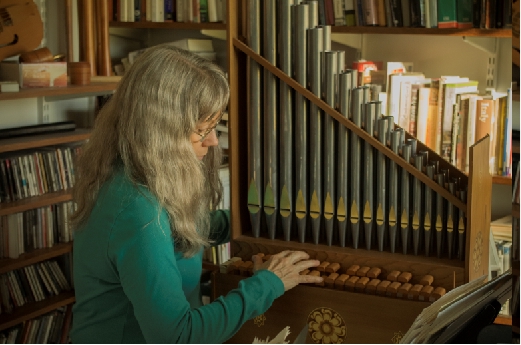
Tinney playing her portative organ.
Tinney: I live with my husband in Madison, Wisconsin. We’re both amateur musicians, studying and performing music of the late middle ages and the early Renaissance on a lot of different wind instruments, including (in increasing decibel levels) recorders, crumhorns, portative organ, and shawms. We love to travel to Italy, and research is only one of many reasons for that. My professional training and background is in journalism, though I did once aspire to become a professional flutist. I was involved in historical reenactment for quite a few years, and that has proved to be a useful background for someone interested in writing historical fiction.
Elizabeth: I love the name “Tinney” ? Is there some story that goes with it?
Tinney: It was my mother’s maiden name. It’s Irish in origin; a lot of Tinneys have come to the US from County Donegal, though I don’t know whether that was their home or just their point of departure. I’m an American mongrel, a mix of Irish, English, Welsh, Scottish, French, German, Swiss, and Cherokee – and those are just the ones I know of. No Italian, alas.
Elizabeth: What do you read for pleasure, and what do you avoid?
Tinney: I read many different kinds of fiction. Dorothy Dunnett is my hero in the area of historical fiction, but I also enjoy fantasy, some contemporary fiction, and mysteries, as long as they’re either historical or set in Italy (or both). I read Hemingway or the sagas as a corrective when I find myself getting too wordy. I don’t seek out Young Adult, romance, or the unfortunately-named genre called chicklit, though I’m sure there are individual books in each category that I would enjoy. Thrillers generally don’t thrill me. And in my home territory of historical fiction, I’m totally tired of Tudors.
Elizabeth: We’ve now reached the time in our interview for the let’s-get-to-know-the-author-better, nearly-pointless, sort-of-silly, rapid-fire questions:
Elizabeth: Coffee or tea?
Tinney: Coffee. Preferably Italian, strong, and in quantity.
Elizabeth: Ocean or mountain?
Tinney: Mountain. Big, sharp, pointy mountain.
Elizabeth: Hiking or shopping?
Tinney: Hiking, especially if the aforementioned mountain is nearby.
Elizabeth: Violin or piano?
Tinney: Violin. (Though if you had asked “portative organ or shawm?” it would have been a tougher call.)
Elizabeth: Mystery or fantasy?
Tinney: Fantasy, though I read both.
Elizabeth: Darcy or Heathcliff?
Tinney: Heathcliff. With so many novelists and screenwriters unwilling to let Ms. Austen’s characters retire, I’m about Darcy’d out. Besides, I prefer moors to drawing rooms. (If you haven’t seen the Monty Python sketch of Wuthering Heights done in semaphore, I urge you to watch it!)
Jessica Knauss has initiated a blog hop to allow book fans a chance to read excerpts from a number of historical novelists. Welcome if you have come here from her page. Go there next, if you started here. My excerpt from Syncopation: A Memoir of Adèle Hugo is below:
Pulling off her gloves, she placed her palms and right cheek against the stone wall. “I like how the cold moves into my blood. I can feel the music, even when there is no service; the building stores the sound of the music. I can hear hymns sung a hundred years ago.”
Adèle opened her eyes and saw him standing several paces from the building. “Come,” she said, tugging at him. “You’re not feeling the cathedral.” She removed his hat, and, threading her fingers through his hair, gently pressed his head against the cold stone. “Close your eyes and feel Notre Dame.”
Auguste closed his eyes, but he felt only the nearness of Adèle, and her palm against his temple.
Today I’m welcoming Gale Borger to my series of author interviews. Gale writes humorous mysteries, including the Olive Branch series and the Miller Sisters Mystery series. Gale’s six Olive Branch short mysteries, formerly only available as ebooks, have just been released in a print collection that includes an all-new sixth mystery.
Elizabeth: Gale, thanks for visiting today.
Gale: Thank you for having me.
Elizabeth: Tell me a little about the Olive Branch kids and the mysteries they solve.
Gale: The Olive Branch mysteries were the product of a brainstorm by Karen Syed, owner and President of Echelon Press out of Orlando, Florida. A huge proponent of the literacy movement, Karen came up with the idea of having several authors each publish a series of six short e-stories (one per month over the summer) in YA format, which would read like episodes. At the end of the sixth “Electric Shorts” installment, the readers would have read an entire story, but not face the intimidation of struggling through a long chapter book. The shorts worked great for summer reading programs.
Elizabeth: How did this idea evolve into the Olive Branch Mysteries?
Gale: Because I’m a Master Gardener, Karen suggested I write about gardening, and I tutor and work with many young adults in their late teens and early twenties, so it was decided that I take the teenage readers and develop my series from that.
I thought writing gardening for teens would be like trying to talk a group of Ultimate Fighters into taking ballet lessons. What I came up with was to establish a garden center where teens in trouble with the law could work off court ordered community service while receiving counseling and schooling at the same time.
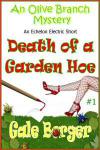
The mystery comes into play while walking back to the garden center after a day of planting flowers downtown. The five teens, Cash, Pone, Shroom, Spaz, and Bean, stumble across a dead prostitute in an alley. They are compelled to find out who murdered her. Thus was born the first installment, “Death of a Garden Hoe.”
Elizabeth: Now tell me about the Miller sisters.
Gale: I was sitting at home after knee surgery when my husband, Bob, dropped a laptop into my lap and said, “It’s time for that story to come out, Gale.”
I started out by sketching characters; taking personality traits, quirks, eccentricities (and just plain weirdness) from my siblings, my friends, my mother and her friends, and from people I’ve known over the years. I came up with four girls raised on a farm (Buzz, the eldest, is Wisconsin’s newest member of the AARP). Buzz is an ex-detective, and in each of the books, one of the sisters “help” solve a murder. The results are pretty funny. Mag is a high school biology teacher, Al is a librarian, and Freddie owns the local pet shop. Buzz’s love interest is a childhood friend and the local Sheriff, and they still make all major decisions by the tried and true Rock, Scissors, Paper method.
Elizabeth: But how can murder be made funny?
Gale: Murder is never funny, but how you get to the truth can be a riot.
Elizabeth: As a mystery writer, do you find you need to outline the plot before you begin writing?
Gale: I don’t outline, I develop characters. They write the stories.
Elizabeth: Is there a mystery writer you especially admire or one that you read to learn the craft from?
Gale: There are many writers I admire and read. The truth of the matter is I’ve spent over twenty years in law enforcement, so I know crime, and the people who commit crimes. Actually, some of my favorite people are bad guys. I grew up with humor, and hung out with creative and funny people. When it came to putting it all down on paper, it seemed natural to combine the two.
Elizabeth: Do you find that you need to work and plan to be humorous in your stories, or does the humor just flow?
Gale: Great question. The humor flows. Humor has to come naturally, or it looks forced–like punch lines stuck where they don’t belong. If you have funny characters, they will do things in a funny manner. Quick, witty dialog is so very important. That is why I stress character development. I never know what is around the corner, but my characters fling me around it like crack-the-whip.
Elizabeth: Anything else you’d like us to know about your books?
Gale: Well, now that you mention it, I’ve been asked if I thought it was rather silly and far-fetched to have grownups have nicknames and Three Stooges humor. The funny thing is, I really do have a sister with the nickname of Maggot, mine was Buzz, and I have a sister Sam, whose real name is not Samantha! The old ladies with police scanners are real (thanks to Mom and her friends), and we really do call my baby sister Jack the Tripper. Mark Twain once said, “Truth is stranger than fiction, but it is because fiction is obliged to stick to possibilities; truth isn’t.” I don’t know about strange, but the truth sure can be funny!
Elizabeth: Enough of your book—tell us about yourself.
Gale: I grew up in northeast Illinois on a horse farm in a household who watched Red Skelton, Jack Benny, Dick Van Dyke, and The Three Stooges. I loved Carol Burnett, Gilda Radner, Lily Tomlin and Lucille Ball–brilliant comediennes who didn’t have to take their clothes off to entertain their audiences. I love screwball comedy and I don’t apologize for pie-in-the-face jokes.
I’ve lived in southeastern Wisconsin for the past 20 years. I have a Bachelor’s degree in Criminal Justice and a Master’s degree in Education. I have been a Correctional Officer with the Walworth County Sheriff’s Office for the past seventeen years, and I already mentioned I was a Master Gardener, and I want to learn to train therapy dogs (in my spare time, of course).
My husband Bob and I have about 1,000 gallons of freshwater tropical fish, and Bob makes the best tropical fish food you can buy (captainbobsfishtales.com). Our daughter, Shannon is a double music major at UW Milwaukee, and plays a mean trombone.
Elizabeth: We’ve now reached the time in our interview for the let’s-get-to-know-the-author-better, nearly-pointless, sort-of-silly, rapid-fire questions:
Elizabeth: Coffee or tea?
Gale: A pot-o-coffee in the morning, tea in the late evenings, and Diet Pepsi any time of day.
Elizabeth: Ocean or mountain?
Gale: Mountains. I love the water, but I’ll take a lake over an ocean any day.
Elizabeth: Hiking or shopping?
Gale: Hiking-definitely. I abhor shopping!
Elizabeth: Violin or piano?
Gale: Piano if it’s Victor Borge
Elizabeth: Historical fiction or fantasy?
Gale: I prefer hysterical over historical fiction
Elizabeth: Darcy or Heathcliff?
Gale: Mr. Darcy, of course. How can one resist a 200 year old unattainable, yet endearingly awkward man, who loves you for who you are, who sees you as an intellectual equal, and he’s a rich, handsome guy to boot?
Elizabeth: Love scene or death scene?
Gale: Love scene (sans the milky white thighs), which turns into the death scene.
This past year was an excellent reading year for me. I read a total of ninety-four books (so close to one hundred…) and many were superb. Creating this list has been very difficult. I’ve left off many good books, and this list is still longer than I’d like. The ones I’ve chose are listed in the order I read them, mostly. Anyway, here we go:
The Marriage Plot by Jeffrey Eugenides
Some have called this pretentious, and it probably is, but I liked it nevertheless. Eugenides creates a college experience more like what I imagined college would be (a serious intellectual experience) than what I experienced (interesting classes and a lot of mindless parties). The author’s sculpturing of mental illness is fascinating.
Feathers by Jacqueline Woodson
Set in 1971 and narrated by sixth-grader Frannie, this is a well-crafted story that explores many themes, including hope (“the thing with feathers”). Everyone in Frannie’s school is black, until a white boy with long hair joins their class. He’s called Jesus-Boy because of his hair and his apparent serenity. Frannie’s best friend begins to wonder if the boy might really be the Savior. At home, Frannie’s mother is pregnant which is scary because she’s had several miscarriages, and Frannie’s teenage deaf brother struggles with his place in the world. Moving story.
The Wednesday Wars and Okay for Now both by Gary D. Schmidt
These two books are brilliant children/young adult reads. The Wednesday Wars is about Holling Hoodhood’s seventh-grade year and Okay for Now is about Holling’s friend Doug Swietek’s eighth grade year. Holling is forced to read Shakespeare by his teacher, and the book is thematically built around the plays he reads. Doug studies Audubon paintings in the local library and the book is thematically built around those paintings. So, the books are cleverly structured, but what readers are going to mostly notice are the realistic, likable main characters dealing with difficult family, friend, and school situations. Serious issues written with a deft hand. The stories are funny, clever and heart-felt. Schmidt deserves a Newbery.
Caleb’s Crossing by Geraldine Brooks
Caleb was the first Native American to graduate from Harvard and is the title character, but this is really Bethia Mayfield’s story. Bethia, the daughter of a liberal Calvinist minister, journals of her life on the Wampanoag’s island (now Martha’s Vineyard), Bethia runs fairly free for a young girl, meeting Indian Caleb and playing with him on the beach, though knowing that most would not approve of their friendship. When her mother dies, Bethia must take on more responsibility. Caleb comes to live with them to become educated, and each keeps their past connection secret. When he goes to Harvard, she goes to the mainland too, as a servant to pay for her own brother’s education. The marvel of this book is the way Brook brings to life the setting. The altered language, the sea, the tight grip of Puritanism, the racism, the poverty. It’s a fascinating re-imagining of people who lived long ago.
I, Iago by Nicole Galland
How do you take one of literature’s most vile villains and make your readers like him? Galland begins in his childhood and lets him tell the story. Iago is a fun, likable character, and the story rolls along at a good pace. When Othello begins wooing Desdemona, I found myself wondering how Iago would be able to narrate and explain the tragic events that I knew must follow. Did Shakespeare misunderstand? Had Iago behaved well and gotten a bad rap? Or would this character I’d learned to love turn on his friends? How could that happen? I won’t tell you here–get the book and find out.
The Diamond Age; or a Young Lady’s Primer by Neal Stephenson
In a list of hard-to-summarize books, this is probably the most difficult. But I will try. In a future world, Hackworth is an engineer who helps to design a book that is really a supercomputer with the intent of educating its reader. The book is intended for the King’s daughter, but Hackworth steals a copy for his own daughter, only to lose it to the streets, where urchin Nell gets it. Hackworth’s book is marvelous, teaching Nell how to read, how to fight, how to survive, and finally how to think for herself. Much more happens (there are probably a half a dozen other subplots) but this is what I remember best. Stephenson’s imagination is extraordinary and his ability to predict technology is nothing short of genius.
Ready Player One by Ernest Cline
Everyone in my family enjoyed this book. The year is 2044 and the world is in terrible shape, so most people escape from it by logging in to the virtual world of OASIS, created by James Halliday. Halliday, a multi-billionaire obsessed with 1980s culture, dies without an heir, but in his will he tells the world that he has left keys in OASIS, which when found will open gates and lead to other keys. The first person to open all three gates will get his fortune. Ready Player One is narrated by the teenager who finds the first key. Part sci-fi, part mystery, part love story, part 1980s-nostalgia trip, part dystopian fantasy, part thriller, this book is all good fun.
Finding Emilie by Laurel Corona
Lili is the could-have-been daughter of the real-life Emilie, Marquise de Chatelet, 18th century French intellectual, mathematician and lover of Voltaire. The Marquise dies giving birth to Lili, a child that history does not remember. The novel moves between the stories of Lili and Emilie, two women who are intelligent, strong, and independent, characteristics not valued among women in 18th century France. A fascinating, moving story.
The Descendants by Kaui Hart Hemmings
Picture the spouse you love in the hospital in a coma about to die. Are you sad? Heart-broken? Now picture finding out that the person you love was cheating on you. Was possibly planning to leave you. How do you feel? How do you deal with those feelings? How do you deal with your children, who are having trouble with their own grief? That’s the premise of this beautiful, well-crafted, heart-wrenching story.
Liar and Spy by Rebecca Stead
New York City seventh-grader Georges (the “s” is silent, but causes him no end of grief in school) must deal with bullying, a change of residence when his father loses his job, and a mother who works so much she’s never home. In his new apartment, Georges meets Safer, a home-schooled boy who accepts Georges into the Spy Club to investigate the strange doings of Mr. X who lives in the apartment above Georges. As the parent of a seventh-grade boy, I can tell you that Stead knows kids. The characters are smart and funny and troubled and, more than anything, real. I loved Georges, and loved Safer’s little sister Candy, and as my focus was on the characters, I was taken completely by surprise at the turn of events at the end of the story. Wow! A great book for kids and adults alike.
Leviathan, Behemoth,and Goliath all by Scott Westerfeld
I loved this trilogy so much that I forced my twelve-year-old to read them, and they became three of his favorite books. Westerfeld has created a world divided between “clankers,” people who work with all types of fantasy-type machinery, and “Darwinists” people who have genetically altered animals to work like machines. But wait, this is an alternate history of World War I as well: the clankers are the Austria-Hungarian empire and the Darwinists are Britain and its allies. The book opens with the murder of Archduke Franz Ferdinand and the escape of the archduke’s son, Alek, one of the story’s main characters. The other main character is Deryn Sharp, a girl pretending to be a boy so that she can become a British midshipman. She gets work on the Leviathan, a living airship which is a genetically-altered, whale-like creature that flies because it is filled with hydrogen. Sound far fetched? It doesn’t when you read it. The world building is meticulous. The characters are well drawn and the story fast-paced. Fun, fun, fun!
The Iron Wyrm Affair by Lilith Saintcrow
Sorceress Emma Bannon teams up with mentath (think Sherlock Holmes-type intellect) Archibald Clare to protect Queen Victrix and all of Britannia in this alternate-history, sort of Victorian era, steampunk thriller. The breath-taking action begins mid-story, with reader and characters trying desperately to figure out what’s going on. Although the story is non-stop, the world building and character development are what impressed me the most. I hope this is the beginning of a series.
In the Garden of the Beast by Erik Larson
The only nonfiction book to make my list; this reads like fiction. Larson uses letters, journals, and other primary sources to describe the lives and thoughts of William E. Dodd, American ambassador to Hitler’s Germany, and Dodd’s twenty-something daughter, Martha. The Dodds don’t know World War II is on the brink, although the ambassador has a very low opinion of the men in charge of Germany. Martha, on the other hand, is seduced by the charming Germans and makes light of the few bad things she hears about. This book is a brilliant look into the experiences and thoughts of two people who bumped elbows with some of the most infamous characters in history, as history was unfolding. Fascinating.
This Lullaby, What Happened to Goodbye? and The Truth about Forever all by Sarah Dessen
Dessen is the master of young adult books for girls. She covers serious teen issues with well-developed, realistic characters. I read these three books in about four days—not because they are short, but because I couldn’t put them down.
Today seems like a good day to point out something good happening in the world.
Heifer International helps families in developing nations buy animals or other agricultural products that can reproduce, thus feeding themselves and providing off-spring which they can give to their neighbors, thus helping the entire village. I donate to Heifer every year in April, for my mother’s birthday, and in November through World Builders.
World Builders is run by my fellow Stevens Point writer Patrick Rothfuss, who gets authors to donate books (Syncopation and The Stolen Goldin Violin are two of the lesser-know titles) and other cool things. You can bid on items or donate to Heifer and get your name in a lottery for items. Last year (if I’m getting my research right) World Builders raised $311,699.00 for Heifer. So, join the fun and learn what’s going on at World Builders.
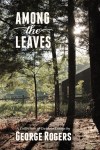
Today I’m welcoming George Rogers to my series of author interviews. George is the co-author of For the Love of Postcards. His most recent book is Among the Leaves, published by Cornerstone Press in November.
Elizabeth: Among the Leaves has the subtitle: A Collection of Outdoor Essays. How would you explain an “outdoor essay?”
George: Anything that has to do with nature.
Elizabeth: Could you tell us the topics of some of the essays?
George: I say in the introduction that this isn’t a “me and Joe went fishin'” book. I don’t ignore fishing and hunting but I’m more into other outdoor activities, wildlife and the environment in general. Some of the topics are the Apostle Islands and Isle Royale in Lake Superior, prairie chickens, deer, jackass rabbits (now thankfully called jackrabbits), wolves, camping in Costa Rica and climbing Mount Fuji. But mostly it’s about Wisconsin.
Elizabeth: You’ve been a journalist for more than fifty years. How were you able to choose which essays to include and which to leave out of this collection?
George: I tried to choose topics that appealed to people who liked the outdoors, not just the hook and bullet crowd.
Elizabeth: You grew up in Wisconsin and spent a lot of time in the woods as a child. How do you think that has affected your outlook on life?
George: I was exposed to nature as a kid by fishing with my father and getting to see the ruined old-growth Wisconsin forest, and learning what a grand thing it had once been. That doesn’t mean I’m against logging. I’ve cut many trees in my time (and planted thousands of them), but from an early age I learned logging had to be done judiciously.
Elizabeth: Tell us about one of your favorite vacations or travel destinations.
George: I’ll mention several. Northern Wisconsin is always a good one. I like the Gulf Coast of Texas because it isn’t as overdeveloped (yet) as Florida, it’s on the ocean and it’s low-key. Japan was good, but when I was there I was in the military and not really vacationing. However, it gave me the opportunity to climb Mount Fuji. Also I saw some incredibly polluted waters, which was a real lesson.
Elizabeth: What is your writing process or schedule?
George: I’m not on a schedule. I write an outdoor column and a few other things for a weekly newspaper, the Portage County Gazette, but that’s a relaxed timetable. I write any time the mood strikes me and email my stuff in. That way I don’t get in the hair of the real working people. If I were writing another book, I’d set a target – so much production per week.
Elizabeth: How did the idea for Among the Leaves come to you?
George: I didn’t plan to write Among the Leaves. A co-worker from my daily newspaper days talked me into it. I thought it would be a chore but I found out it wasn’t. I should have known that. All my working career I was on a deadline and learned to live with it. Relatively speaking, this was easy.
Elizabeth: Cornerstone Press is a small press sponsored by the English Department at the University of Wisconsin, Stevens Point. Students enroll in the Editing and Publishing class, and over the course of the semester select a manuscript, design a cover and layout, edit, publish, market and sell the book. What has been your experience working with this group of students?
George: They were good people, really interested in turning out a good product, and quite professional. I predict a bright future for them.
Elizabeth: We’ve now reached the time in our interview for the let’s-get-to-know-the-author-better, nearly-pointless, sort-of-silly, rapid-fire questions:
Elizabeth: Coffee or tea?
George: When I get up in the morning I brew a cup of tea because I don’t like instant coffee and it takes too long to make a pot of regular coffee.
Elizabeth: Ocean or mountain?
George: Both.
Elizabeth: Hiking or shopping?
George: Anything but shopping.
Elizabeth: Violin or piano?
George: Much to my regret, I’m devoid of musical talent.
Elizabeth: Mystery or Fantasy?
George: Mystery. There’s already too much fantasy in life.
Elizabeth: Hester Prynne or Scarlet O’Hara?
George: My attitude on this one was adequately summed up by Rhett Butler in his memorable farewell to Scarlett, “Frankly, my dear, I don’t give a damn.”
For months, I have thought that the Southwest Wisconsin Book Festival was on the Sunday after Thanksgiving. I’ve told people that date, publicized that date…. and I was wrong!!! It is
Saturday, November 24, 2012
My husband needed some details about the Festival this morning and went to the website and discovered that the festival is
Saturday, November 24, 2012.
I can’t even begin to imagine what it would have been like to drive the three hours to Mineral Point only to discover that the book festival was the day before, and we missed it. I feel sick thinking about it.
Book signings from 1:00 – 5:00 at the Quality Inn in Mineral Point
There are workshops in the morning at the public library and a keynote address in the evening at the Opera House. For more information visit the Southwest Wisconsin Book Festival webpage.
Because I’m writing a new version of the Cinderella tale, I’m also reading Cinderella-remake novels. In the past couple of weeks, I’ve read Ella Enchanted, by Gail Carson Levine and Just Ella, by Margaret Peterson Haddix. Cinder, by Marissa Meyer is on my to-read list.
I’ve searched Google, and the number of novels re-telling the Cinderella story is large — much larger than my time available for reading. Do you have a favorite to recommend? If so, please let me know in the comments below.
(PS My favorite movie version is Ever After with Drew Barrymore. What’s yours?)
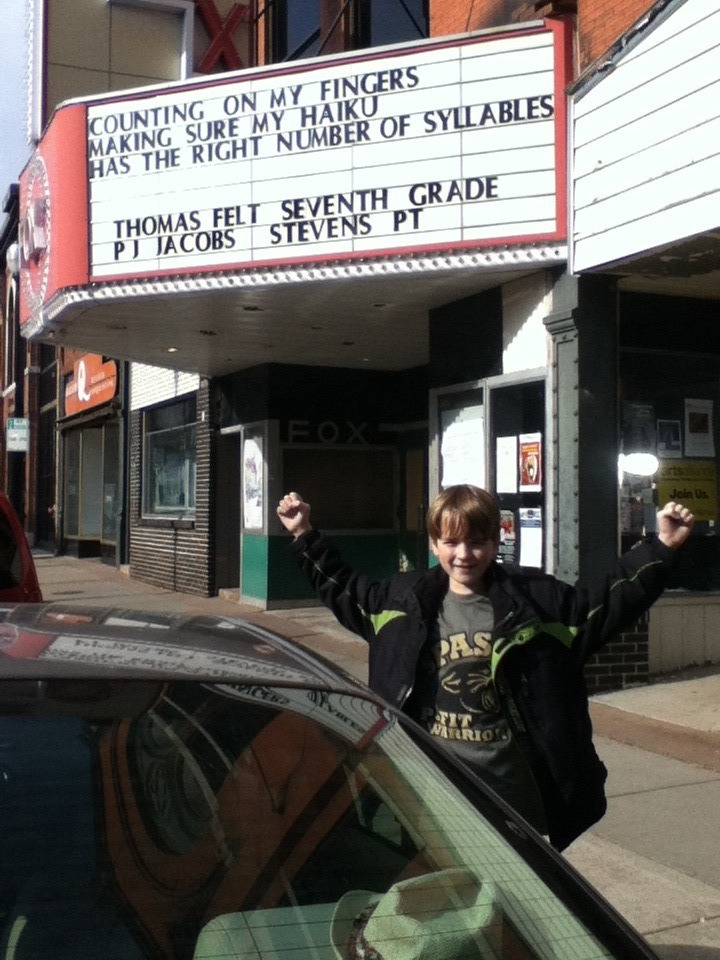
I wrote a month or so ago about the Stevens Point Haiku Marquee. Well, I’m happy to announce that my son Tom’s haiku was chosen to be displayed for the month of November.
Click to enlarge
Tom is our resident funny-guy, so, yes, the irony in the poem is intentional.
(For those who don’t know, the haiku format requires three lines: 5 syllables, 7 syllables, 5 syllables.)
 Cinder is the first book, a sci-fi, young adult Cinderella-story. Obviously marketed to the young adult female reader, I’m working to get my sons to read them. There’s a lot in here for boys to like too. Action-packed with really cool technology and humor too.
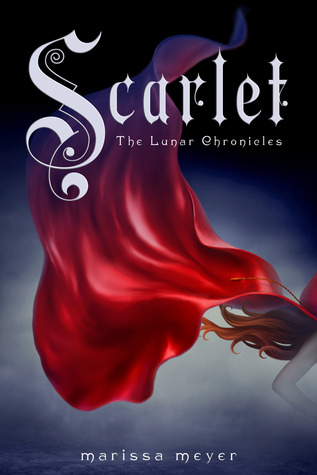 Wolf is as hard for us to figure out as he is for Scarlet. He’s genetically altered and scary, but sometimes kind and gentle. Cool story.