Videos and Marketing

Cornerstone Press has created a number of videos, which can be viewed on youtube, to market Syncopation.  I’m going to see if I can imbed some of these videos in this blog.  Wish me luck!

Of course, we should start off with the amazing book trailer:

Next, is Chalk Talk:

The next three are readings from the text:


I think I did it!  I hope you enjoyed the clips.

Come back tomorrow for my author interview with Beth Elliot.


Interview with Linda Collison


Today I’m welcoming Linda Collison to my series of author interviews. Linda is the author of the Patricia MacPherson Nautical Adventure Series.

Q: Can you give us a brief description of your books?

A: Stripped to the bone, it’s about a girl pretending to be a man aboard a ship in the 18th century.

The series begins in 1761 during the Seven Years War and is told in first person by Patricia, the illegitimate daughter of a dissolute English sugar planter. When her profligate father dies, sixteen-year-old Patricia finds herself without funds, family or interest. How is she to survive? She chooses to portray herself as a young man and make her living at sea. Living in disguise aboard ship with so many men (and a few women) is fraught with its own risks and rewards and I’ve drawn on numerous historical accounts of 18th century women who really did pass themselves off as men.

Q: How did you come to write this series?

A: My first novel, Star-Crossed (Knopf;2006) was the inspiration for the Patricia MacPherson Series. Knopf originally published it as a stand-alone and they weren’t really interested in doing a series. But Tom Grundner, publisher and senior editor of Fireship Press was! He published Surgeon’s Mate, the sequel, and waited to acquire the rights to Star-Crossed, once I obtained the reversion of rights after it went out of print with Knopf. Tom recognized that Star-Crossed was adult historical fiction, not YA, and he was committed to publishing the series. Tragically, Tom died suddenly last fall, but his publishing company Fireship Press lives on. Star-Crossed will soon be republished as Barbados Bound, the first book of the Patricia MacPherson Nautical Adventure Series, and the third book in the series will hopefully see print early 2013.

Q: In 2007, Star-Crossed was named by the New York Public Library as a “Book for the Teen Age.” Did you write it for adults or teens?

A: Funny you should mention that! I didn’t write Star-Crossed specifically for young adults; I wrote it from the perspective of a young woman, a sort of coming-of-age historical. The character is impetuous and she doesn’t always make good decisions. But she does what she can to survive.

My agent at the time, Laura Rennert, was keen to sell it as YA. She assured me she could attract a big publisher if she marketed it as YA, and she did. I was thrilled to be published by Knopf and to be included on the Books for the Teen Age – but throughout the series Patricia matures, and if the series continues she will grow old –which makes it more of an historical maritime saga than YA. So it’s a “cross-genre, cross-gender” book.

I do write young adult novels. Looking for Redfeather, a contemporary young adult literary novel I’ve recently completed, is represented by literary agent James Schiavone. I’m also working on a YA paranormal thriller set at sea that I’m very excited about.

Q: You studied history in college. How has that influenced you as a writer?

A: I’ve been a life-long student of history but the first time I went to college I majored in nursing to become a registered nurse (there being more jobs for nurses than historians — and I with a family to support!) I worked in acute care for over a decade, specializing in emergency and critical care. At the same time I worked as a freelance writer and had numerous articles, essays and short stories published by various magazines including Ladies Home Journal, Caribbean Travel& Life, Sail, Cruising World, Sailing, Parachutist, Nursing, etc. I wrote two guidebooks with my husband, which were published by Pruett, back in the ‘90s.

Over the years I’ve taken many college level history courses, mostly in history and French. Studying history has helped me examine sources objectively; it has helped me approach my research more efficiently and given me a wider perspective.

Q: How did you come to write historical fiction with a nautical setting?

A: In 1999 my husband and I served as voyage crew members aboard HM Bark Endeavour, an Australian-built replica of Captain James Cook’s 18th century sailing ship. The Endeavour was the closest thing to a time machine I have ever experienced and one of the most accurately reproduced historical ships in existence. We voyage crew members helped to sail her from Vancouver to Hawaii, a crossing that took nearly three weeks. We were expected to stand our watches, climb aloft and go out on the footropes to make and furl sail, take our turn steering the ship and keeping a look-out, as well as other duties necessary to keep the traditional vessel in good working order. We slept in hammocks strung from the deckhead, just as sailors did in the 18th century.

In many ways the experience changed my life. When I got off the ship in Hawaii I had a much better understanding what it was like to have sailed on an 18th century sailing vessel. And I carried inside the seeds for a novel. I had lived the time period, and the setting; I knew the ship intimately. I was getting to know the main character, the cross-dressing surgeon’s mate. But I still had years of research and writing ahead of me before Star-Crossed would be published. What a journey that was! And Star-Crossed was only the beginning. Book three of the series is taking me into the period leading up to the American Revolution where Patricia and her lover will find themselves on opposite sides of the war.

Your whole series sounds fascinating.  I look forward to reading about Patricia.

We’ve now reached the time in our interview for the let’s-get-to-know-the-author-better, nearly-pointless, sort-of-silly, rapid-fire questions:

Q: Coffee or tea?

A: Coffee, black! Except when I’m in England eating scones and clotted cream, then I’ll have tea.

Q: Ocean or mountain?

A: You might think I would choose the ocean because of my nautical books. But that isn’t necessarily the case! I divide my time between ocean and mountain. Today I’m at the ocean but next week I head for the Rocky Mountains. I need them both!

Q; Hiking or shopping?

A: Today I am hiking. Tomorrow I might be shopping. Life is broad!

Q: Violin or piano?

A: How about clarinet or cello? I played them both in high school, but maybe I should have learned piano, it’s so versatile and expressive. I do love piano — Adele, Elton John, Duke Ellington and Frederic Chopin jump to mind.

Q: Mystery or fantasy?

A: What about a mysterious fantasy? Actually, I don’t care for the mystery genre. Literary mysteries, such as Umberto Eco’s The Name of the Rose, now that’s a different story!

Q: Darcy or Heathcliff?

A: Heathcliff, of course!

Q: Love scene or death scene?

A: The best love scenes are usually lovers’ quarrels. It’s all about the conflict! Throughout the series I’m writing, Patricia tries to get together with her lover, and only sometimes are the trysts successful.

Death scenes are the best. “Out, out brief candle!”

Learn more about Linda and her writing at Linda’s website and at the Fireship Press website.

You can also order her books and learn more about her at Linda’s amazon.com page

Thank you, Linda!


Interview with T.C. Isbell


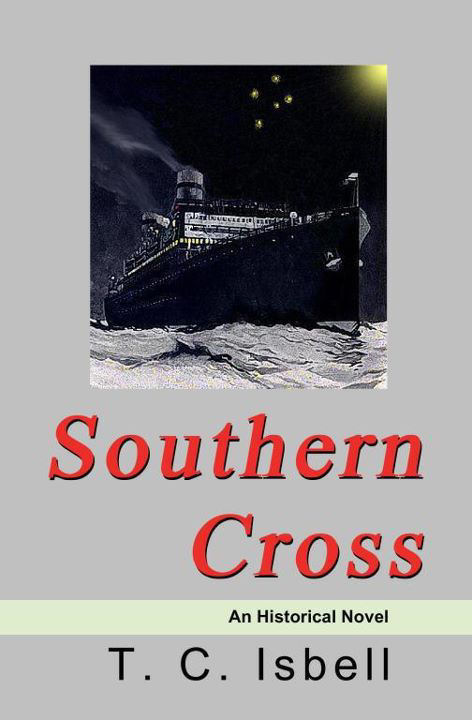
Today I’m welcoming T. C. Isbell to my series of author interviews.  T. C. is the author of Southern Cross, the first in the Prelude to War series.

Q: Can you give us a brief description of your novel?

A: Southern Cross is a World War 2 historical thriller. German agents Elsa Gable and Chris Schulte grew up together in a Germany ravaged by the Great War. They became inseparable as they matured into more than friends, more than family. They had a bond no one could destroy, at least that’s what Chris believed until the night of December 2, 1938 when a telegram arrived that changed Chris’ life forever.

Q: When will the second book in the series, Icarus Plot, be released and how does it continue the story started in Southern Cross?

A: Icarus Plot, the second novel in my Prelude to War series, takes place in Panama in 1940. Clive Smith, an MI6 agent, tracks a German spy, Chris Schulte, through the first book in the series. Clive is certain that the threat has not been resolved in Havana at the end of Southern Cross. He follows a trail to Panama where he discovers foreign and American interests are attempting to disable the Panama Canal and effectively divide the world in half. I hope to finish Icarus Plot before Christmas 2012.

Q: What drew you to this time period?

A: I have been an avid fan of World War Two history ever since high school. When I retired I started an in depth research project into the time period preceding Germanyfs invasion of Poland. Before I knew it, I was writing a novel that weaved the story of Chris Schulte and my other characters into my historical research.

Q: I see that you’ve written short stories in the past, can you tell us about them?

A: Yes, I have written a number of short stories. Presently, two of them, “Mattie’s Shoes” and “Surf’s Up” are available for Amazon’s Kindle. In “Mattie’s Shoes” a sixty-nine year old widow confronts a closet full of old shoes and old memories. “Mattie’s Shoes” placed in the 79th Annual Writer’s Digest Writing Competition in the Mainstream/Literary Short Story category. In the other story Billy Bonzer, an old surfer from Southern California, learns a lesson about working for big business and big government by participating in an inner tube race.

Q: Enough of your books tell us about yourself.

A: Ever since childhood, I have been intrigued by the arts–painting, music, and writing. Starting in high school, I wrote short stories and poetry. In the late sixties I joined the Navy. During the Vietnam era I wrote a number of poems that were published in the Berkeley Barb. I may publish them as a collection sometime, but for now they remain locked away. After my discharge, I returned to college and graduated with a BA in mechanical engineering. I worked for the Navy repairing nuclear power plants until I retired in 2005. My first challenge after retirement was to learn how to not write like an engineer. My second challenge was to learn everything I missed while staring out the window during my high school English classes.

Q: What advice would you give to an aspiring author?

A: First: sit down and write – write everyday. Set aside a specific time each day. Maybe in the beginning it’s just thirty minutes or an hour, but do it religiously. Soon writing will become a habit. Don’t get bogged down with creating the perfect sentence. Nothing is ever perfect to a writer. Write what’s in your head and sort it out later. Second: read books in the genre you write in. The authors you read have spent a lot of time learning their craft and have things to teach you. Third: consider, but don’t be deterred by the opinions of others – follow your dreams.

We have now reached the time in our interview for the let’s-get-to-know-the-author-better, nearly-pointless, sort-of-silly, rapid-fire questions:

Coffee or tea?

Coffee, I drink vast mounts of strong, French Roast coffee while I work. I don’t smoke, so I have to do something that’s bad for me. To paraphrase Mark Twain, when you get really sick, you need a vice to throw overboard to stop your ship from sinking. I guess coffee is mine.

Ocean or mountain?

Mountains – I was in the Navy for six years and have seen enough of the world’s oceans.

Hiking or shopping?

I enjoy hiking and climbing. I have climbed most of the volcanoes in the Cascade Mountain Range, including Mt Rainier.

Violin or piano?

Piano, but really harpsichord. In the early seventies when I lived outside of San Francisco I owned a Baldwin electric harpsichord along with an assortment of guitars and other musical instruments.

Mystery or fantasy?

Mystery, but actually both. I like writing mysteries, but I am working on a science fiction novel.

Hester Prynne or Scarlett O’Hara?

Hawthorne’s Hester Prynne for all of the contradictions in her life. Her story becomes even more poignant, considering today’s political climate.

Love scene or death scene?

Death scene – I think a richer palette of emotions from love to hate can be drawn into a death scene.

Thank you, T.C.

To learn more about T.C. And his writing, visit his website, like him on Facebook
and even better, buy his books:

Amazon , Barnes & NobleGoogle Play

Thanks, T.C. !


This Will Surprise You

How long does it take to grade a paper? If the paper is fairly short, say 2 pages, it will probably take about 5 minutes to read the paper and offer feedback. If the paper is well-written, it could take slightly less than 5 minutes, but if it is poorly written, it could take a great deal longer than 5 minutes.

My son’s high school English teacher has 175 students, a fairly normal load these days (6 classes with about 30 students in a class). When she needs to grade papers, it is going to take a long time. 175 papers x 5 min = 875 grading min or more than 14 hours of grading. And, to be honest, 14 hours is assuming a batch of short, well-written papers. Poorly written papers can take a long time to grade. If each paper takes 10 minutes, she’s up to 28 hours of grading. But she is in the classroom all day, so when can she grade these papers? 28 hours is a lot of evenings and weekends. For one short paper. High school English classes require a lot more than one paper.

I’ve heard people blame high school teachers for not giving enough feedback, not returning papers, not assigning enough work, not doing a good job, etc. The truth is, we are asking a lot of teachers, and nobody realizes how much we are asking. Some people think teachers work the same hours that students go to school, with summers off. The truth is, they work long hours. Teachers get summers off, but many teachers spend some of the summer preparing for the next school year—lesson planning, reading books, going to conferences, etc. And, yes, after a long, stressful school year, teachers should have some time off to have the energy for the next school year. Unfortunately, many teachers take on summer jobs to make ends meet.

Teachers in the US aren’t paid what lawyers and stockbrokers and CEOs are paid, though their hours are just as long, their jobs more difficult, and the importance of their work crucial to the success of our country.

So, the next time you see a school teacher, tell them how much you appreciate what they do.

Thank you teachers of America!!

Author Interview: Francis Hamit

Today I’m welcoming Francis Hamit to my series of author interviews. Francis is the author of The Queen of Washington, a Civil War spy thriller about Confederate spy and Washington hostess Rose Greenhow, and The Shenandoah Spy, another Civil War thriller about Confederate Army spy and scout Belle Boyd. Additionally, Francis has a film forthcoming, based on his 1988 stage play Marlowe: An Elizabethan Tragedy,  about the poet and playwright, Christopher Marlowe, and his career as a spy for the Crown.

Q: Francis, do I detect a theme here?

A: The usual rule is to write about what you know. I do have some background in Intelligence that informs my work.

Q: So you were a spy?

A: I was part of the largest spy agency of the U.S. Government, but my duties were mostly clerical. That is the dirty little secret about intelligence work. Most of it is paper-pushing and not that interesting, day to day. I did learn how such organizations work and that’s important if you write spy thrillers.

Q: Tell us about Belle Boyd and how you came to write about her.
A: In the early 1980s, I was one of about four thousand people hired to help revise the Micropaedia part of the Encylopaedia Britannica. I started researching her story, thought it was deserving of more than a paragraph and decided that I would do more with it, later. Belle’s story is a true one, about a young woman fighting, against the prevailing conventions of her time, for what she thought of as her country, the State of Virginia, against a foreign invader. The documentation is pretty spotty but she did shoot and kill a Union soldier at the beginning of the war who was part of a party of home-invaders, she did spy from the middle of a Union Army headquarters in Front Royal and have an affair with a Union Army Captain named Daniel Keily, and she did use intelligence she gathered to alert Stonewall Jackson and Turner Ashby to Union Army plans in order to trap them. She also ran across the battlefield on May 23rd 1862 at the Battle of Front Royal to give them a report about how lightly defended the town was, which was the start of Jackson’s famous Valley Campaign that pushed the Union lines back. Later historians, all of them male, disputed this, but there are two eye-witness accounts and a historical marker where she delivered that report. This is the reason that they commissioned her as a Captain of Scouts at age 18. She was the first woman in American History to be commissioned an army officer, which has made her something of a feminist icon despite the fact it was the wrong army. It is a terrific story.

Q: Tell us about Rose Greenhow, the protagonist in your most recent book.
A: Rose and her husband, Robert, were power-players in Washington. There are indicators that she was working for the French and the British as an agent of influence, and probably as a spy, while he was the number three guy in the State Department in the 1840s. James Buchanan, who was later her great friend before the Civil War, was suspicious of her when he was the Secretary of State and Robert got promoted out of his job and sent to Mexico on a fruitless mission having to do with California land claims after the Mexican War. He’d written a book on the history of California and Oregon, and that was part of the dialog about the ultimate boundary between the U.S and Canada. Rose had been a great friend, and possible lover of John C. Calhoun, and was very pro-slavery, so spying for the South was simply part of what she’d been doing all along.

Q: Why did you entitle the book The Queen of Washington?

A: Because she was, during the Buchanan Administration. She’d been mentored by Dolley Madison, who also had that title, and created that entire society in Washington where the men were above politics and the women did the deals. Rose couldn’t vote, but she could get you a government job…or a spouse. It was a very corrupt system and the secessionists infiltrated the government before the Civil War and started to steal information and assets. Weapons were shipped South. Documents and maps disappeared. Money disappeared. And Rose was up to her neck in most of it. She was very dangerous. Rose went to great lengths to get intelligence for the South. One of her lovers was Senator Henry Wilson, Chairman of the Senate Military Committee. Another was a Union Provost Martial responsible for the defenses of Washington city. That last relationship led to her arrest by Allan Pinkerton and eventual imprisonment with her eight-year old daughter in the Old Capitol Prison. There is a famous photo by Matthew Brady of the two of them there. You have to ask, why is that child there? They played rough, but that really is indecent, since Rose had relatives nearby who might have taken that child in.

Q: Why didn’t they?

A: Read my book and you can read my theory of the case, but it’s Alternative History without many facts to back it up.

Q: So it’s not all true?

A: It’s mostly true with a lie or two thrown in to make it more entertaining. I don’t pretend to be a a historian, just a novelist trying to provide an entertaining read. When a reviewer calls it that and says they really enjoyed the book, that’s when I know I’ve accomplished that goal. It’s the highest compliment I can receive.

Q: In the 1980s you wrote and directed for stage the play Marlowe: An Elizabethan Tragedy. Tell us a bit about that story and what inspired you.
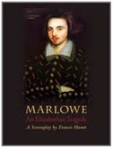
A: The Marlowe story is another one I found when I was working for the Britannica. Another terrific story about a spy who was also one of the most brilliant writers in history. It’s true. He was a spy for the Crown, and it’s probably what got him killed. He was betrayed by his lover, Thomas Kyd, and then assassinated by his friends for reasons of state. I conceived of it as a lights and levels show with costumes. It went through staged readings in Chicago and Los Angeles, and someone suggested I take it to Thad Taylor at the Shakespeare Society of America in West Hollywood. At the time SSA was a producing organization with its own Globe Theater. Thad wanted to produce it and suggested I direct it since there was so much background knowledge that has to be known to make it work. We had a one-month Equity Waiver run, got good reviews, but it didn’t get picked up because it’s hard to do. Last year, my old friend Mike Donahue, who is now directing films, read it. He saw its potential as a film, optioned it and asked me to write the screenplay. We’ve published that in a first draft reading copy and republished the original script as an e-book.

Q: How is writing a play different than writing a novel?

A: A play or a film, unlike a novel, is a collaborative work. It requires a lot of other talents to realize for an audience. You have to be open to sharing the process. A film is different from a stage play because of all the other things you can do with close-ups, jump cuts and editing to drive the story, and the format is different even if the dialog is pretty much the same.

Q: Why did you decide to write this story as a play and not as a novel?

A: For several reasons. I always saw it that way, and with a play you can stand back from the character and be somewhat objective. A novel is more intimate. You have to get into people’s heads. Kit Marlowe’s is not a head I want to spend much time in. He was a very cruel man, a bully and murderer, a social climber and he was also homosexual, which I am not. That’s an entire emotional context I know nothing about, and am not going to try and fake. To know Kit Marlowe is to not love him. A writer has to recognize his or her limitations. I think it will make a great film, and that Mike Donahue will do a terrific job with it because he does understand that character and emotional context. It’s high drama. We’re in pre-production and Mike has other projects and obligations. He’s done four films in the last year. We also have to find financing and distribution and all that, and are still working on casting.

Q: How are you filling the time until this is ready?

A: Several ways. I was very ill last fall, just as The Queen of Washington was published, and the entire promotional scheme got trashed. So we’re playing catch-up on that, mostly through social media such as Facebook. We’ve turned some of my shorter fiction into audiobooks in collaboration with some terrific and talented narrators we found through ACX.com. Those are available on Audible, iTunes and Amazon.com. I have a book of security essays that will soon be out in e-book form. These are columns I originally did for Security Technology & Design magazine in the 1990s, but still relevant in out post 9/11 world,and some of the best writing I’ve done. And I’m still writing new fiction and raiding the files and knocking the dust off some of the stuff that never got published.

Q: Who is your publisher?

A: Technically, I am one of those horrid people who self-publishes. My roommate, Leigh Strother-Vien, and I own Brass Cannon Books. She’s also my editor and has been for the last 23 years. We hope to eventually publish work by other writers, but for the moment I will have to do. We use a team approach and hire others, such as George Mattingly, who designs some of our book covers, to help out. We’re careful about providing a superior product. We expect to make a film or television rights deal for The Shenandoah Spy soon.

We’ve now reached the time in our interview for the crowd-pleasing, rapid-fire questions:

Coffee or tea? Both.

Ocean or mountain? We live in the mountains.

Hiking or shopping? I’m physically disabled, so neither appeals as entertainment. We buy what we need, but don’t make a big deal of it.

Violin or piano? I don’t play an instrument, but if I did, it would be piano.

Mystery or fantasy? Both. I don’t restrict my reading by genre. It is intellectually stultifying.

Hester Prynne or Scarlett O’Hara? Neither. I dislike drama queens.

Love scene or death scene? Love scene.

Thank you, Francis.

Readers, if you want to learn more about Francis and his writing, visit brasscannonbooks.net or the Facebook pages and Youtube videos for The Queen of Washington, The Shenandoah Spy or Brass Cannon Books. Don’t forget to hit the like button.


Author Interview: Melissa Westemeier

To begin my series of author interviews, I’ve invited Cornerstone Press author Melissa Westemeier.  I was fortunate enough to attend the release party for her novel Whipped, Not Beaten and get an early copy, which I thoroughly enjoyed.

Whipped Not Beaten tells the story of Sadie Davis. Recently dumped and working for a boss she despises, she is determined to shake up her life as a single woman in the city of Madison, Wisconsin. She takes a side job as a home party consultant selling kitchenware, hoping that it will be the spice that turns her life around. Through failed recipes and cold ovens, Sadie works to create something that’s a bit sweeter, a lot richer, and oh, so very delicious.

Melissa, welcome.

Q: Tell us about Whipped, Not Beaten, and how you came to write it

A: The main plotline is about how Sadie starts selling home party products. When I quit my teaching job and became a stay at home mom, my social life became nonexistent. The only time I had a night out was when I got invited to a home party―and naturally I accepted every invitation. After attending several―Partylite Candles, Tupperware, Tastefully Simple, Mary Kay, Creative Memories, Pampered Chef―it struck me how a novel could appeal to women by poking fun at the entire set-up. I’d already written a couple of YA novels, and the idea of a romantic comedy, “chick lit” with home parties as the backdrop really appealed to me. Like I begin all my books, I just started writing and the plot and characters fleshed out as I kept at it. I chose Madison as the setting because all chick lit seems to take place in New York or Los Angeles. The Midwest gets almost no attention, unless someone’s writing about a rural setting. Also, I’m familiar with Madison, which made the book easier to write than if I had to research a different setting, like New York City.

Q: Many readers think that the main characters in novels are like the authors themselves. Is there a lot of Sadie Davis in you?

A: That’s a funny question! One of my best friends read the book with me as Sadie in her head. Needless to say, when Sadie has her first sex scene, Nicole had to set the book down…

I think there’s a little of any woman my age in Sadie. As far as specific traits that we share, I do fantasize about George Clooney, battle the occasional blemish, and find my medicine cabinet terribly disorganized. When I was younger I had to learn to stand up for myself at work and I enjoyed the mentorship of some great older women. Really, the character most like anyone in real life is Sadie’s mom, who I based almost entirely on my Grandmother, Gloria Volkman. If I were to BE like any of my characters, I confess that I wish I were just like Sadie’s older sister, Jane. She lives my fantasy.

Q: Whipped, Not Beaten was your first published novel. Have you written other things?

A: I co-wrote a chapter in Teaching Writing in High School and College (NCTE, 2002) and co-wrote Writing in a Changing World (Bridle Path Press, 2010). I’ve had some poetry and essays published, and like most writers, I have a drawer full of rejected or partially-developed manuscripts.

Q: You’ve worked as both a teacher and as an editor. How have those jobs influenced your writing?

A: After teaching high school English for almost 10 years, I really developed an eye for recognizing what makes a piece of writing strong or weak. I also developed the knowledge base to help writers tend to those issues. My writing group works well together because we all have teaching backgrounds, so instead of just getting together and pointing out what “doesn’t work” in each other’s manuscripts, we advise each other on how to make revisions, play to our individual strengths, and address the problems with suggestions. I think the best thing a writer can do for their own craft is to find other writers to work with―I really enjoy editing manuscripts for other authors and it’s a personal thrill when they get published, too.

The only drawback is when I’m with my book club―I need to learn to turn off my “editor eyes” and approach some books with only my “reader eyes.” Writers read books differently than other people.

Q: What can you tell me about working with the student-run publishing house Cornerstone Press?

A: They were lovely and so professional. From the content editing to the marketing, every step of the way demonstrated the investment they made into my book. I loved getting 100% of their attention, which I know wouldn’t happen in a larger press, and they were so creative, too.

Q: What are you working on now?

A: Currently I’m working on 2 projects―final revisions on a nonfiction book I wrote with Jen Brecht, my co-founder over at Ecowomen.net. It’s a guidebook to making one’s lifestyle environmentally friendly by making one behavioral change a week over a whole year.

Also, I’m bringing a revised version of my latest novel, Across the River to a writing workshop this summer. It’s the story of a small town on a river, loosely based on my bartending days during college when I lived in Fremont, Wisconsin. The main characters are the daughter of a dairy farmer who sees a different future for her family’s farm and a bait shop owner who has dreams of big development moving into the area. It’s funny, but with a more earthy humor than Whipped, Not Beaten, in part because most of the characters are men, and it takes place during the white bass run.

We’ve now reached the time in our interview for the let’s-get-to-know-the-author-better, nearly-pointless, sort-of-silly, rapid-fire questions:

Coffee or tea? Coffee.

Ocean or mountain? Ocean.

Hiking or shopping? Hiking.

Violin or piano? To listen to, right? Violin.

Mystery or fantasy? Mystery.

Darcy or Heathcliff? Always, always Mr. Darcy.

Love scene or death scene? Love scene.

A great big thanks to Melissa for being the laboratory rat in my first interview experiment.

I encourage you to  order her book, Whipped, Not Beaten, and to visit Melissa at Green Girl in Wisconsin

World Builders

Pat Rothfuss, a colleague of mine and a New York Times best selling author, is once again running World Builders, a fundraiser for the Heifer Project

Pat, who has become hugely famous because of his fantasy novels The Name of the Wind and A Wise Man’s Fears, has gotten novelists, publishers, and generous individuals to donate books, illustrations, maps, trinkets, and all sorts of really cool stuff. 

For every ten dollars a person donates to the Heifer Project, that person gets one chance at having his name drawn from a hat for a cool, donated item.  ($20 earns 2 chances, etc.)  Although Pat is a fantasy writer and much of the cool stuff comes from the world of fantasy, there are exceptions, including a couple signed copies of The Stolen Goldin Violin.

Other donated items are so desirable that they are not a part of the lottery but instead will be auctioned off. 

If you don’t feel like hoping to win the lottery, and don’t want to bankrupt yourself at an auction, you can visit the very cool “Tinker’s Packs” and purchase cool, donated items straight up.

All proceeds benefit the Heifer Project.  You can visit Heifer to learn more about that organization, but to be a part of the lottery/auction/Tinker’s Packs, you need to donate through the World Builders page.   

I encourage you to visit World Builders, check out the cool stuff, and make a donation today !

Bravo J.K. Rowling!

I finished the Harry Potter series several years ago but having just watched the last movie, I want to state how much I admire J.K. Rowling.

When Harry Potter first moved into the limelight, everyone loved the series, then of course, the nay-sayers found voice. I don’t want to pretend here that I find the Harry Potter series the best literature I’ve ever read, or that I believe J.K. Rowling to be the most adept wordsmith, but the truth is, what Rowling did is phenomenal. Her story is immense—and because it was being published as she wrote it, she couldn’t go back and fix things. My heart races and sweat drips from my brow at the mere thought of it.

The idea of publishing part of a story before the full story is written terrifies me. In a stand-alone novel, if I get near the end and decide that it would work better if the protagonist didn’t have a brother, I can go back and fix it—or turn him into a sister. If the strange rash that breaks out on her hands in chapter two doesn’t evolve into anything, I can go back to chapter two and delete the whole rash incident. If J.K. Rowling had decided that it would be better for Harry’s …. well, I can’t even think about what she might have wanted to change because she couldn’t “fix” anything. She was forced to work with what she had previously decided, and she was able to make it work. Always. Stupendous!

In addition to being unable to revise those early books, J.K. Rowling was under an incredible amount of pressure. Can you imagine trying to finish a story when you know millions—MILLIONS! of people are waiting to see what you write? And they want you to hurry. What if you don’t feel like writing today? What if the characters stop talking to you? What if the story has become boring to you? J.K. Rowling had to finish, with critics and fans and practically everyone in the world looking over her shoulder.

Phew!

Some people will lean back and rub their fat stomachs and say, “Well, she got paid a lot of money for all that,” as though money causes the creative process to flow smoothly and perfectly. I don’t think money is the recompense so many people seem to think it is.

As much as I’ve always wanted to be a writer, and as much as I’d love to write something that was as beloved as the Harry Potter series, I don’t think I would ever want to write under that kind of pressure.

I realize J.K. Rowling will never read this blog, I will pretend for a moment that she is:

Well done! Brilliant! <insert standing ovation>

Costume Dress

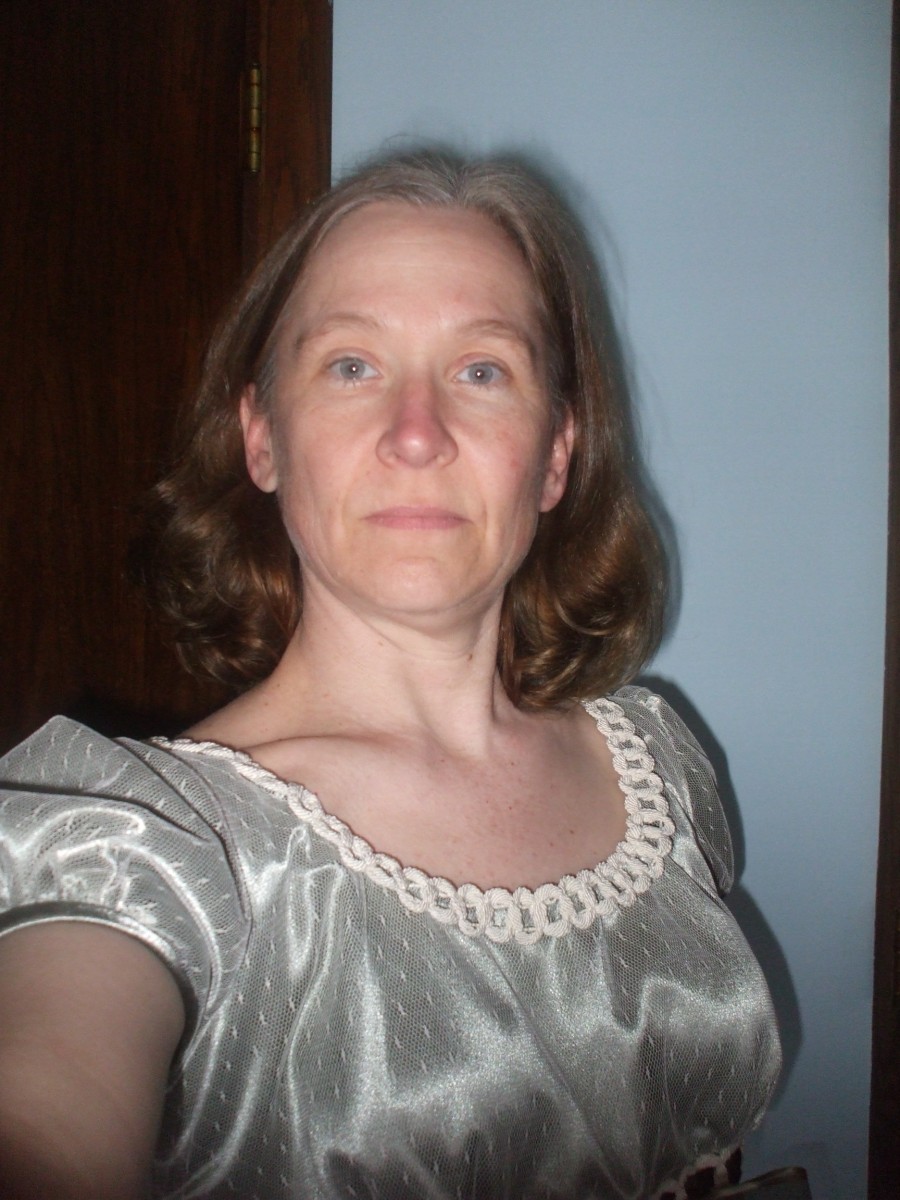
I was trying so hard to get the camera angle right, I forgot to smile.

I have wanted a nineteenth century gown for a long time.  How does one go about finding something like that?  I contacted the theater department at the university to find out what they do with costumes after a performance is over (answer:  they keep them).  I did learn that the department’s cutter/draper sometimes does freelance projects.  How could I possibly justify the cost?

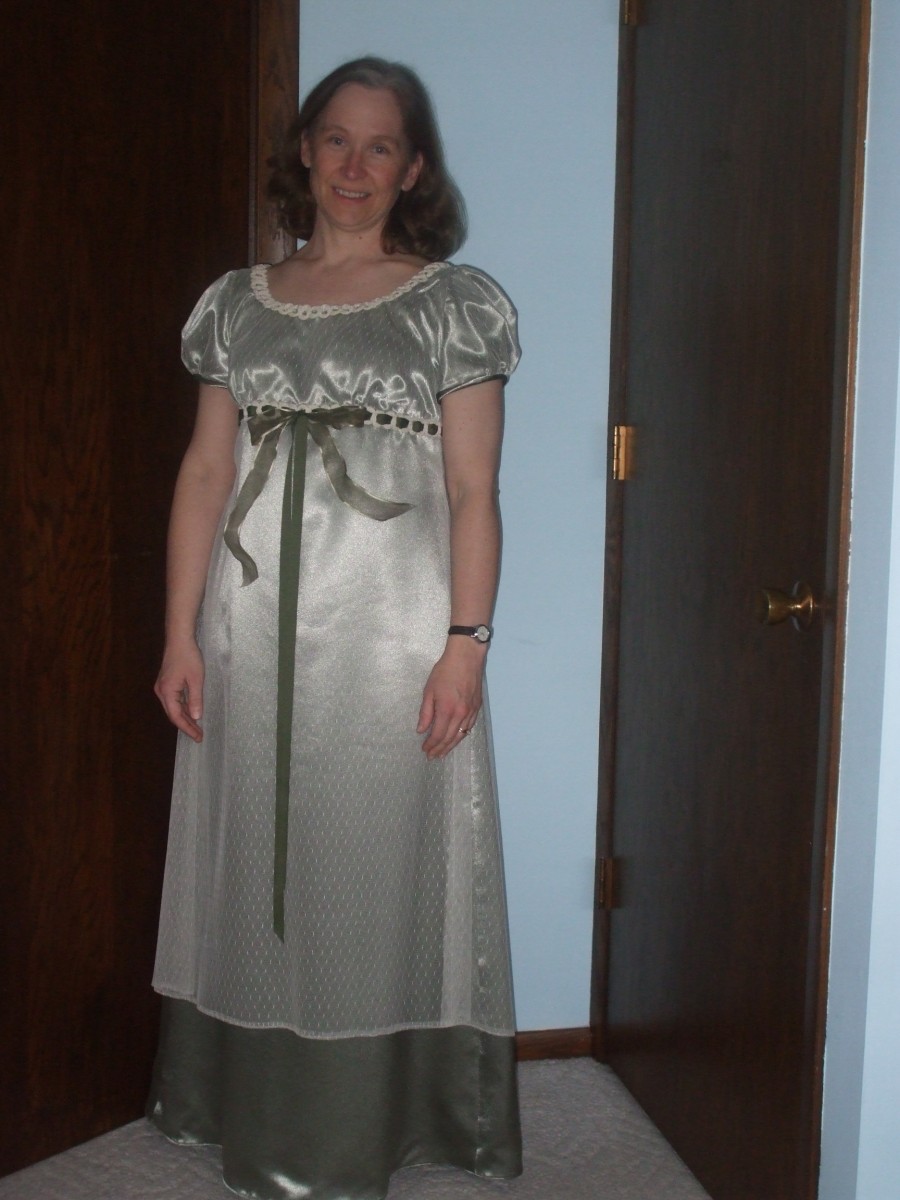
Then, out of the blue, a friend who is moving asked me if I would like a regency gown she had had made for a costume party and will probably never wear again !!!!

I answered “yes” very quickly.

I hope to upload some better pictures soon, but for now these will have to do.  This is the full view.  I’m not too happy with how it looks, but that is more the fault of the person in the dress, than the dress itself.  (Note to self: make time to exercise!)

I’m hoping to take this to the Historical Novels Society conference in June (and get some better pictures).

When one of my historicals is finally published, I plan to do book signings in costume.  This could be one of the costumes, but I will probably hire that draper to make a costume that is more era-appropriate depending on which book I’m selling.  Charlotte’s Inheritance and Syncopation are both mid-nineteenth century, while Wilde’s Wager is late nineteenth century.

I guess I’ll just have to write a book to go with my new regency-era, Jane Austen-style gown!