Today I welcome best selling author Kate Quinn to my series of interviews. Kate is the author of Mistress of Rome, Daughters of Rome, Empress of the Seven Hills and the soon-to-be-released The Serpent and the Pearl. Kate will be participating on two panels at the Historical Novels Society Conference: “Sex in Historical Fiction: How to Make It Hot” and “Historical Fiction Set in the Ancient World: the Good, the Bad and the Ugly.”
Welcome, Kate.
Q: What got you first interested in historical fiction?
A: The past has always fascinated me, ever since the days when I was six years old and I couldn’t sit down on the school steps without pretending I was Elizabeth I refusing to enter the Tower of London. My favorite movie was Spartacus, and I was crushed that no boys of my own age were even remotely capable of leading a slave rebellion or wielding a gladius like Kirk Douglas. Under those circumstances, it was probably inevitable that I ended up writing historical fiction!
Q: Is there an era/area that is your favorite to write about?
A: I first got interested in ancient Rome because of I, Claudius, which I watched when I was far too young, but adored anyway. Imperial Rome is so far away from us in time, but culturally so close. From sports fans to fast food, from running water and daily baths to birth control and no-fault divorce, the Romans embraced cultural traditions that wouldn’t be seen again on a widespread scale for two thousand years. And now I’m giving ancient Rome a break and have moved on to the Renaissance—another fascinating period; so much art and beauty existing side by side with so much bloodshed.
Q: Do you have a favorite era for reading?
A: I’ll read historical fiction set in any era as long as it’s well-written!
Q; Is there a writer, living or deceased, you would like to meet?
A: I would have loved to meet Judith Merkle Riley, who was my idol for historical fiction. In a genre that can sometimes take itself deadly serious, she wasn’t afraid to make her readers laugh. I understand she was very active with HNS—I will always be sorry that I didn’t join up until after she had died.
Q: Can you tell us about your latest publication?
A: The Serpent and the Pearl is my latest book, set for release in early August—and it’s my first book set outside Imperial Rome. I’m hopping on the Borgia bandwagon for a rollicking story starring Giulia Farnese, a Renaissance beauty with floor-length hair who was mistress to the Borgia Pope. Stir Giulia’s incredible real-life adventures together with those of her acerbic bodyguard, add in one fiery-tempered cook with a dangerous past, and light on fire for a fun fast-paced read.
We’ve now reached the time in our interview for the let’s-get-to-know-the-author-better, nearly-pointless, sort-of-silly, rapid-fire questions:
Coffee or tea? Coffee. I don’t care if it tastes like motor oil, as long as it’s black, hot, and strong enough to take the roof of my mouth off.
Ocean or mountain? Ocean. I have a periodic fantasy of taking a waterproof laptop and going to live on a houseboat in the middle of the ocean where I can be absolutely, completely alone except for the sound of waves.
Hiking or shopping? Hiking. A long ramble with my dog helps me unsnarl plotting problems – I feel just like Emily Bronte, sans Yorkshire moors.
Violin or piano? Piano – as long as it’s not me playing it!
Mystery or fantasy? Both. I’ll happily hop from George R.R. Martin to Robert B. Parker.
Darcy or Heathcliff? Darcy. Heathcliff killed baby birds, which is just a bit of a turn-off for me.
Love scene or death scene? I’m a sucker for a good love scene. Who isn’t?
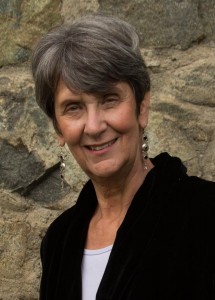
Today I welcome novelist Ann Weisgarber to my series of author interviews. Ann will be at the Historical Novels Society Conference as a panelist on the Historical Fiction: the American Experience session.
Welcome, Ann.
Q: For you, what is the line between fiction and fact?
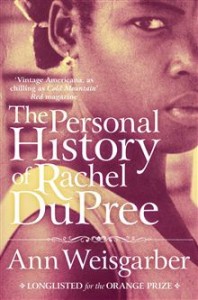
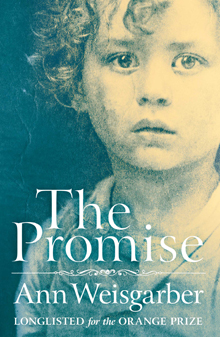
A: I believe that readers trust us to tell the truth about historical events, locations, and cultural norms. I work very hard to keep those aspects as accurate as possible. If the facts don’t fit with the story I’m writing, I change my characters rather than the facts. In The Personal History of Rachel DuPree, I wanted my main character to have a brief interaction with Ida B. Wells Barnett, a historical journalist in Chicago. To make that work, I had to make my main character older by a few years. In The Promise, I wanted one of the main characters to play in an orchestra. However, in the late 1800’s, this was very rare for a woman. Rather than bend the facts, I changed the character so that she played in a four-woman ensemble, something that was becoming increasingly popular at the time.
These were small sacrifices that allowed me to keep the story historically accurate.
Q: Do you have an anecdote about a reading or fan interaction you’d like to share?
A: When The Personal History of Rachel DuPree was published in the United States, many African-American readers told me stories about their ancestors who homesteaded in the West. They thanked me for writing a novel about people who have been overlooked in the history books and a few readers sent photographs of their relatives. I’m deeply touched by these responses.
Q: Where do you feel historical fiction is headed as a genre?
A: I’m on the selection committee for the Langum Prize in American Fiction and am impressed by the range of topics, locations, and time periods. There are many Civil War-based novels but there are also those that take place during the Industrial Era, World War I and Prohibition. Locations vary from North Carolina to Missouri to California. Some focus on historical people while others highlight ordinary characters. Each novel is a reminder that historical fiction is broad in scope, that the writing isn’t formulaic, and that as each decade passes, new material surfaces. That keeps the genre fresh. It offers something for every reader.
Fifty years from now, I’m confident that the Historical Novels Society will continue to meet and members will continue to discuss the fascinating evolution of historical fiction.
Q: Is there a writer, living or deceased, you would like to meet?
A: How I wish I could have met E.B. White so I could thank him for writing Charlotte’s Web. It’s the first book that I remember my mother reading to me when I was a child. I was spellbound by this story about impending death, friendship, hope, and most of all, the power of the written word. I’m still spellbound.
Q: Can you tell us about your latest publication?
A: The Promise was published in March 2013 by Mantle (Pan Macmillan) in the UK. It takes place on Galveston Island, off the coast of Texas, and begins a few weeks before the 1900 Storm, the worst natural disaster in the U.S. during the 20th Century. There are two narrators, Catherine and Nan, who both strive to cope with change as they struggle to find their places within a small household. Little do they know that a hurricane in the Gulf of Mexico is about to upend all that they know.
We’ve now reached the time in our interview for the let’s-get-to-know-the-author-better, nearly-pointless, sort-of-silly, rapid-fire questions:
Coffee or tea? Coffee. I love the aroma.
Ocean or mountain? Ocean
Hiking or shopping? Hiking
Violin or piano? Violin (May I call it a fiddle?)
Mystery or fantasy? Mystery
Darcy or Heathcliff? Heathcliff
Love scene or death scene? Death scene. The possibilities are endless—the deathbed wishes, promises made, and, of course, the reading of the will.
Today I welcome Stephanie Barko to my series of interviews. Stephanie will be presenting at the Historical Novels Society Conference as a literary publicist. In the workshop Building an Effective Platform for your Historical, Stephanie will lead attendees through her proprietary exercises that coax a book’s platform to the surface. Welcome, Stephanie.
Q: What does a typical day look like in your job as a literary publicist?
A: My day begins with black coffee, a lit candle, a gratitude list and soul writing (a la Janet Conner).
After listening to a guided meditation through a headset, I clean up my email before beginning to execute client deliverables. During my day, I may be shipping galleys for pre-pub review, pitching radio producers, subcontracting for a colleague in Manhattan, or arranging a virtual tour. Depending on the season of the year, I will be working in some yoga, aqua aerobics, Tai Chi or walking to keep my brain oxygenated during the work week. I break to cook dinner and then get right back to it during the evening unless there’s something I can’t bear to miss on PBS.
Q: What do you like most about promoting historical novels and nonfiction?
A: My favorite task during a contract is research–researching journalists for a media list, researching the top Technorati book bloggers, or researching the best endorser candidates for a client’s book. The pre-pub phase is when I can add the most value, and that’s the part of a campaign I enjoy the most.
Q: What do you like the LEAST about your job?
A: Redirecting stray prospects who have queried for my services without doing their homework.
Q: What can historical novelists and nonfiction authors do to help you help THEM?
A: A good start would be to approach me with a publisher already on board, a release date, an edited manuscript, and professionally designed cover still in progress, and a list o potential or actual endorsers.
We’ve now reached the time in our interview for the let’s-get-to-know-the-interviewee-better, nearly-pointless, sort-of-silly, rapid-fire questions:
Coffee or tea? Organic French Roast
Ocean or Mountain: Mountains of the American West
Hiking or shopping? Hiking
Violin or piano? Piano
Mystery or fantasy: Mystery
Darcy or Heathcliff? Darcy
Love scene or death scene? Death scene
For more information about Stephanie Barko and her work, visit her website www.stephaniebarko.com, read about her at Literary Marketplace or visit her in your favorite online milleu:
Today I welcome Anne Easter Smith to my series of author interviews. Anne is the author of the highly acclaimed historical novels, A Rose for the Crown, Daughter of York, The King’s Grace, and Queen by Right. Her recently-released Royal Mistress is the story of Jane Shore, the final mistress of King Edward IV of England. Anne will be speaking on the To Trump or Trumpet: the History Police panel at the Historical Novels Society conference.
Q: What got you first interested in historical fiction?
A: A great teacher in boarding school hooked me on history, and so when I went home during the holidays I would go to the local library and read every historical novel I could get my hands on. I was not interested in any books that did not have women in long dresses. Even today, if a book cover, TV show or movie is period, I’m instantly interested.
Q: For you, what is the line between fiction and fact?
A: I’ll be talking about this on my panel at the conference. I fall into the “don’t mess with history” camp. To be honest, the people I have written about couldn’t have had more dramatic lives, even if I’d wanted to embellish them! I was mortified recently that a reader caught an egregious historical error that I cannot imagine not catching during the editing process. I feel a certain responsibility to my readers to not fudge the facts. After all, it was fact-fudging by Shakespeare and Sir Thomas More that got my favorite protagonist, Richard III, such a bad reputation.
Q: Do you have an anecdote about a reading or fan interaction you’d like to share?
A: Imagine my surprise when, at a reading near Albany, New York, a woman turned up dragging an 11-year-old boy with her. When I went to greet her, talking over the boy’s head, and said how brave she was to come when her son was surely not there of his own volition, she said: “Oh, I’m not here to see you, Jason is. He’s your biggest fan and his room is covered in English royalty genealogy charts!” Jason and I have kept up a correspondence ever since.
Q: What book was the most fun for you to write?
A: Definitely A Rose for the Crown. It’s not that I haven’t adored all my other protagonists, but I wrote that in my own time without any intention of letting anyone but my family read it and believed it would be my only attempt at writing a book.
Q: Can you tell us about your latest publication?
A: Royal Mistress is the fifth in my series about the York family during the Wars of the Roses. It tells the story of Jane Shore, King Edward IV’s final and favorite mistress. I love that she was born into the merchant class of London, which allowed me to do a lot of research on the medieval guilds, and as she was called his “merriest” mistress by Edward himself, I knew she must have been quite a character. She had a roller-coaster of a life before and after Edward, but while she was his mistress, Jane was said to have truly been loved by the king. All the York family come into this book, including my Richard (III), although his treatment of Jane was rather harsh and forced me to look at him in a less saintly light than my first book A Rose for the Crown.
As part of my series of interviews with Historical Novels Society Conference Speakers, I today interview Kathleen Kent. Kathleen is the author of the bestselling novels, The Heretic’s Daughter and The Traitor’s Wife. At the conference, Kathleen will be participating in “The Witchcraft Window: Scrying the Past” panel discussion.
Question: What got you first interested in historical fiction?
Kathleen: When I was a child, my mother gave me a book on ancient Greek artifacts. Soon after, I started reading Mary Renault’s books and historical fiction became my time machine to the past.
Question: How do you find the people and topics of your books?
Kathleen: My first two books, The Heretic’s Daughterand The Traitor’s Wife were based on my 9 times great grandmother, Martha Carrier, who was hanged as a witch in Salem in 1692. I grew up hearing stories of Martha and her family.
Question: Do you have an anecdote about reading or fan interaction you’d like to share?
Kathleen: For the release of my second book, The Traitor’s Wife, I had a launch event in Salem, Mass. Over 250 fellow descendants of Martha Carrier—from all over the U.S.— attended to share their personal histories and stories that they had heard about Martha and her husband, Thomas Carrier.
Question: Can you tell us about your latest publication?
Kathleen: My third novel, The Outcasts, will be published this October. Set in 1870 Texas, the story follows both a young Texas State Policeman on the hunt for a serial killer, and a woman fleeing a life of prostitution to pose as a school teacher in a small Texas town.
Over the next few weeks, I will be featuring some of the speakers scheduled to present at the Historical Novels Society Conference June 21-23 in St. Petersburg, Florida. Today I welcome Heather Webb, who will be on a panel discussing the “Virtual Salon: Historical Fiction Blogs” at the conference. This is my second interview with Heather Webb. You can read the first interview here.
Question: What got you first interested in historical fiction?
Heather: I’ve been fascinated by history all my life–the clothes, the gadgets (or lack there of), and the evolution of the human story. I credit my parents for much of this interest. My dad loved old epic movies like Ben Hur and Cleopatra, westerns, and war films, and my mom enjoyed museums, so my siblings and me spent loads of time learning about the past.
Question: How do you find the people and topics of your books?
Heather: My book topics are based on people who have always fascinated me. Also, I stumble upon new gems by accident during my research of a current project.
Question: Do you follow a specific writing and/or research process?
Heather: I research for at lease a couple months first and flesh out an outline and character maps. From there, I begin writing scenes and continue to research as I go.
Question: For you, what is the line between fiction and fact?
Heather: Gross errors of important dates that define a person’s life within the novel is the only thing I’d watch for. Otherwise, to me, fiction is fiction. Fact is fact. Writers are artists with their own interpretation of how events unfolded, the emotions and thoughts of the characters. It frustrates me to see people attack each other over differing elements in historicals. So what if the relationship may or may not have happened? It sure is fun to read and dream about. Factual accounts (which is impossible as none of us lived during these times that we write about), are nonfiction, not fiction.
Question: Where do you feel historical fiction is headed as a genre?
Heather: I think crossover elements will become more popular–fantasy elements, women’s fiction themes, mysteries and thrillers, rather than classic historical biographies or war novels.
Question: Is there an era/area that is your favorite to write about? How about to read?
Heather: I love to write about late 18th-19th century France. Revolutions, whether through war or in ideologies are fascinating to me and France’s history is rich in revolts of every kind. I love to read any era, as long as I fall in love with the characters. Right now I’m on an early 20th century kick.
Question: What are your favorite reads? Favorite movies? Dominating influences?
Heather: Favorite reads change over time for me and they aren’t all historical, but right now I’d say: Gone Girl by Gillian Flynn and The Painted Girls by Cathy Marie Buchanan. As for favorite films, my list is long, but I love artsy French films and most versions of those based on Jane Austen’s books. I could throw in Eternal Sunshine of the Spotless Mind, Silverlinings Playbook and the like, or the odd superhero film and I’m happy as a clam.
Question: Is there a writer, living or deceased, you would like to meet?
Heather: Josephine Bonaparte! But so so many more! I couldn’t possibly name them all.
Question: Can you tell us about your latest publication?
Heather: My debut Becoming Josephine be lead title for Plume/Penguin in January 2014 and has already been mentioned in The Wall Street Journal. I can’t tell you how excited I am! After years of hard work, it’s a dream come true! I bet Empress Josephine would be so pleased. 🙂
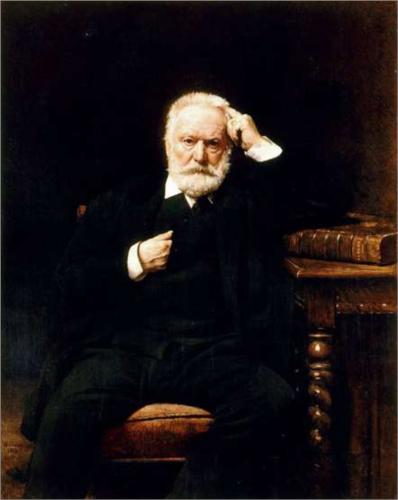
Today I’m welcoming Victor Hugo to my series of author interviews. Victor is the French author, playwright and poet of many works, such as the plays Hernani and Ruy Blas, the novels, Les Misérables and Notre Dame de Paris (sometimes called The Hunchback of Notre Dame), and many collections of poetry, including Feuilles d’automne, Châtiments and des Contemplations.
Elizabeth: Welcome, Victor.
Victor: Thank you for having me.
Elizabeth: Your novel, Les Misérables, was converted more than twenty-five years ago into a very successful musical play and most recently into a movie. What do you think of these adaptations?
Victor: It’s an honor for my work to be sought out in this way. I feel that Les Misérables is one of my greatest achievements and for it to be brought to new generations is rewarding. I think it might have been more effective, though, if it had been done as a serious play. As many of your readers may know, I don’t care for music as an art form. Making my characters sing and dance creates an aura of superficiality and flightiness, making it seem as though these events could never have happened in real life, which is disappointing. It lessens the message of the novel.
Elizabeth: Did you realize that many who view the play Les Mis believe the stand at the barricades was a part of the French revolution?
Victor: Is this true? Pathetic. Those who cannot remember the past are condemned to repeat it. But don’t quote ME on this. I’m not really the one who said it.
Elizabeth: Which authors do you see as having influenced your writing?
Victor: Goethe is the first name that comes to mind. He revolutionized what it meant to be a writer; he understood the depth of ideas and emotion that could be transferred through a written work. Who else? I’m quoted as saying, at age fourteen, “I must be Chateaubriand or nobody,” although I don’t remember saying it. I met Chateaubriand once. He was a belittling, arrogant man.
Elizabeth: You’ve written plays, poetry, novels and essays. Is there a format you prefer?
Victor: Not really. Each has a distinct purpose. A writer should know his purpose before writing and then choose the format that will help him accomplish it. A play has an immediacy not found in other genres; it creates a community of the audience who can be moved all together. A novel can create a depth of emotion difficult to sustain in other formats, and its ability to thoroughly express and share complicated ideas is unparalleled. I find, in my old age, that poetry most suits me now. I’m more reflective than I was in my youth, and I don’t feel the need to make grand, passionate statements that move a people to action. Through poetry I can thank God and my family for what I have and what I’ve learned about live. Hopefully others can read my poems and glean some small wisdom.
Elizabeth: If I may, I’d like to ask you some questions about your daughter.
Victor: Yes, of course. Léopoldine was perfection. I think I always recognized her as an angel, but I didn’t realize her time with us would be so short. I never fully recovered from her death.
Elizabeth: I didn’t mean Léopoldine. I want to ask you about Adèle.
Victor: Adèle? Who put you up to this? I refuse to talk about Adèle. In fact, you can consider this the end of —
Elizabeth: We don’t have to discuss Adèle; I’m sorry for bringing her up. In fact, I believe its time for the let’s-get-to-know-the-author-better, nearly-pointless, sort-of-silly, rapid-fire questions:
Elizabeth: Coffee or tea?
Victor: Coffee. Tea is for wimpy Englishmen.
Elizabeth: Forest or mountain?
Victor: Through forest I will walk, o’er mountain I will fly
Elizabeth: Hiking or shopping?
Victor: Hiking. I’m always telling my wife and daughters that they shop too much.
Elizabeth: Violin or piano?
Victor: I’d rather silence.
Elizabeth: Mystery or fantasy?
Victor: Fantasy. This may surprise you, but I wish that I’d written the Lord of the Rings. Perhaps in another life I am J.R.R. Tolkien.
Elizabeth: Hester Prynne or Scarlet O’Hara?
Victor: Both.
Elizabeth: Love scene or death scene?
Victor: In real life, the love scene; I’m working to avoid the death scene.
I’d like to thank Victor Hugo for joining me today.
Wait!
Victor Hugo died on May 23, 1885. This isn’t a real interview: it is an April Fools’ Day interview!
Thanks for playing along. I hope you enjoyed meeting my Victor Hugo character. Although this interview was a piece of historical fiction, Victor did indeed write the books, plays and poems named above. He was the father of four children, all but one of whom he outlived. His “crazy” daughter Adèle stars in my novel, Syncopation.
I’ve been studying Victor Hugo and his work for several decades, and so for many of his answers I allowed myself to “channel” his thoughts. If you want accurate information about Victor Hugo, I suggest going somewhere more credible than a blog!
I recommend: Johanna Richardson’s Victor Hugo, published by St. Martin’s Press in 1976.
Leslie Smith Dow’s Adèle Hugo La Misérable published by Goose Lane Editions in 1993.
My favorite quick source for all things French is my Petit Larousee Illustré, 1987.
Thanks for joining me today and have a Happy April Fools’ Day!
Today I’m welcoming Tinney Heath to my series of author interviews. Tinney is the author of A Thing Done, published in October 2012 by Fireship Press.
Tinney: Hi, Elizabeth. Thanks for hosting me.
Elizabeth: Welcome, Tinney. Can you give us a brief description of your novel?
Tinney: A Thing Done is a historical novel which takes place in Florence in 1216. Here’s the blurb:
The noble families of Florence hold great power, but they do not share it easily. Tensions simmer just below the surface. When Corrado the Jester’s prank-for-hire goes wrong, a brawl erupts between two rival factions. Florence reels on the brink of civil war. One side makes the traditional offer of a marriage to restore peace, but that fragile peace crumbles under the pressure of a woman’s interference, an unforgivable insult, and an outraged cry for revenge.
Corrado is pressed into unwilling service as messenger by both sides. Sworn to secrecy, he watches in horror as the headstrong knight Buondelmonte violates every code of honor to possess the woman he wants, while another woman, rejected and enraged, schemes to destroy him.
Corrado already knows too much for his own safety. Will Buondelmonte’s reckless act set off a full-scale vendetta? And if it does, will even the Jester’s famous wit and ingenuity be enough to keep himself alive and protect those dear to him?
This is Corrado’s story, but it is also the story of three fiercely determined women in a society that allows them little initiative: Selvaggia, the spurned bride; Gualdrada, the noblewoman who both tempts Buondelmonte and goads him; and Ghisola, Corrado’s great-hearted friend. From behind the scenes they will do what they must to achieve their goals—to avenge, to prevail, to survive.
Elizabeth: How did you first learn about this Florentine feud and what made you decide to write a novel about it?
Tinney: I was researching Florence in Dante’s time, several decades after the pivotal event in A Thing Done, and almost every contemporary chronicle, every diary, every after-the-fact history looks back at this incident and cites it to explain the beginning of the Guelf-Ghibelline split that divided Italy for centuries. Dante refers to it, in such a way that it’s obvious he expects his readers to know the story. Machiavelli details it in his history of Florence. You really can’t avoid it. It’s either a footnote or a prologue to every history of 13th century Florence.
Elizabeth: How much historical fact is woven into the story?
Tinney: Pretty much everything I could find in the historical records about this incident is there. Even though the story pops up everywhere, the actual information provided was minimal – a paragraph here, a brief mention there, and the jester is only mentioned in the earliest chronicle. Even in that one, as soon as he performs the action that sets it all in motion, he disappears from the record. Other chronicles tend to begin with the betrothal and continue from there. The families, their political alignments, the contracted marriage, the jilting, the vendetta, its outcome, its aftermath are all as history records them. The places are as I wrote them: the palace with its tower, the bridge, the church where the meeting took place. Even the heraldry is accurate. What is my own invention is the personality and the continued involvement of the jester, some of the specifics of how it all happened, and the roles played by the women other than Gualdrada (whose role as strategist and gadfly is in the historical record). Medieval chroniclers tended not to record much about women.
Elizabeth: How do you go about doing historical research?
Tinney: My research is mostly extensive reading, and I’m lucky to have access to a good university library. I read in both English and Italian, and I’ve been to Florence a number of times. I do use the internet, but sparingly and with caution, because I’ve encountered so much utter drivel there, strutting around as if it were backed up by real research.
Elizabeth: What is your writing process?
Tinney: My writing process is rather volcanic: a lot of rumbling below the surface for quite a long time, the occasional belch of smoke, and suddenly everything erupts onto paper. (Then there’s the looooong cleanup and rewrite…)
Elizabeth: What’s the story behind the title of your book?
Tinney: “Cosa fatta, capo ha.” These words, which translate roughly to “A thing done has an end,” were uttered by a Florentine knight in 1216 as he urged his colleagues and allies to take lethal vengeance against an enemy, rather than merely wounding him as payback for an insult. This is the vendetta that’s at the heart of A ThingDone. Dante repeated it when he wrote of the incident; even today, the phrase is used in Italy, though an Italian friend tells me that these days the meaning is closer to “It’s over, so get on with it.” They didn’t get on with it, though, not for a very long time. Even today it’s possible to identify Italian towns as having been either Guelf or Ghibelline (though many switched sides more than once).
Elizabeth: What are you working on now?
Tinney: In the time period about halfway between A Thing Done and Dante’s lifetime, a female poet lived and wrote in Florence. She was known as “La Compiuta Donzella” – The Accomplished Maiden. No one really knows anything about her – her life, her real name, whether the three poems attributed to her are in any way autobiographical or not. But she lived in a period that fascinates me, turbulent and full of change, so I’m now working on a book about her, using her surviving work as a starting point.
Elizabeth: Sounds wonderful. I look forward to reading it. Now, tell us about yourself.
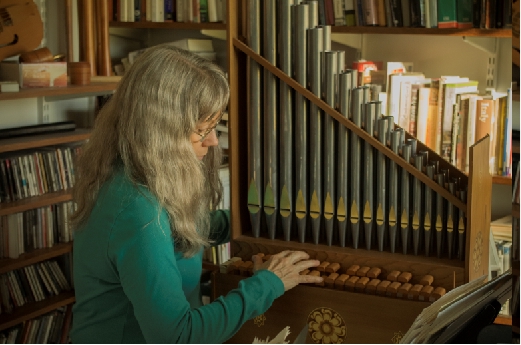
Tinney playing her portative organ.
Tinney: I live with my husband in Madison, Wisconsin. We’re both amateur musicians, studying and performing music of the late middle ages and the early Renaissance on a lot of different wind instruments, including (in increasing decibel levels) recorders, crumhorns, portative organ, and shawms. We love to travel to Italy, and research is only one of many reasons for that. My professional training and background is in journalism, though I did once aspire to become a professional flutist. I was involved in historical reenactment for quite a few years, and that has proved to be a useful background for someone interested in writing historical fiction.
Elizabeth: I love the name “Tinney” ? Is there some story that goes with it?
Tinney: It was my mother’s maiden name. It’s Irish in origin; a lot of Tinneys have come to the US from County Donegal, though I don’t know whether that was their home or just their point of departure. I’m an American mongrel, a mix of Irish, English, Welsh, Scottish, French, German, Swiss, and Cherokee – and those are just the ones I know of. No Italian, alas.
Elizabeth: What do you read for pleasure, and what do you avoid?
Tinney: I read many different kinds of fiction. Dorothy Dunnett is my hero in the area of historical fiction, but I also enjoy fantasy, some contemporary fiction, and mysteries, as long as they’re either historical or set in Italy (or both). I read Hemingway or the sagas as a corrective when I find myself getting too wordy. I don’t seek out Young Adult, romance, or the unfortunately-named genre called chicklit, though I’m sure there are individual books in each category that I would enjoy. Thrillers generally don’t thrill me. And in my home territory of historical fiction, I’m totally tired of Tudors.
Elizabeth: We’ve now reached the time in our interview for the let’s-get-to-know-the-author-better, nearly-pointless, sort-of-silly, rapid-fire questions:
Elizabeth: Coffee or tea?
Tinney: Coffee. Preferably Italian, strong, and in quantity.
Elizabeth: Ocean or mountain?
Tinney: Mountain. Big, sharp, pointy mountain.
Elizabeth: Hiking or shopping?
Tinney: Hiking, especially if the aforementioned mountain is nearby.
Elizabeth: Violin or piano?
Tinney: Violin. (Though if you had asked “portative organ or shawm?” it would have been a tougher call.)
Elizabeth: Mystery or fantasy?
Tinney: Fantasy, though I read both.
Elizabeth: Darcy or Heathcliff?
Tinney: Heathcliff. With so many novelists and screenwriters unwilling to let Ms. Austen’s characters retire, I’m about Darcy’d out. Besides, I prefer moors to drawing rooms. (If you haven’t seen the Monty Python sketch of Wuthering Heights done in semaphore, I urge you to watch it!)
Today I’m welcoming Gale Borger to my series of author interviews. Gale writes humorous mysteries, including the Olive Branch series and the Miller Sisters Mystery series. Gale’s six Olive Branch short mysteries, formerly only available as ebooks, have just been released in a print collection that includes an all-new sixth mystery.
Elizabeth: Gale, thanks for visiting today.
Gale: Thank you for having me.
Elizabeth: Tell me a little about the Olive Branch kids and the mysteries they solve.
Gale: The Olive Branch mysteries were the product of a brainstorm by Karen Syed, owner and President of Echelon Press out of Orlando, Florida. A huge proponent of the literacy movement, Karen came up with the idea of having several authors each publish a series of six short e-stories (one per month over the summer) in YA format, which would read like episodes. At the end of the sixth “Electric Shorts” installment, the readers would have read an entire story, but not face the intimidation of struggling through a long chapter book. The shorts worked great for summer reading programs.
Elizabeth: How did this idea evolve into the Olive Branch Mysteries?
Gale: Because I’m a Master Gardener, Karen suggested I write about gardening, and I tutor and work with many young adults in their late teens and early twenties, so it was decided that I take the teenage readers and develop my series from that.
I thought writing gardening for teens would be like trying to talk a group of Ultimate Fighters into taking ballet lessons. What I came up with was to establish a garden center where teens in trouble with the law could work off court ordered community service while receiving counseling and schooling at the same time.
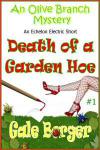
The mystery comes into play while walking back to the garden center after a day of planting flowers downtown. The five teens, Cash, Pone, Shroom, Spaz, and Bean, stumble across a dead prostitute in an alley. They are compelled to find out who murdered her. Thus was born the first installment, “Death of a Garden Hoe.”
Elizabeth: Now tell me about the Miller sisters.
Gale: I was sitting at home after knee surgery when my husband, Bob, dropped a laptop into my lap and said, “It’s time for that story to come out, Gale.”
I started out by sketching characters; taking personality traits, quirks, eccentricities (and just plain weirdness) from my siblings, my friends, my mother and her friends, and from people I’ve known over the years. I came up with four girls raised on a farm (Buzz, the eldest, is Wisconsin’s newest member of the AARP). Buzz is an ex-detective, and in each of the books, one of the sisters “help” solve a murder. The results are pretty funny. Mag is a high school biology teacher, Al is a librarian, and Freddie owns the local pet shop. Buzz’s love interest is a childhood friend and the local Sheriff, and they still make all major decisions by the tried and true Rock, Scissors, Paper method.
Elizabeth: But how can murder be made funny?
Gale: Murder is never funny, but how you get to the truth can be a riot.
Elizabeth: As a mystery writer, do you find you need to outline the plot before you begin writing?
Gale: I don’t outline, I develop characters. They write the stories.
Elizabeth: Is there a mystery writer you especially admire or one that you read to learn the craft from?
Gale: There are many writers I admire and read. The truth of the matter is I’ve spent over twenty years in law enforcement, so I know crime, and the people who commit crimes. Actually, some of my favorite people are bad guys. I grew up with humor, and hung out with creative and funny people. When it came to putting it all down on paper, it seemed natural to combine the two.
Elizabeth: Do you find that you need to work and plan to be humorous in your stories, or does the humor just flow?
Gale: Great question. The humor flows. Humor has to come naturally, or it looks forced–like punch lines stuck where they don’t belong. If you have funny characters, they will do things in a funny manner. Quick, witty dialog is so very important. That is why I stress character development. I never know what is around the corner, but my characters fling me around it like crack-the-whip.
Elizabeth: Anything else you’d like us to know about your books?
Gale: Well, now that you mention it, I’ve been asked if I thought it was rather silly and far-fetched to have grownups have nicknames and Three Stooges humor. The funny thing is, I really do have a sister with the nickname of Maggot, mine was Buzz, and I have a sister Sam, whose real name is not Samantha! The old ladies with police scanners are real (thanks to Mom and her friends), and we really do call my baby sister Jack the Tripper. Mark Twain once said, “Truth is stranger than fiction, but it is because fiction is obliged to stick to possibilities; truth isn’t.” I don’t know about strange, but the truth sure can be funny!
Elizabeth: Enough of your book—tell us about yourself.
Gale: I grew up in northeast Illinois on a horse farm in a household who watched Red Skelton, Jack Benny, Dick Van Dyke, and The Three Stooges. I loved Carol Burnett, Gilda Radner, Lily Tomlin and Lucille Ball–brilliant comediennes who didn’t have to take their clothes off to entertain their audiences. I love screwball comedy and I don’t apologize for pie-in-the-face jokes.
I’ve lived in southeastern Wisconsin for the past 20 years. I have a Bachelor’s degree in Criminal Justice and a Master’s degree in Education. I have been a Correctional Officer with the Walworth County Sheriff’s Office for the past seventeen years, and I already mentioned I was a Master Gardener, and I want to learn to train therapy dogs (in my spare time, of course).
My husband Bob and I have about 1,000 gallons of freshwater tropical fish, and Bob makes the best tropical fish food you can buy (captainbobsfishtales.com). Our daughter, Shannon is a double music major at UW Milwaukee, and plays a mean trombone.
Elizabeth: We’ve now reached the time in our interview for the let’s-get-to-know-the-author-better, nearly-pointless, sort-of-silly, rapid-fire questions:
Elizabeth: Coffee or tea?
Gale: A pot-o-coffee in the morning, tea in the late evenings, and Diet Pepsi any time of day.
Elizabeth: Ocean or mountain?
Gale: Mountains. I love the water, but I’ll take a lake over an ocean any day.
Elizabeth: Hiking or shopping?
Gale: Hiking-definitely. I abhor shopping!
Elizabeth: Violin or piano?
Gale: Piano if it’s Victor Borge
Elizabeth: Historical fiction or fantasy?
Gale: I prefer hysterical over historical fiction
Elizabeth: Darcy or Heathcliff?
Gale: Mr. Darcy, of course. How can one resist a 200 year old unattainable, yet endearingly awkward man, who loves you for who you are, who sees you as an intellectual equal, and he’s a rich, handsome guy to boot?
Elizabeth: Love scene or death scene?
Gale: Love scene (sans the milky white thighs), which turns into the death scene.
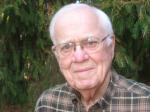
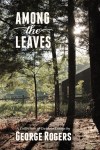
Today I’m welcoming George Rogers to my series of author interviews. George is the co-author of For the Love of Postcards. His most recent book is Among the Leaves, published by Cornerstone Press in November.
Elizabeth: Among the Leaves has the subtitle: A Collection of Outdoor Essays. How would you explain an “outdoor essay?”
George: Anything that has to do with nature.
Elizabeth: Could you tell us the topics of some of the essays?
George: I say in the introduction that this isn’t a “me and Joe went fishin'” book. I don’t ignore fishing and hunting but I’m more into other outdoor activities, wildlife and the environment in general. Some of the topics are the Apostle Islands and Isle Royale in Lake Superior, prairie chickens, deer, jackass rabbits (now thankfully called jackrabbits), wolves, camping in Costa Rica and climbing Mount Fuji. But mostly it’s about Wisconsin.
Elizabeth: You’ve been a journalist for more than fifty years. How were you able to choose which essays to include and which to leave out of this collection?
George: I tried to choose topics that appealed to people who liked the outdoors, not just the hook and bullet crowd.
Elizabeth: You grew up in Wisconsin and spent a lot of time in the woods as a child. How do you think that has affected your outlook on life?
George: I was exposed to nature as a kid by fishing with my father and getting to see the ruined old-growth Wisconsin forest, and learning what a grand thing it had once been. That doesn’t mean I’m against logging. I’ve cut many trees in my time (and planted thousands of them), but from an early age I learned logging had to be done judiciously.
Elizabeth: Tell us about one of your favorite vacations or travel destinations.
George: I’ll mention several. Northern Wisconsin is always a good one. I like the Gulf Coast of Texas because it isn’t as overdeveloped (yet) as Florida, it’s on the ocean and it’s low-key. Japan was good, but when I was there I was in the military and not really vacationing. However, it gave me the opportunity to climb Mount Fuji. Also I saw some incredibly polluted waters, which was a real lesson.
Elizabeth: What is your writing process or schedule?
George: I’m not on a schedule. I write an outdoor column and a few other things for a weekly newspaper, the Portage County Gazette, but that’s a relaxed timetable. I write any time the mood strikes me and email my stuff in. That way I don’t get in the hair of the real working people. If I were writing another book, I’d set a target – so much production per week.
Elizabeth: How did the idea for Among the Leaves come to you?
George: I didn’t plan to write Among the Leaves. A co-worker from my daily newspaper days talked me into it. I thought it would be a chore but I found out it wasn’t. I should have known that. All my working career I was on a deadline and learned to live with it. Relatively speaking, this was easy.
Elizabeth: Cornerstone Press is a small press sponsored by the English Department at the University of Wisconsin, Stevens Point. Students enroll in the Editing and Publishing class, and over the course of the semester select a manuscript, design a cover and layout, edit, publish, market and sell the book. What has been your experience working with this group of students?
George: They were good people, really interested in turning out a good product, and quite professional. I predict a bright future for them.
Elizabeth: We’ve now reached the time in our interview for the let’s-get-to-know-the-author-better, nearly-pointless, sort-of-silly, rapid-fire questions:
Elizabeth: Coffee or tea?
George: When I get up in the morning I brew a cup of tea because I don’t like instant coffee and it takes too long to make a pot of regular coffee.
Elizabeth: Ocean or mountain?
George: Both.
Elizabeth: Hiking or shopping?
George: Anything but shopping.
Elizabeth: Violin or piano?
George: Much to my regret, I’m devoid of musical talent.
Elizabeth: Mystery or Fantasy?
George: Mystery. There’s already too much fantasy in life.
Elizabeth: Hester Prynne or Scarlet O’Hara?
George: My attitude on this one was adequately summed up by Rhett Butler in his memorable farewell to Scarlett, “Frankly, my dear, I don’t give a damn.”
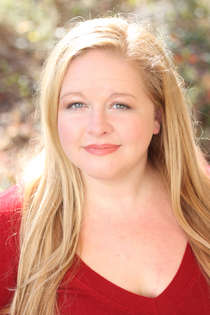 Today I welcome best selling author Kate Quinn to my series of interviews. Kate is the author of Mistress of Rome, Daughters of Rome, Empress of the Seven Hills and the soon-to-be-released The Serpent and the Pearl. Kate will be participating on two panels at the Historical Novels Society Conference: “Sex in Historical Fiction: How to Make It Hot” and “Historical Fiction Set in the Ancient World: the Good, the Bad and the Ugly.”
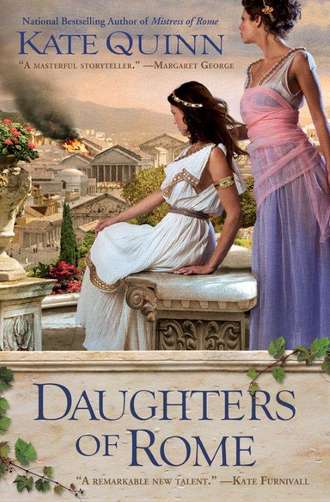 A: I first got interested in ancient Rome because of I, Claudius, which I watched when I was far too young, but adored anyway. Imperial Rome is so far away from us in time, but culturally so close. From sports fans to fast food, from running water and daily baths to birth control and no-fault divorce, the Romans embraced cultural traditions that wouldn’t be seen again on a widespread scale for two thousand years. And now I’m giving ancient Rome a break and have moved on to the Renaissance—another fascinating period; so much art and beauty existing side by side with so much bloodshed.
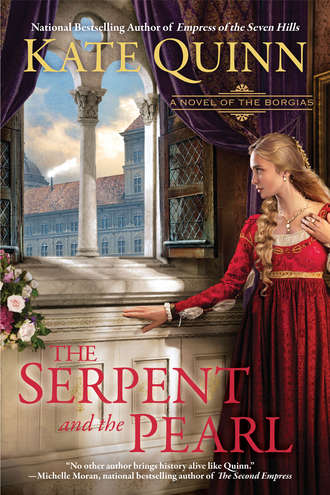 A: The Serpent and the Pearl is my latest book, set for release in early August—and it’s my first book set outside Imperial Rome. I’m hopping on the Borgia bandwagon for a rollicking story starring Giulia Farnese, a Renaissance beauty with floor-length hair who was mistress to the Borgia Pope. Stir Giulia’s incredible real-life adventures together with those of her acerbic bodyguard, add in one fiery-tempered cook with a dangerous past, and light on fire for a fun fast-paced read.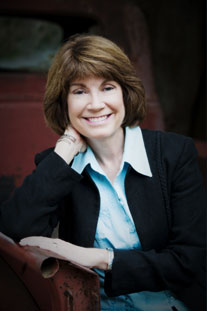






 Elizabeth Caulfield Felt