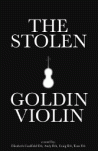
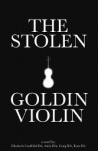
Here is the cover design for our children’s mystery. A big thanks to Jillian Noble who did the artwork and design. I’m not sure why there are two images, but it is such a nice cover that I’m going to leave them both in this post!
The copyright holder wanted $50 for the lyrics to appear in a first printing of 2000 books. That seemed reasonable to us, so we have mailed the check. When we’ve signed the contract and all the paper work is settled, we will send The Stolen Goldin Violin to the printer!
It’s been a while since I’ve blogged, so I’ll update you on what’s happening.
The Stolen Goldin Violin is ready to go to the printer–except that we have not yet gotten copyright permission to use some lyrics from a Beach Boys song in the book. It took me a long time to discover who owned the copyright, but I did, and now we are just waiting. If we get permission for free or for a very small fee, we will add the copyright permission information at the back of the book. If the lawyers want to charge us too much, we’ll just remove the lyrics. Either way, the book should be at the printers by spring break, which was our goal.
The trick with self-publishing is now we have to market. The background work on this is time consuming and not an activity I find fun or intriguing. In my spare time, I want to be writing my new historical novel.
I find myself fighting myself: shall I write? or shall I look up names of people to contact, emails, music conferences, etc. about the children’s book? This battle is interesting because writing is hard and, in the past, I have done little chores and other little work activities, to delay my sitting in front of the computer to write. However researching marketing is hard and boring and so it is pushing me to write more often.
A good thing and a bad thing at the same time.
My family went downhill skiing this weekend. The first time I ever skied I was 23 which is much too late. When we went skiing last year, I worried the entire week before we went, I was terrified as I was skiing, and only relaxed when the weekend was over.
This year, I planned to stay in the ski lodge and write while everyone else skied. I brought my laptop and had a chapter already outlined in my head. And then tragedy struck! I had forgotten to bring the cord to plug the laptop into the wall. The battery is fickle and unreliable. I had to write longhand.
If there were no computers, I would not be a writer. For most of my youth and early adulthood, I wrote on paper and never finished anything. I edit a lot, and going back and re-writing and crossing out sections and inserting sections creates more mess than masterpiece. After a while, I would look at my project, unable to understand what was going on, what was meant to be there, where it was supposed to go, and end up throwing out the whole thing.
I did write on paper in the ski lodge. I got that chapter out, although the pages are a total disaster. Later today I will sort through them and type up what I can decipher–editing as I go. Then, I can keep on editing in a clean and organized manner. Aren’t computers wonderful?
As a reader, I’ve always been focused on story and character. I don’t need to be kept breathless with constant action and excitement because an exceptional, complex character will keep me engaged. However, books that have long passages devoted to setting and other descriptive narrative not directly related to character or story bore me. I discovered a few years ago that as a reader I actually just skim through these sections. I don’t read them with my full attention. I don’t care what kind of dresses people are wearing or what sort of furniture is in the room; I don’t care about the no-name people walking down the street and what they are doing; I want to find out what will happen to the real characters.
When I became a writer I discovered (no surprise) that I had trouble writing good description. Although I don’t like to read it, setting is important and needs to be handled, whether in short concise sentences or long detailed paragraphs. This is especially true in historical fiction because the reader needs to understand and connect with the environment of the story. Having skimmed this kind of narrative for so many years, I now give it my full attention.
And now that I’m doing it, I can’t help but wonder: how much of this does the reading public want? Some writers do it, in my opinion, exceptionally well: Tracy Chevalier, Philippa Gregory, Markus Zusak. Their writing is poetic, descriptive and concise. I don’t even realize I am reading setting, or if I do, it is so well written and fascinating that it works for me. I never feel the need to skim with these authors. Other extremely successful historical novelists put so much into their settings that the setting becomes a character in the novel. I admire their ability to do this, and yet the setting is not a character I care about. Although I love Claire and Jamie and their story, I stopped reading the Outlander series because I was so tired of wading through material I didn’t care about.
I find this true of modern short stories as well. I feel like I’m missing something. Most short stories I have read recently (in the New Yorker or in published collections) leave me thinking: Huh? They seem to have very little story and fairly boring characters. I don’t mean to seem anti-intellectual or uncultured. I’m hoping to have a conversation about this with people who do get it and can explain to me why they love the modern short story or Gabaldon’s lengthy narrative.
So, comment please!
In the past week, I have received two kind, thoughtful and detailed rejection letters. Both praised my writing and decried the current marketplace and economy–just the sort of rejection a writer most wants to get (if one has to receive a rejection….)
So, I want to apologize for my earlier rant about not getting replies from agents and editors. I would rather wait and get a thoughtful reply than get a quick “no thanks” right away.
I will breathe patience and faith.
Ever since school got out, I’ve been reading Oscar Wilde: I’ve read all his comedies, and I’m in the middle of The Portrait of Dorian Gray. Wilde was so clever. I’ve watched several movie versions of The Importance of Being Earnest and The Ideal Husband. You see, Oscar Wilde is going to be a minor (or perhaps major, it’s too early to tell) character in my next novel. It takes place in 1880 London and is the story of two women who trade places for a week, each pretending to be the other, and the mayhem that follows. I started writing yesterday and got a good 1000+ words in.
I’ve had so much fun doing my research, that I’ve had trouble getting started on this novel. I like to immerse myself in a time period by reading that time period exclusively and intensely. Wilde’s work is perfect, because he has a strong and unique voice. I’m trying to get his voice to move into my own head, so when I write, I write in a Wilde-esque manner.
The problem for me is balancing the immersion and the writing. Beginning to write is hard, so I’m always tempted to sit and read and use that as an excuse to delay my writing. I think that if I were able to write full-time, I would have an easier time of it. I’m good at sticking to a schedule once I have made one: maybe mornings for research/reading/immersion and afternoons for writing. Or maybe immersion on Tues/Thurs and writing on Mon/Wed/Fri. What a dream that would be!
As it is, I have two weeks until classes start again, and next week I will need to be on campus doing prep and attending meetings. So, I have what is left of this week to try and get things really going, going in such a strong way that my brain can stay focused on my story and characters and my Wilde-esque voice.
So, it’s time to log off this blog and get writing!
Why don’t people in the publishing industry take the time to respond? When I send out queries or partials, I expect rejection. I hope for interest, but I’m realistic. How long does it take a person to click the reply button, type “not interested” or “no thanks” and click the send button ? But agents have stopped doing that. I understand not having the time to write long rejection letters with details about the project, but there is a decided lack of courtesy in this industry.
I have a manuscript out with an agent and a partial with an editor. I have not heard from either in more than three months and expect I never will. I emailed them both two weeks ago to find out where things stood. No response.
I keep track of my queries so I don’t re-send to the same agency. According to my current list, just fewer than half have not deigned to reply. I might get a reply or two from my recent queries, but on average half of the people I query won’t even bother to say “no thanks.” I don’t take this personally; I imagine they don’t reply to any of the queries for which they aren’t interested. It’s both rude and unprofessional, in my opinion.
 Elizabeth Caulfield Felt